Money in Story, is there any escape from cold hard cash?

Is story all about money? Even when there is not a bag of money to motivate the characters, are we dealing with wealthy characters? Are movies secretly about the Lifestyles of the Rich and Famous? Characters can quickly become wealthy and barely notice it, like Harry Potter, who went from sleeping in a closet under the stairs to inheriting a mountain of gold at Gringotts in chapter 5 of the first book.

Let’s take a look at IMDB’s top 25 rated movies to see. It’s not a fair sampling of all stories, but it might be enough to run a simple test.

  1. The Shawshank Redemption (1994): Andy Dupree withdraws $370,000 of laundered money in 1966, or about $3.3 million today.
  2. The Godfather (1972): The Corleone family is worth a billion, possibly more. We don’t see stacks of money lying around, but killing off your competitors for the family has a solid profit margin.
  3. The Dark Knight (2008), Bruce Wayne is the quintessential billionaire worth an estimated $50 billion.
  4. The Godfather Part II (1974): The billionaire Corleone family again.
  5. 12 Angry Men (1957): Unknown. Juror #4 seems to be a man of wealth and position, but we do not know most of the jurors’ names, let alone their income.
  6. Schindler’s List (1993): Oskar Schindler, a wealthy German industrialist and entrepreneur is a millionaire who uses his fortune to save Jews during WW2.
  7. The Lord of the Rings: The Return of the King (2003): Aragorn, crowned as High King Elessar, reunites Arnor’s and Gondor’s kingdoms. While his net worth may be difficult to judge, there would be few in middle earth with more power and resources.
  8. Pulp Fiction (1994) Crimelord Marsellus Wallace is a millionaire with influence from the world of boxing to drugs and smuggling.
  9. The Lord of the Rings: The Fellowship of the Ring (2001), Bilbo is the wealthiest hobbit in all the Shire. The Mithril armor he gifts Frodo is worth more than the whole Shire combined. Estimated fantasy armor millionaire.
  10. The Good, the Bad, and the Ugly (1966) Blondie walks away with 200,000 gold dollars, or about 16.5 million in today’s currency.
  11. Forrest Gump (1994) Forrest Gump is a billionaire and possibly a gozillionaire thanks to Bubba Gump Shrimp and Hurricane Andrew.
  12. Fight Club (1999): Tyler Durden may not be wealthy, but he destroys all the credit card records worth, gifting debt holders $480 billion in 1999 or $887 billion today. Project Mayhem is all about debt and money.
  13. Inception (2010): Fischer and Saito are billionaires keeping the dream alive.
  14. The Lord of the Rings: The Two Towers (2002) I am going with Galadriel this time, who surpasses all other elves in beauty, knowledge, and power. Not all about money, but she did get one of the three elf rings of power.
  15. Star Wars: Episode V – The Empire Strikes Back (1980) – Lando might be the wealthiest member of this film; he owns Cloud City and lives in luxury. Estimated Cloud City millionaire, but Vader definitely is more powerful. Leia probably lost much of her wealth when Alderan blew up, otherwise, she would top the list.
  16. The Matrix (1999) – This is not all about money because the world is a simulation. It’s hard to worry about money when humans are batteries, and you eat amino goop for every meal.
  17. Goodfellas (1990) – When you measure money by inches, not amount, it just might be about the money. Henry’s biggest frustration in leaving organized crime is he’s just an average nobody, like everyone else.
  18. One Flew Over the Cuckoo’s Nest (1975) – There are no millions here, but gambling, betting, and games like Monopoly make appearances teaching inmates about their agency. Not about the money, but money makes some great arguments here.
  19. Se7en (1995) – John Doe targets his second victim, wealthy and amoral attorney Eli Gould, for his sin of greed. Not sure about the amount, but Gould has lots of ill-gotten money.
  20. Seven Samurai (1954): Poor farmers look for impoverished Samurai who will take rice as their payment for defending the village from bandits. No millionaires here, but rice motivates everything in this Japanese period epic.
  21. It’s a Wonderful Life (1946) Mr. Potter is the wealthiest and meanest man in Bedford Falls and owns most businesses, including the Bank. He offers George a $20K salary in 1936, more than $350K today. Definitely a millionaire, possibly a billionaire.
  22. The Silence of the Lambs (1991): The most influential person is probably Senator Ruth Martin. Buffalo Bill has the FBI after him because he kidnapped the Senator’s daughter. Dr. Lector was wealthy, but I have difficulty putting money first in this psychological thriller.
  23. City of God (2002) – Drug lords fighting for control in a Brazilian favela. I’m not sure about the exchange rate, but the crime war involves most of the drug money in town.
  24. Saving Private Ryan (1998) – Not much money here, just world war two combat up close and personal.
  25. Life is Beautiful (1997) – Another world war two film focused on the Holocaust. Hard to say this one is about money even if the family wins a tank in the end.

Well, it’s hard for me to count this one clearly, especially where we have Middle Earth, the Star Wars universe, and the postapocalyptic world of the Matrix to calculate finances. But even in those fantasy worlds, we often deal with their wealthiest and most powerful characters. Morpheus owns a sweet hovercraft!

By my count, 18 have millionaires, billionaires, kings, senators, and drug lords. And why shouldn’t they? Money is a major motivator in our lives, why should fictional characters be different? And even when the characters have nothing but the rice they grow themselves, it is a major focus of the movie. You don’t have to have many resources to find motivation.

So is there an escape from money in stories? Yes! But the authors probably have to kill characters to make it happen.

Speaking of death, murders, and war, how many of those movies don’t have violent death? None of them.

I thought It’s a Wonderful Life came the closest, except it has a montage of World War Two where Navy fighter pilot Ace Harry Bailey shoots down 15 enemy planes. Joe Baley prepares for suicide to collect life insurance money. Inception deaths besides Mal’s suicide are dream projections, but we still get plenty of murder and mayhem on screen.

Maybe money as a motivator is the safer option in the end.
The Antagonist Assistant, how to make intelligent heroes do dumb things.

There’s a shark in the water, an invisible hunter in the forest, an alien egg looking for romance, and hungry dinosaurs strolling through the park. These situations sound more dangerous than crossing the street blindfolded. But, there’s a simple solution; stay away. Let someone else handle it. Go home and take a nap. Only a fool would wander into trouble knowing terrible and painful death awaited them.

But great life choices often make terrible stories. So how can we make likable and intelligent heroes go into this kind of trouble when it is obviously a bad idea?

We need someone to orchestrate the whole mess. But, unfortunately, the monsters can’t manage it. They are marauding killing machines, so there is little chance they can ask nicely for more victims. So, no, we need someone to assist the monsters in bringing our heroes into trouble. I call these characters Antagonist Assistants, but if I can come up with a better term in the future, I’ll change the title.

Often these characters set up the most severe problems for the heroes but will not make it to the end of the story because their job is complete. It’s like an assist in basketball; they make the epic slam dunk possible.

Let’s look at four of these Antagonist Assistants and how they get our heroes in trouble; Mayor Larry Vaughn from Jaws, Security Expert Dennis Nedry from Jurassic Park, CIA officer Al Dillon from Predator, and Ash from Alien.

Jaws (1979) Mayor Larry Vaughn

Vaughn: Martin, i-it’s all psychological. You yell ‘barracuda’ everybody says ‘huh, wh t?’. You yell `shark!’ and we’ve got a panic on our hands on the fourth of July.

Mayer Vaughn knows the financial cost to Amity Island if they close down the beaches on Independence Day. Yes, a girl died, and it probably was a shark, but is that risk worth shutting the beaches down and missing out on re-election? The community needs open beaches and even hold a town meeting about it. Vaughn takes a risk, and people die for it. He even puts out a full shark watch to protect swimmers, and Bruce the Shark gets past them by eating a vacationer in the estuary. Vaughn realizes his mistake and signs the papers to hire Quin to hunt and kill the monster in the sea.

Vaughn: I was, I was, I was acting in the, in the town’s best interest. I
thought I was acting in the town’s best interest.

Martin: That’s right, you were acting in the town’s best interest. And that’s
why you’re going to do the right t ing! That’s why you’re gonna sign this, and
we’re gonna pay that guy what he wants!

Vaughn: Martin, Ma tin. My kids were on that beach too!
Martin: Sign it, Larry.

After Vaughn signs the papers, he is out of the film. His role in the plot was to give Bruce plenty of food and keep the beaches open! But his reasoning is understandable. The town needs business. But most of Bruce’s victims are thanks to Mayor Vaughn’s effort to keep the waters open and filled with swimmers.

Jurassic Park (1996) Dennis Nedry

Nedry: I got an eighteen-minute window. Eighteen minutes and your company catches up on ten years of research… Don’t get cheap on me, Dodgson. That was Hammond’s mistake.

Dennis Nedry is looking to make 1.5 million dollars with corporate espionage at Jurassic Park. He rehearsed everything. He will temporarily disable the security measures so he can break into the cryogenics lab and then drive to the dock to give his contact a shaving cream bottle filled with dinosaur embryos. But Nedry runs into a problem; a tropical rain storm. The ships must leave early, and it pushes his timetable up. He pulls off the embryo heist but gets lost in the storm. Nedry does not make it to the dock or return to his locked computer. The security remains disabled, which turns Jurassic Park’s visitors into dino-meals.

Nedry has no intention of physically hurting anyone in the park, but his actions cascade into every death in the movie, including his own. So while Ian Malcolm pontificates about Chaos Theory, the real culprit who helps the dinosaurs is less life finds a way, and more Nedry must get paid.

Predator (1989) – Colonel Al Dillon

Dutch: So you cooked up a story and dropped the six of us in a meat grinder.

Dutch leads an elite crew of six badass soldiers-of-fortune, but they have rules. As Dutch tells Dillon, “We’re a rescue team, not assassins.” But Dillon had already lost the first batch of Green Barrets he sent into the jungle to stop a group of Soviet-backed weapons traders. His cover story is a scam to bring in the best soldiers, even if he must lie to get them. But it was not insurgents who killed his Green Berets; it was an alien Predator. Once the Predator starts hunting Dutch’s team, Dillon is stuck with them. Knowing how much trouble he put them in, Dillon joins the fight and returns to help Mac kill the creature. Dutch warns him it is a death trap, but Dillon goes anyway.

Dutch: You can’t win this, Dillon.
Dillon: Maybe I can get even.

Dillon set up the situation and provided the best trophies the Predator could want. Unfortunately, Antagonist Assistants often do not know they are helping the big baddie. And when Dillon realizes it, he goes after the creature and dies a hero with probably the best human death scene in the movie.

Alien (1979) – Ash

Ripley: What was your special order?
Ash: You read it. I thought it was clear.
Ripley: What was it?
Ash: Bring back life form, priority one. All other priorities rescinded.
Parker: The damn company! What about our lives, you son of a bitch?!
Ash: I repeat, all other priorities are rescinded.

Ash is the most helpful and willing Antagonist Assistant in today’s post. He crosses the line and becomes a complete accomplice to the Alien creature, helping by bringing it on the ship and assisting its birth. He protects it until it no longer needs protection. Ripley realizes too late that Ash helped the creature. Not the crew. Ripley suspects the whole mission may have been a setup.

Parker: How come the company sent us a goddamn robot?
Ripley: They must have wanted the alien for the weapons division. He’s been protecting it all along.

Ash knows the alien is dangerous, but the Nostromo crewmates’ lives do not matter. It can kill all of them, and he would not care because Ash is not human. He is an android embedded with the crew, and none of them knew it until they tore his head off. This qualifies as a plot twist (or identity twist, as I call them), but there is so much horror going on it is hard to remember Ash compared to the hulking monster stalking the crew through the Nostromo’s narrow corridors.

Ash does not have human morality, but he is intelligent enough to pass as a human and seems to think deeply. If anything, he likes the Alien more than the crew. Maybe it is just his programming, but he believes in the creature.

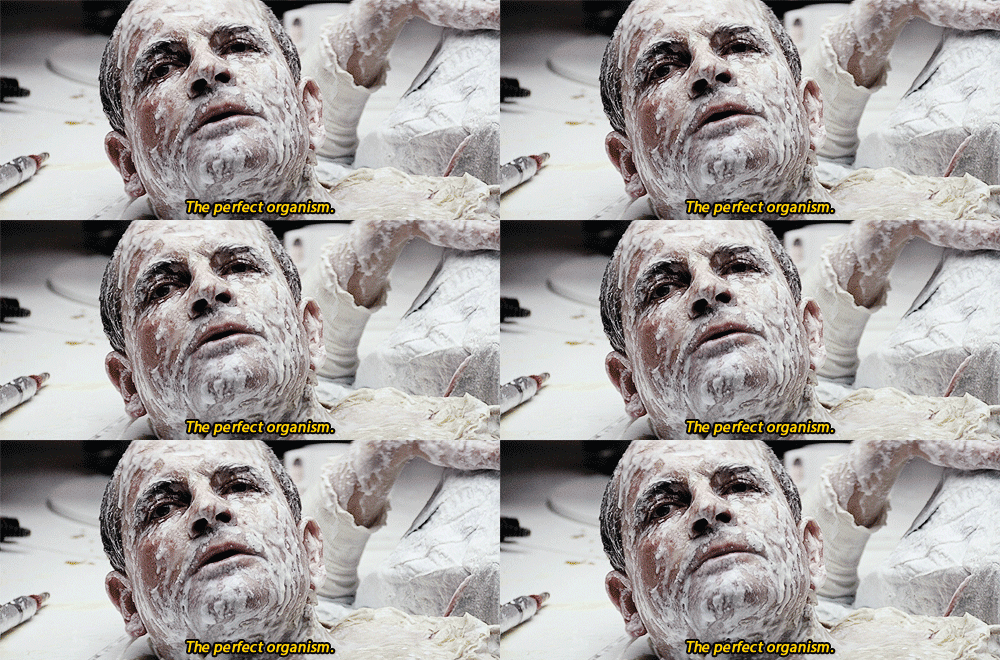
Ash: You still don’t understand what you’re dealing with, do you? The perfect organism. Its structural perfection is matched only by its hostility.
Ripley: You admire it.
Ash: I admire its purity. A survivor, unclouded by conscience, remorse, or delusions of morality.

Ash does not get any redemption; arguably, he is just as villainous as the Alien picking off the crewmates one by one. Ash goes out cheering for the alien, pure in his desires until the end.

Ash: I can’t lie to you about your chances, but… you have my sympathies.

It is possible that only the meanest of villains need help. Maybe Antagonist Assistants are just a feature of horror genres. But if you see brilliant heroes in dumb situations, look for who set the problem up. Often someone knowingly or unknowingly assists the bad guy.

A World Building Secret hidden in the opening Star Wars Title Crawl.

While researching my story structure book on Star Wars, something stuck out to me in the opening line of the title credits. It reads;

A long time ago in a galaxy far, far away…

STAR WARS
Episode IV
A NEW HOPE

It is a period of civil war. Rebel spaceships, striking from a hidden base, have won their first victory against the evil Galactic Empire. During the battle, Rebel spies managed to steal secret plans to the Empire’s ultimate weapon, the DEATH STAR, and space station with enough power to destroy an entire planet. 

Pursued by the Empire’s sinister agents, Princess Leia races home aboard her starship, custodian of the stolen plans that can save her people and restore freedom to the galaxy….

Wait a second. Let’s rewind.

It is a period of civil war.

Civil War.

But if Star Wars is a civil war, taking place inside the Empire’s borders, that should be in contrast to interstate war outside its borders. Star Wars’ central conflict is a civil war, which means other geo-political (or astro-political) entities border the galactic empire!

The evil Galactic Empire has neighbors.

And so did the Republic the Jedi protected. The Star Wars Universe is much bigger than a single galaxy. Our Milky Way Galaxy is part of the Star Wars Universe even if it is far, far away.

Even the name Star Wars is plural! This civil war is just one of many wars.

There are Extra-galactic aliens in the extended Star Wars Universe, but these are only half canon. But I think there is a gold mine of world-building opportunities in the opening few lines of Star Wars. How do the neighbors react to the death of the Emperor? What are their Jedi equivalents? The Force is much bigger than a single galaxy, after all. Was the Death Star designed to deter an intergalactic conflict? Are the other galaxies unified?

Vader tells Luke “With our combined strength, we can end this destructive conflict and bring order to the galaxy.” How surprising would it be if the Empire was more afraid of what lurked outside their Galaxy than the rebels inside? What if the Empire needs a Death Star to protect itself? What if other groups looked at the chaos in the Empire and saw an opportunity to attack?

A nice view of a galaxy at the end of the Empire Strikes Back

And what other types of war could there be? Here are some options:

  • Cold War – political, economic, propaganda, and espionage instead of military action
  • Invasion – Military Offensive that aggressively enters to conquer or liberate
  • Proxy War – armed conflict instigated on behalf of other parties
  • Undeclared War – A military conflict without either side issuing a formal declaration.
  • Total War – all civilians and resources become military targets.

Star Wars occurs during a civil war between remnants of the old republic and the current empire. Inspired by Rome’s transition from republic to empire under Julius Caesar in 31 BC, Star Wars combines that political setting with iconography from the World Wars, especially ace pilot combat footage.

But with Rome as an inspiration, there could be many options to keep the Star Wars engine moving! Egyptian Pharaos, Mithradites the Poison King, Successive Emperors, good and bad, Pompey, putting down the pirates in the Mediterranian! You could even have The Republic’s Hannibal resurface like Star Trek’s Khan in Star Punic Wars.

While we will likely never see the multiple Wars in Star Wars play out, I think it is fun to imagine the possibilities.

Archetypes vs Stereotypes, what is the Difference?

In college, my storyboarding professor asked the class, “What is the difference between archetypes and stereotypes?” I thought about it for a long time. After considerable reflection, I think I have an answer.

Stereotypes are cultural and external.
Archetypes are responsibilities and internal.

The tricky part is the terms dramatically cross over. A student is both an archetype and a stereotype.

A stereotypical student could be someone who is currently in school, studying hard for tests, worried about their grades, and trying to build a foundation for the rest of their life. They have a backpack, textbooks, and homework. Maybe some extra-curricular activities pad their college application.

Stereotypes compete and divide into groups. A stereotypical student differs from a stereotypical nerd obsessed with details. Stereotypes use patterns to divide groups of people up into more stereotypes. Stereotypical students often are not trying to learn.

An archetypal student, however, is someone with a responsibility to learn. An apprentice, a disciple, or someone learning on the job when they start a new career. Continued education for senior citizens is not what we think of stereotypical students or teachers. Still, the responsibilities of teachers and students are apparent even if the teacher is a twenty-year-old urban farmer and the class is silver-haired retirees.

So if you can find a group of people in similar situations, you have a stereotype. A stereotypical archeology professor differs from a stereotypical attractive professor who happens to teach archeology, like Indiana Jones. Stereotypes deal with group dynamics.

Archetypes deal with responsibilities and are based on the individual. A classical mother archetype must nurture her children, but it is only when that responsibility is accepted and carried out that the archetype manifests. A grandfather or an older sibling might mother children by accepting the nurturing responsibility.

If you classify by the groups, tropes, and patterns someone represents, you are looking at stereotypes.
If you look at the responsibilities carried by the individual, you are looking at archetypes.

Both are important. Both progress and change throughout life as well. Students can become masters. Daughters and sons can become mothers and fathers. But if we look at patterns we expect from a group of mothers, fathers, students, or teachers, I think that is a stereotypical analysis. If we analyze their individual responsibilities, we are looking at archetypes.

If you can continually divide the group into smaller groups, I think that is a good indication you are looking at stereotypes. On the flip side, if you can describe someone by all the groups they belong to you are also looking at stereotypes.

Describing someone as an only child, orphan, gang banger, Chinese-Mexican, and high school jock might conjure up a specific image representing all these groups. You might expect what car they drive, the fashion they wear, and the places they live.

But if their responsibility is protecting their neighborhood from an attack, they are an archetypal warrior.