What is the Story Palette for Bladerunner?

The Story Palette for Bladerunner differs significantly from Star Wars or Indiana Jones. Star Wars has two competing teams, one chasing the other. Indiana Jones is a cycle of finding and losing something for all parties. But Bladerunner’s primary focus is more cerebral. It took me a while to identify the repeating pattern, and I documented my thought process, which I will include in a later post.

If the concept of a Story Palette will help others, I hope I can find tools to accelerate assembling and playing with story palettes. I hope Large Language Models and other AI tools will help. Until I figure those tools out, maybe the best thing I can do is communicate my discoveries.

So, what is the pattern of repeating actions in Bladerunner? Here they are:

  • Questions: Asking questions, investigating, trying to find answers.
  • Playing: Pretending, playful deception (usually harmless on its own), misleading, acting, toys, origami, and games, including chess.
  • Violence: threats, death, breaking fingers, killing butterflies, boiling dogs, etc.

That’s it. So, to explore how these points repeat throughout the film, let’s go through the scenes of Bladerunner. The Big Story Goals for Bladerunner are pretty simple, so I won’t highlight them in the scenes this time around as I do in my book for the Original Star Wars trilogy. Here are the Big Story Goals at a high level:

  • Replicants search for a genetic engineer to help them get more life, leading them from Holden to Chew, to Sebastien, to Tyrell. They fail to extend their lives.
  • Deckard hunts the replicants on his list.
  • Rachel is added to Deckard’s list. Rachel saves his life, and Deckard decides to save her in return. Then Roy saves Deckard before dying. The original replicants on Deckard’s list are retired, but Deckard continues to protect Rachel.

Now that the Big Story Goals are out of the way let’s get into how Questions, Play, and Violence repeat throughout the story, creating the feel of Bladerunner. Buckle up. This is a bit of a trip. The bolded text relates back to the Story Palette of repeating actions.

Holden questions Leon. Leon pretends to be human, trying to pass the Voight-Kampff test. Leon shoots Holden.

“They’re just questions, Leon. In answer to your query, they’re written down for me. It’s a test, designed to provoke an emotional response… Shall we continue?”

Gaff arrests Deckard and asks him to speak with Police Chief Bryant. Deckard pretends he can’t understand Gaff.

“He say, you under arrest, Mr. Deckard.”

Bryant asks Deckard to help with the Nexus-Six replicants. He pretends to be friendly, but Deckard has no choice. When he tries to leave, Bryant threatens him. Gaff folds an origami chicken.

“You wouldn’t have come if I’d just asked you to. Sit down, pal.”
“Stop right where you are. You know the score, pal. If you’re not cop, you’re little people.

Bryant describes how the replicants slaughtered their way to Earth. Deckard asks questions about the replicant’s motivations. Gaff folds an origami unicorn.

“Well, I don’t get it. What do they risk coming back to earth for? That’s unusual. Whywhat do they want out of the Tyrell Cooperation?”

At Tyrell’s office, Rachel introduces herself and asks Deckard about his job. Deckard questions Rachel with the Voight-Kampff test. Tyrell misleads Deckard, pretending Rachel is human. They discuss retiring replicants, killing a human by mistake, killing butterflies, cheating in a relationship, and boiled dog. They even discuss watching a stage play.

“I’m impressed. How many questions does it usually take to spot them?”

Deckard searches Leon’s apartment, finding Leon’s photos and fish scales. Gaff escorts Deckard and folds an origami statue of a man with an erection. Leon walks outside the apartment, watching Deckard and Gaff, but does not enter.

Roy asks Leon about his photos and the police. They break into Chew’s lab. Leon tears off Chew’s coat, freezing him. Roy questions Chew about morphology, longevity, and incept dates. Chew doesn’t know, so Roy asks who does. Leon plays with the cryogenic tanks and puts eyeballs on Chew’s shoulders like toys.

“Chew, if only you could see what I’ve seen with your eyes. Questions.”
“I don’t know answers.”
“Who does?”

Rachel hides in Deckard’s elevator, and he almost shoots her. She brings photos to prove she is human, but he questions her memories, calling out her memory of playing doctor with her brother.

Remember that? You ever tell anybody that? Your mother, Tyrell, anybody huh?

Pris pretends to meet J.F. Sebastian by accident, and Sebastian promises not to hurt her. Pris asks him about himself and his genetic creations, pretending not to know anything about genetic design, while Sebastion introduces his engineered toy friends.

“I make friends. They’re toys. My friends are toys. I make them. It’s a hobby. I’m a genetic designer. Do you know what that is?”
No.

Toys that greet you!

Deckard asks a fishmonger about the scale he found in Leon’s apartment. She tells him it’s a snake scale, leading him to Abdul ben Hassan. Deckard asks Abdul who bought the snake, but Abdul tries to evade. Deckard grabs him by his tie and gets the name Taffy Lewis.

“My work? Not too many could afford such quality.”

Deckard asks Taffy Lewis questions, and Taffy pretends he’s never seen the girl in the photo. Deckard threatens him, asking, “Your licenses in order, pal?” He calls Rachel and invites her to drink, but she refuses, acting like she hasn’t already run away from Tyrell Corp (we’ll find this out later).

Deckard pretends to be an agent from “The American Federation of Variety Artists” to ask Zhora some questions.

“Ha! Are you for real?”

Zhora lures Deckard in, chops him in the throat, and almost strangles him to death with his tie. Deckard chases her and shoots her in the back, retiring her.

Violence in slow motion

Gaff hits Deckard with his cane to get his attention, and Deckard says he’s going home. Bryant tells Deckard there are four more to go and informs Deckard that Rachel has been added to his hit list.

Note: This scene doesn’t fit the Palette as well as others, but it is necessary exposition for the rest of the film. Star Wars had this, too, with Obi-Wan introducing the lightsaber to Luke and again when they introduced the Death Star trench run to the pilots. Brief exposition scenes build up the following Big Story Goals that guide the characters.

Deckard sees Rachel on the street and tries to find her but is intercepted by Leon, who is much stronger than him. Leon asks, “How old am I?” Deckard lies and pretends he doesn’t know. Leon asks how long he will live. Leon slaps Deckard’s gun out of his hand and throws him around like a doll. Rachel shoots and kills Leon with Deckard’s gun.

Wake up! Time to die.

Deckard takes Rachel back to his apartment, where she asks him how she can survive. Deckard won’t chase her, but another Bladerunner will. She plays piano, and they get romantic, but then Deckard gets violent, throwing her against the window blinds.

Pris puts on makeup and does a cartwheel before she asks J.F. Sebastian many questions about how she looks, his health, and why he’s still on earth. Roy enters and informs Pris they are the only two left.

“Then we’re stupid, and we’ll die.”

Roy plays with Sebastian’s chess pieces. Pris plays with a dismembered doll. Sebastian asks, “What generation are you?” Pris does a backward cartwheel and puts her hand into boiling water to grab an egg, which she throws at Sebastian, who can’t hold it.

Roy asks about Sebastien’s opponent in chess, trying to get access to Tyrell. Roy squeezes Sebastien, who initially refuses but, under pressure, agrees to help them.

“Will you help us?”

Sebastien and Roy go to Tyrell’s apartment and play chess to get in. Roy asks for more life and about the possible ways to extend his longevity. Roy kills Tyrell and Sebastien.

“Would you like to be modified?”

Deckard hears a bulletin about Sebastien’s death, and a police car buzzes by, asking what he is doing and threatening to arrest him. Deckard confirms his police ID and calls Sebastien’s apartment. Pris answers, asking who’s calling. Deckard pretends to be a friend of Sebastien’s, and Pris hangs up.

“That’s no way to treat a friend.”

Deckard investigates the apartment. Pris pretends to be one of Sebastien’s toys. When Deckard gets close, she attacks him. He shoots and kills her.

Roy returns and dodges Deckard’s bullets twice. He asks Deckard, “Aren’t you the good man?” and “Proud of yourself, little man?” Roy breaks Deckard’s fingers and instigates a game of cat and mouse.

“You better get it up, or I’m gonna have to kill ya! Unless you’re alive, you can’t play, and if you don’t play…”

Deckard hits Roy with a pipe, and Roy drives a nail through his own hand as his longevity runs out. As Deckard’s grip slips from the roof, Roy asks his last question, “Quite an experience to live in fear, isn’t it?”

Then Roy saves Deckard’s life before his own life runs out.

Gaff returns Deckard’s gun to him, saying, “It’s too bad she won’t live. But then again, who does?

Deckard returns to his apartment, asking, “Rachel? Rachel? Rachel?” looking for her. He finds her in bed, and it seems like she might be dead, but she is only sleeping. He asks, “Do you love me? Do you trust me?” as they leave, he finds a paper unicorn on the floor.

So, that is the repeating pattern that drives Bladerunner’s mood. Lots of questions, playing pretend, toys, and games, punctuated by threats, violence, and death. I was surprised by how playful the dark story is, but it profoundly contrasts the deep questions about life and the violence surrounding the characters.

Does this cover everything in the story? Definitely not. There’s a lot of world-building and themes that are not included in the Story Palette. For instance, the movie mentions and shows many animals: owls, snakes, doves, pigeons, rats, ostriches, dogs, butterflies, unicorns, and tortoises. Rescue appears like an exclamation point in Bladerunner when Rachel and Roy save Deckard, but it is not a repeating action throughout the film. And maybe in some examples, I am stretching trying to prove my point.

But Bladerunner would not be Bladerunner if you removed the questions, the playful pretend, or the violence. The plot points could be almost identical, but the story could focus on rescues, escapes, and fights like Star Wars. The whole mood would change. I believe these repeating actions are the heartbeat of the story’s mood and feel. The creativity comes in combining the elements from the palette into the scenes, almost like mixing paint. How many ways can characters play and pretend? What questions could they ask? And how can you thread violence and threats into most scenes in new and exciting ways?

So, if you want a story to feel more like Bladerunner, have the characters ask lots of questions and search for answers, play pretend and play some games, and then delve into threats and violence to punctuate each scene. Then, throw in lots of animal and animal references and beautiful visuals for good measure.

What does Forrest Gump want?

Which of the 16 desires motivates Forrest Gump? The first thing that comes to mind is he likes running, chocolate, and ice cream. Does that fit into the 16 desires? I think it might!

Forrest starts life with a back as ‘crooked as a politician’ and sports leg braces through elementary school. He’s ridiculed for being mentally slow, but Forrest can outrun bullies on their bikes when he kicks off his shackles.

“Now, you wouldn’t believe me if I told you. But I can run like the wind blows. From that day on, if I was going somewhere, I was running!”

The bullies chase Forrest throughout high school, switching out bikes for trucks, but by the time Forrest is nearing graduation, he is a world-class runner. This is his ticket to college football with a full-ride scholarship. He even becomes an All-American and eventually a world-class ping pong player. But we are looking at ability. Forrest is a gifted athlete. Maybe even superhuman. But people may like sports for the friends they make or the competition, but Forrest likes physical activity for its own sake.

“I ran clear across Alabama. For no particular reason, I just kept on going. I ran clear to the ocean. And when I got there, I figured, since I’d gone this far, I might as well turn around just keep on going.”

Reporters ask him, “Sir, why are you running?” They ask if he is doing it for world peace, women’s rights, the environment, animals, or nuclear arms.

But that wasn’t Forrest’s motivation. “They just couldn’t believe that somebody would do all that running for no particular reason.” But his answer was, “I just felt like running.”

So, what else motivates Forrest Gump? Maybe the next clue is in another of the film’s famous lines, “Life is like a box of chocolate.” Does food motivate Forrest? He remembers meeting the president, but the real treat of that trip was all the free Dr. Pepper! Forrest offers Lieutenant Dan ice cream. And he and Bubba bond over shrimp! Forrest even starts the shrimping company in Bubba’s name. He is also excited to invest in the fruit company Apple.

So, eating might be on his list. What else? We can look at Forrest’s dedication to Bubba after his death. Is Forrest honorable? He respects his mother but doesn’t understand or follow local traditions. He’s not interested in social hierarchy, power, or vengeance. In fact, the only times Forrest gets violent is when defending his friends. He beats up several of Jenny’s abusive boyfriends and carries his whole unit to safety in Vietnam. What about social contact? Is Forrest motivated by his friends? I think he is.

He may not be smart, and he may misunderstand situations, but Forrest loves being with his friends. Throughout the movie, he has three close friends: Jenny, Bubba, and Lieutenant Dan. He meets Jenny and Bubba on a bus. When everyone else rejects him, saying, “Seat’s taken,” Jenny and Bubba invite him to share their seat, saying, “You can sit here if you want to.” Forrest is constantly rejected and bullied, but does he want to be accepted? I don’t think that is his motivation. Instead, he wants companionship.

Forrest and his friends protect one another. Jenny tells Forrest to run away from danger, and Forrest attacks her abusive boyfriends. Forrest saves Bubba and Lieutenant Dan, and Lieutenant Dan kicks the drunk girls out of his New Year’s party for calling Forrest Stupid.

So here is my guess for Forrest Gump’s motivations:

  • Physical Activity (Exercise, Active, Moving)
  • Social Contact (Friendship, Companions, Group play)
  • Eating (Food, thinking about food and planning meals)

And while we are here, let’s guess what motivates Forrest’s best friends.

I think Jenny is motivated primarily by acceptance because she always wants to fit into social trends, whether playing guitar or doing drugs. I think she values her own independence because she is fiercely self-reliant. That behavior may come from her abusive childhood, but she has a chance to stay with Forrest when he gets her pregnant, and she chooses to leave and live on her own, leaving him and his gazillion dollars behind. I think where Forrest wants a friend, Jenny wants someone who will accept her. Romance may be another of her motivations. She’s entranced by art and appearance, always fitting in with the times. She could also be an idealist, but I think most of that is a cover to be accepted by the cool crowd of her day.

So here are my guesses for Jenny’s motivations:

  • Acceptance (Attention, Approval, Inclusion)
  • Independence (Freedom, Self Reliance, Determination)
  • Romance (Beauty, Art, Attraction)

For Bubba, Eating is his primary motivation. He can talk for days about food. We don’t see as much of Bubba in the film, but my second guess would be social contact. He is happy to have Forrest as a friend. As for a third motivation, I am not sure. Maybe even the second motivation is weak since we don’t get to know Bubba that well.

So my guesses for Bubba’s motivations are:

  • Eating (Food, thinking about food, and planning meals)
  • Social Contact (Friendship, Companions, Group play)

Lieutenant Dan’s primary motivation is Honor. Forrest tells us that Dan “was from a long, great military tradition. Somebody in his family fought and died in every single American war.” And Dan had every intention of honoring that tradition. If not for Forrest, Lt. Dan would have died in the field, which is exactly what he wanted. But Forrest saved him. One night, in the hospital in Vietnam, Dan pulls Forrest to the ground and accuses him of dishonoring him.

“You cheated me. I had a destiny. I was supposed to die in the field! With honor!
That was my destiny! And you cheated me out of it! You understand what I’m saying, Gump? This wasn’t supposed to happen. Not to me. I had a destiny. I was Lieutenant Dan Tyler.”

Dan sarcastically promises Forrest that he will be his first mate if he starts a shrimping company. And Dan honors that promise. Even his protecting Forrest might be because he owes Forrest his life. My guess for his second motivation is Vengeance, which mostly comes from the Hurricane Andrew scene when he curses at the sky. This one isn’t as strong as his motivation for Honor. Now that I think about it, Honor still covers Dan here. Dan feels dishonored and wants to die, just like he did in the field.

So I take it back. I think Lt. Dan is motivated by the following:

  • Honor (Integrity, Loyalty, Trust, Tradition)

Dan’s motivation for honor is so all-encompassing it makes him a force of nature. Losing his legs is such a deep blow that it might give him enough dimension without secondary motivations. We don’t get to know Dan on a personal level until after Forrest saves him. Dan has lost the honor he wanted and has to come to peace with himself, Forrest, and God.

The characters in Forrest’s have significant flaws. Jenny was abused. Lt. Dan lost his unit and his legs. Bubba wasn’t much smarter than Forrest. And Forrest knows he is not a smart man. Forrest hates being called stupid and cries in relief when he finds out his son is one of the “smartest in his class.” Forrest’s lack of intelligence is a weakness but does not determine his motivations or personality. Forrest wants physical activity, friends, and food. And I think examining his friends rounds out Forrest’s world.

Interestingly, while we know Forrest well and can carefully pick out his motivations, the secondary characters present more of a challenge. I’d be pushing too far by demanding that Bubba or Lt. Dan have three unique motivations. They do not seem to.

Maybe we’d get to know them better if we had more time with them in the film. But they are memorable characters who significantly impact Forrest and us. And the motivations they do have are so clear they are almost archetypal in their presence. Dan’s talk about Honor and Bubba’s talk about shrimp are legendary. So maybe if you have a side character who needs to leave a serious impact on the audience, pick one motivation and turn it up to eleven.

The ULTIMATE personality test: Big 5 vs. 16 desires – which one reveals the real you?

Note that I am NOT a psychological researcher. Instead, I like to take lists of items from theories and turn them into games. Then, I play with them and see what happens. Usually, this involves turning the list into cards and dealing them out to see how they interact. Sometimes nothing happens; other times, the items react like I’ve discovered alchemy.

The Big Five psychological traits, also known as the five-factor model, is a widely used framework for understanding and measuring personality. It identifies five broad dimensions of personality: openness, conscientiousness, extraversion, agreeableness, and neuroticism. These traits are thought to be relatively stable across a person’s lifetime and are believed to be influenced by genetic and environmental factors.

On the other hand, Steven Reiss’s 16 basic desires are a specific theory of human motivation. Reiss believed that all human behavior could be explained in terms of the fulfillment of 16 basic desires, which are power, independence, curiosity, acceptance, order, saving, honor, idealism, social contact, family, status, vengeance, romance, eating, physical exercise, and tranquility.

Unlike the Big Five traits, which are broad dimensions of personality, Reiss’s 16 desires are more specific and focus on the underlying motivations for different behaviors. Additionally, while the Big Five traits are thought to be relatively stable over time, Reiss’s 16 desires may vary in intensity for a given individual depending on their experiences and circumstances.

Or do they? How connected are the Big Five traits to the 16 Desires? Are they measuring the same things under different names?

The Big 5 personality traits have two sides, presented as a dichotomy with high and low values. I am going to combine them with the potential 16 desirable traits.

Openness to Experience

  • High: Imaginative, creative, curious, original
  • Low: Down-to-earth, conventional, uncreative, uncurious

Potential Desires:

  • Curiosity (Explore, Analyze, Discuss)
  • Romance (Beauty, Art, Attraction)
  • Honor (Integrity, Loyalty, Trust, Tradition)

High Openness to Experience fits with Curiosity and Romance. Low Openness might map well to Honor, which can focus on tradition.

Conscientiousness

  • High: Hardworking, Punctual, Conscientious
  • Low: Negligent, lazy, late, Messy, Disorganized

Potential Desires:

  • Honor (Integrity, Loyalty, Trust, Tradition)
  • Order (Organize, Plan, Clean)
  • Saving (Collecting, Preserving, Valuing)

Honor’s focus on integrity and loyalty seems to fit well with hard work, while Order’s organization and planning fits well not being messy. Saving focuses on collecting things, which may push towards being disorganized and messy.

Extraversion

  • High: Center of attention, Talkative, Social, comfortable around people
  • Low: Loner, Quiet, Reserved, enjoys smaller groups

Potential Desires:

  • Social Contact (Friendship, Companions, Group play)
  • Social Status (Exclusivity, Connection, Reputation)
  • Acceptance (Attention, Approval, Inclusion)
  • Independence (Freedom, Self Reliance, Determination)
  • Tranquility (Preparation, Comfort, Calm)

Extraversion fits well with the social desires of social contact which wants to play with a group of friends, social status, which requires a group to climb, and acceptance where people want to be with a group. Independence, which focuses on self reliance away from a group, fits more with the loner trait of low extraversion Tranquility could fit being quiet and reserved.

Agreeableness

  • High: Sympathetic, Soft-Hearted, Good-Natured, Caring, Interested in people
  • Low: Insulting, Critical, Ruthless, Irritable

Potential Desires:

  • Social Contact (Friendship, Companions, Group play)
  • Family (Nurturing, raising offspring)
  • Power (Domination, Control, Authority)
  • Vengeance (Compete, Retaliate, Defeat, come from behind)

For high agreeableness, social contact, family, and idealism seem like the best fit. Social contact is an interest in friends and companions. Family is an interest in nurturing or raising others. For low agreeableness, power and vengeance seem the most likely desires to create conflict and disagreeable situations.

Neuroticism

  • High: Worried, Temperamental, Self Conscious, Emotional
  • Low: Calm, Even-Tempered, Comfortable, Un-emotional

Potential Desires: Tranquility (Preparation, Comfort, Calm)

Tranquility is the only desire that seems to focus on mental state and it may span both high and low neuroticism.

Which desires don’t fit with the Big 5 Traits?

  • Idealism (Belief, sacrifice, Justice, and making things right)
  • Eating (Food, thinking about food and planning meals)
  • Physical Activity (exercising body)

For sure Eating and Physical Activity do not have a place in the Big 5 Traits. Idealism might fit into conscientiousness in being aware of problems and working on them, but I wasn’t sure.

So what did I learn from this exercise? I think both tools have their uses. What I like about the 16 Desires is that it puts each desire on its own scale, not in a dichotomy of opposites that may be hard to reconcile. In the 16 Desire model, you can be curious and honorable, open to new experiences yet interested in traditions. You could also want social contact and vengeance, so someone who likes to play with friends but also loves competition.

The 16 desires give many more options to describe someone’s personality; each desire is independent and unaffected by another desire. As a result, they do not contradict one another but can build a surprising amount of complexity. And, of course, some of the 16 desires, like eating or physical activity, are not described at all by the Big Five Personality Traits.

What I like about the Big Five is that its more limited scope puts a greater focus on what kind of person you are. For example, are you, overall, interested in new experiences? Are you neurotic, and do you like people? How often do you confront others?

It also highlights many of the weaknesses of the desires. For example, are you an organized hard worker or tardy and negligent? I think the Big 5 helps describe how you interact in society. It is a fantastic tool to quickly get a general idea of someone’s personality.

I have learned much from the 16 desires because it pins down motivations. Of course, none of the desires are wrong. We can just have different desires. But those desires have strengths and weaknesses highlighted by the Big 5 traits. For example, if you only like talking to people to explore your curiosity, many social gatherings may seem like a waste of time. And if your main interests are food and working out, the Big 5 may not have anything for you!

But if I had to take a pick, identifying your desires from the 16 desire list will tell you a shocking amount about yourself. So I have pinned comments on the 16 desires if you haven’t seen them yet.

What does Elon Musk want?

Our desires run so deep that we usually say precisely what we want. But we are often so focused on our desires that we cannot hear others or, even worse, do not believe them.

It might be presumptuous to play this game of what do they want with living people, but we usually leave hints. Sometimes it does not take much guessing because people often tell us what they want. This might be easier than analyzing the shark from jaws or Batman, both of whom surprised me with their motivations.

So, using Steven Reiss’ 16 desires, let’s guess which desires motivate Elon Musk. Let’s start by digging up some quotes.

As a child, I would just question things.

Elon Musk

I say we trust Elon in this. He is inspired (and motivated) by curiosity. Fortunately for us, curiosity is one of the 16 desires, making guessing this desire easy!

Curiosity is the desire to Explore, Analyze, and Discuss. One of the most exciting things about the 16 desires is that there is no other motivation behind these desires; the desire IS the motivation! Someone who wants to explore and analyze is not doing it for an ulterior reason; the exploration and analysis are the rewards. I can talk emphatically about curiosity because it is one of my desires. Curiosity, after all, is the main reason I play this game.

Chances are, whatever your top desires are, you probably spend most of your time feeding them. Then, in your spare time, you probably try to figure out tools or plan time to get more of your desires.

With curiosity locked in for Elon, let’s guess what desires could be next. My guess is family is on his list of motivations too. He frequently talks about his children and his concerns that the world is not having enough children. It is not just that he has ten children (and counting).

  • Family (Nurturing, raising offspring)

Elon reports that “Almost all of my nonwork waking hours are spent with my boys, and they are the love of my life.”

And he enthusiastically encourages having children as well.

It is also reported that Musk said, “My children didn’t choose to be born; I chose to have children. They owe me nothing; I owe them everything.” It’s an excellent quote, but unfortunately, I have been unable to track down the source, even if I found motivational posters for sale. If I find the original, I’ll update it with a link.

Family might be slightly more critical to Elon than Curiosity. They are both his desires, but the zeal he throws behind family and nurturing children makes me think family is his primary desire.

If you can figure out someone’s top three desires, you have a good idea of what motivates them. I am going to guess on this third one. It might be wrong, but I’m going for it anyway. I think Elon’s third desire is acceptance.

Why? Because he loves attention. As one of Twitter’s top users and now its owner, he seems to bask in attention, whether good or bad. It is still attention, after all. When you think of wealthy individuals, dancing for crowds and striking goofy poses is not the first thing that comes to mind. But you can’t stop Elon from getting attention.

So here are my guesses for the top three things that motivate Elon Musk, in order:

  • Family (Nurturing, raising offspring)
  • Curiosity (Explore, Analyze, Discuss)
  • Acceptance (Attention, Approval, Inclusion)

Remember, the desires themselves are not good or bad. It is just who we are. Our desires form the base of our personality, and Steven Reiss’ research identified 16 things we can want. You might like someone because you want the same things, while someone you can’t understand or dislike might be motivated by something you do not care for.

Love him or hate him, Elon catches people’s attention, and maybe that attention motivates him.

Dinosaurs vs. Shapeshifting Alien Spiders, is Steven King’s IT scarier than Michael Crichton’s Jurassic Park?

Let’s compare the events in the opening sequence of the books Steven King’s ‘IT’ and Michael Crichton’s ‘Jurassic Park’. These openings have much more in common than I thought they would. Let’s start with Jurassic Park, the novel.

Jurassic Park introduces us to a different world of science than ours where genetic engineers create entertainment for a profit with small automated labs. There are no thoughts of restraint on their genetic experiments.

Then in the opening sequence, we meet Dr. Roberta “Bobbie” Carter, a visiting doctor in a Costa Rican village. During a raging storm, a helicopter makes a dangerous landing, and the passengers ask for medical assistance for a coworker injured in a construction accident. Dr. Carter is suspicious because the man’s defensive wounds indicate he was attacked. Probably by an animal. Dr. Carter takes photos of the wounds and the man mumbles, “raptor.” Her orderly, Manuel, explains that raptors are dangerous local ghosts. The patient then vomits, convulses, and dies. The workers take the body and steal Carter’s camera, leaving her no evidence about the encounter. Dr. Carter looks up “raptor” in the dictionary. It means “bird of prey.”

Now let’s do the opening of Steven King’s IT.

In 1957 George Denbrough, a six-year-old, floats a waxed paper boat down a rainy street. His ten-year-old brother Bill helped him make the boat, but Bill has the flu, so George floats the boat himself. The boat speeds up, and George tries to catch it but falls and scrapes his knees. The waxed paper boat goes down a storm drain. George looks in the storm drain, and a yellow-eyed clown pops up, holding his paper boat and some balloons. They talk, and when George reaches for his boat, the clown’s face changes and it rips George’s arm out of its socket. Neighbor Dave Gardner runs out to help Georgie, but is 45 seconds too late. George dies of blood loss, and his family mourns his death in the hospital.

Now let’s do a brutally short summary for each.

In a rain storm, a raptor attacks a construction worker at Jurassic Park, disemboweling him, and the crew life-flight him to Costa Rica. He dies in the hospital.

In a rain storm, a monster clown rips off a six-year-old’s arm, and he dies of blood loss in the hospital.

While I am nudging these summaries to be as similar as I can, the events are eerily alike. Both stories take place during historical rain storms. The monsters attack the victims but do not kill them immediately. Both victims live long enough to die under medical care.

But even if the events are similar, these stories feel so different! Michael Crichton focuses on science, medical terminology, and corporate secrets. He views the story mostly through the eyes of doctors and specialists. There is a mystery around the construction worker’s death.

But Steven King focuses on the young victim. We get to know his family, his love for his brother, and his fears. We meet the monster, and while initially its smell and yellow eyes scare George, the clown creature is friendly and charming. It even makes George laugh. Until George gets too close and the clown’s face changes, breaking George’s mind before it rips off his arm.

So while the events might be similar, the feel, the perspective, the focus, and the characters are quite different. The events of Georgie’s death could be viewed through the eye of a doctor trying to save George. Jurassic Park could start from the perspective of the construction worker attacked by a raptor.

This difference in perspective might indicate why Jurassic Park is a thriller, but IT is a horror novel. The events are equally gruesome in both books. If anything, the dinosaurs of Jurassic Park claim many more victims than the shape-shifting spider monster in IT. But the difference in perspective dramatically changes the experience. Horror puts us close enough to the monster for it to introduce itself. Sci-Fi thrillers include mysteries to solve and scientific questions.

The events may be similar, but the experience is different. We mentally become the characters to some extent when we read. So while in Jurassic Park we start as a visiting medical doctor in a small town who suspects something is off, in IT we are a six-year-old child who meets a monster.

What does Disney’s Hercules want?

Disney characters are famous for putting their wants to songs. This is quite convenient for our next game of What Do They Want? Featuring the muscled demigod himself, Hercules. For more on the 16 desires, check my pinned post on the right.

Hercules features the song “Go the Distance” by Michael Bolton to tell the audience what he wants.

The Michael Bolton version is pretty good

Disney’s Hercules’s primary motivation is acceptance. He wants adoration and attention, something he does not get on the rural family farm. It is a burning hole in his life. He wants crowds to cheer for him and feel he finally belongs somewhere. Hercules sings:

Where the crowds would cheer, when they see my face, and a voice keep’s saying this is where I’m meant to be.

I will go most anywhere to feel like I belong.

… I will search the world, I will face its harms ‘Till I find my hero’s welcome waiting in your arms

The desire for Acceptance (Attention, Approval, Inclusion) depends on others, so Hercules needs an audience. He picks Thebes as his target, but the people there are not easily impressed. They are a tough crowd and Hercules must perform some monumental tasks to get their attention. So while he wants acceptance, he needs a way to get their approval, which brings us to his next desire.

I think Herc’s next motivator is Physical Activity. As a son of Zeus, Hercules is blessed with great natural strength, but that is not enough to be a hero. In his world, many demi-god relatives have failed to become heroes. So Hercules has to train like crazy, probably for years, to hone his physical strength. He knows it will be a physical struggle to become a hero, but he can do it because gaining physical strength is its own reward. While the mythical Hercules is known for his powerlifter-like abilities, the Disney version sees his journey as a long uphill battle to get what he wants. He sings:

I’ll find my way, if I can be strong. I know every mile would be worth my while.

It’s an uphill slope, But I won’t lose hope, ’till I go the distance and my journey is complete.

Hercules loves training and working out, which puts him ahead of previous heroes Coach Phil trained, who relied on their demi-god blood to carry them. Hercules will put in more training than anyone else. And the adoration he gets from his bulging muscles and feats feeds into his desire for acceptance. After he becomes a hero, crowds stop by just to see him flex. Even Pegasus likes to headbutt Hercules, making them great sparring partners and friends.

I think Hercules’ third desire is for honor. I am unsure about this one, but this is a guessing game, so I am hazarding a guess.

When Herc’s adoptive parents explain they found him wearing an Olympian medallion and that they are not his biological parents, Hercules knows he must go on a journey to find his true identity and the origin of the medallion. But he only does so with his adoptive parent’s approval, telling them, “This is it! Don’t you see? Maybe they have the answers! I’ll go to the temple of Zeus and– Ma, Pop, you’re the greatest parents anyone could have, but.. I-I gotta know.”

Hercules is the opposite of a rebel, and when he makes it big, he buys his parents a house in the big city. Hercules also honors his biological god-parents, immediately jumping to their side. He even saves the gods from the titans in the end because he is loyal to the Olympians. Hercules is incredibly loyal, follows the tradition of his real parents and adoptive parents, and works hard to earn the trust of Thebes, Meg, and those around him. While there is an idea that many heroes are orphans, Hercules has two sets of adoring parents!

So here are my guesses for Hercules’ primary desires:

  • Acceptance (Attention, Approval, Inclusion)
  • Physical Activity (Exercise, Active, Moving)
  • Honor (Integrity, Loyalty, Trust, Tradition)

And we even have a song about Hercules getting the adoration he wants, Zero to Hero.

Hercules achieves his primary two desires fairly early in the movie. He has all the attention he always wanted and is as physically fit as possible. But his honor is not fulfilled until he saves the Olympians and Meg from Hades. I think this shows why having multiple desires round out a character. If Hercules had only two desires, he would be satisfied before the story begins. But Herc’s loyalty takes us through the rest of the film.

I don’t think the desire for acceptance ever goes away, as eventually, Hercules becomes a god and is accepted back home with the Olympians. But at that point, he has fallen in love with the mortal Meg and asks to stay with her, his adoptive parents, and the people of Thebes. Accepted by mortals and immortals alike, Hercules goes the distance and completes his journey.

Money in Story, is there any escape from cold hard cash?

Is story all about money? Even when there is not a bag of money to motivate the characters, are we dealing with wealthy characters? Are movies secretly about the Lifestyles of the Rich and Famous? Characters can quickly become wealthy and barely notice it, like Harry Potter, who went from sleeping in a closet under the stairs to inheriting a mountain of gold at Gringotts in chapter 5 of the first book.

Let’s take a look at IMDB’s top 25 rated movies to see. It’s not a fair sampling of all stories, but it might be enough to run a simple test.

  1. The Shawshank Redemption (1994): Andy Dupree withdraws $370,000 of laundered money in 1966, or about $3.3 million today.
  2. The Godfather (1972): The Corleone family is worth a billion, possibly more. We don’t see stacks of money lying around, but killing off your competitors for the family has a solid profit margin.
  3. The Dark Knight (2008), Bruce Wayne is the quintessential billionaire worth an estimated $50 billion.
  4. The Godfather Part II (1974): The billionaire Corleone family again.
  5. 12 Angry Men (1957): Unknown. Juror #4 seems to be a man of wealth and position, but we do not know most of the jurors’ names, let alone their income.
  6. Schindler’s List (1993): Oskar Schindler, a wealthy German industrialist and entrepreneur is a millionaire who uses his fortune to save Jews during WW2.
  7. The Lord of the Rings: The Return of the King (2003): Aragorn, crowned as High King Elessar, reunites Arnor’s and Gondor’s kingdoms. While his net worth may be difficult to judge, there would be few in middle earth with more power and resources.
  8. Pulp Fiction (1994) Crimelord Marsellus Wallace is a millionaire with influence from the world of boxing to drugs and smuggling.
  9. The Lord of the Rings: The Fellowship of the Ring (2001), Bilbo is the wealthiest hobbit in all the Shire. The Mithril armor he gifts Frodo is worth more than the whole Shire combined. Estimated fantasy armor millionaire.
  10. The Good, the Bad, and the Ugly (1966) Blondie walks away with 200,000 gold dollars, or about 16.5 million in today’s currency.
  11. Forrest Gump (1994) Forrest Gump is a billionaire and possibly a gozillionaire thanks to Bubba Gump Shrimp and Hurricane Andrew.
  12. Fight Club (1999): Tyler Durden may not be wealthy, but he destroys all the credit card records worth, gifting debt holders $480 billion in 1999 or $887 billion today. Project Mayhem is all about debt and money.
  13. Inception (2010): Fischer and Saito are billionaires keeping the dream alive.
  14. The Lord of the Rings: The Two Towers (2002) I am going with Galadriel this time, who surpasses all other elves in beauty, knowledge, and power. Not all about money, but she did get one of the three elf rings of power.
  15. Star Wars: Episode V – The Empire Strikes Back (1980) – Lando might be the wealthiest member of this film; he owns Cloud City and lives in luxury. Estimated Cloud City millionaire, but Vader definitely is more powerful. Leia probably lost much of her wealth when Alderan blew up, otherwise, she would top the list.
  16. The Matrix (1999) – This is not all about money because the world is a simulation. It’s hard to worry about money when humans are batteries, and you eat amino goop for every meal.
  17. Goodfellas (1990) – When you measure money by inches, not amount, it just might be about the money. Henry’s biggest frustration in leaving organized crime is he’s just an average nobody, like everyone else.
  18. One Flew Over the Cuckoo’s Nest (1975) – There are no millions here, but gambling, betting, and games like Monopoly make appearances teaching inmates about their agency. Not about the money, but money makes some great arguments here.
  19. Se7en (1995) – John Doe targets his second victim, wealthy and amoral attorney Eli Gould, for his sin of greed. Not sure about the amount, but Gould has lots of ill-gotten money.
  20. Seven Samurai (1954): Poor farmers look for impoverished Samurai who will take rice as their payment for defending the village from bandits. No millionaires here, but rice motivates everything in this Japanese period epic.
  21. It’s a Wonderful Life (1946) Mr. Potter is the wealthiest and meanest man in Bedford Falls and owns most businesses, including the Bank. He offers George a $20K salary in 1936, more than $350K today. Definitely a millionaire, possibly a billionaire.
  22. The Silence of the Lambs (1991): The most influential person is probably Senator Ruth Martin. Buffalo Bill has the FBI after him because he kidnapped the Senator’s daughter. Dr. Lector was wealthy, but I have difficulty putting money first in this psychological thriller.
  23. City of God (2002) – Drug lords fighting for control in a Brazilian favela. I’m not sure about the exchange rate, but the crime war involves most of the drug money in town.
  24. Saving Private Ryan (1998) – Not much money here, just world war two combat up close and personal.
  25. Life is Beautiful (1997) – Another world war two film focused on the Holocaust. Hard to say this one is about money even if the family wins a tank in the end.

Well, it’s hard for me to count this one clearly, especially where we have Middle Earth, the Star Wars universe, and the postapocalyptic world of the Matrix to calculate finances. But even in those fantasy worlds, we often deal with their wealthiest and most powerful characters. Morpheus owns a sweet hovercraft!

By my count, 18 have millionaires, billionaires, kings, senators, and drug lords. And why shouldn’t they? Money is a major motivator in our lives, why should fictional characters be different? And even when the characters have nothing but the rice they grow themselves, it is a major focus of the movie. You don’t have to have many resources to find motivation.

So is there an escape from money in stories? Yes! But the authors probably have to kill characters to make it happen.

Speaking of death, murders, and war, how many of those movies don’t have violent death? None of them.

I thought It’s a Wonderful Life came the closest, except it has a montage of World War Two where Navy fighter pilot Ace Harry Bailey shoots down 15 enemy planes. Joe Baley prepares for suicide to collect life insurance money. Inception deaths besides Mal’s suicide are dream projections, but we still get plenty of murder and mayhem on screen.

Maybe money as a motivator is the safer option in the end.

The Antagonist Assistant, how to make intelligent heroes do dumb things.

There’s a shark in the water, an invisible hunter in the forest, an alien egg looking for romance, and hungry dinosaurs strolling through the park. These situations sound more dangerous than crossing the street blindfolded. But, there’s a simple solution; stay away. Let someone else handle it. Go home and take a nap. Only a fool would wander into trouble knowing terrible and painful death awaited them.

But great life choices often make terrible stories. So how can we make likable and intelligent heroes go into this kind of trouble when it is obviously a bad idea?

We need someone to orchestrate the whole mess. But, unfortunately, the monsters can’t manage it. They are marauding killing machines, so there is little chance they can ask nicely for more victims. So, no, we need someone to assist the monsters in bringing our heroes into trouble. I call these characters Antagonist Assistants, but if I can come up with a better term in the future, I’ll change the title.

Often these characters set up the most severe problems for the heroes but will not make it to the end of the story because their job is complete. It’s like an assist in basketball; they make the epic slam dunk possible.

Let’s look at four of these Antagonist Assistants and how they get our heroes in trouble; Mayor Larry Vaughn from Jaws, Security Expert Dennis Nedry from Jurassic Park, CIA officer Al Dillon from Predator, and Ash from Alien.

Jaws (1979) Mayor Larry Vaughn

Vaughn: Martin, i-it’s all psychological. You yell ‘barracuda’ everybody says ‘huh, wh t?’. You yell `shark!’ and we’ve got a panic on our hands on the fourth of July.

Mayer Vaughn knows the financial cost to Amity Island if they close down the beaches on Independence Day. Yes, a girl died, and it probably was a shark, but is that risk worth shutting the beaches down and missing out on re-election? The community needs open beaches and even hold a town meeting about it. Vaughn takes a risk, and people die for it. He even puts out a full shark watch to protect swimmers, and Bruce the Shark gets past them by eating a vacationer in the estuary. Vaughn realizes his mistake and signs the papers to hire Quin to hunt and kill the monster in the sea.

Vaughn: I was, I was, I was acting in the, in the town’s best interest. I
thought I was acting in the town’s best interest.

Martin: That’s right, you were acting in the town’s best interest. And that’s
why you’re going to do the right t ing! That’s why you’re gonna sign this, and
we’re gonna pay that guy what he wants!

Vaughn: Martin, Ma tin. My kids were on that beach too!
Martin: Sign it, Larry.

After Vaughn signs the papers, he is out of the film. His role in the plot was to give Bruce plenty of food and keep the beaches open! But his reasoning is understandable. The town needs business. But most of Bruce’s victims are thanks to Mayor Vaughn’s effort to keep the waters open and filled with swimmers.

Jurassic Park (1996) Dennis Nedry

Nedry: I got an eighteen-minute window. Eighteen minutes and your company catches up on ten years of research… Don’t get cheap on me, Dodgson. That was Hammond’s mistake.

Dennis Nedry is looking to make 1.5 million dollars with corporate espionage at Jurassic Park. He rehearsed everything. He will temporarily disable the security measures so he can break into the cryogenics lab and then drive to the dock to give his contact a shaving cream bottle filled with dinosaur embryos. But Nedry runs into a problem; a tropical rain storm. The ships must leave early, and it pushes his timetable up. He pulls off the embryo heist but gets lost in the storm. Nedry does not make it to the dock or return to his locked computer. The security remains disabled, which turns Jurassic Park’s visitors into dino-meals.

Nedry has no intention of physically hurting anyone in the park, but his actions cascade into every death in the movie, including his own. So while Ian Malcolm pontificates about Chaos Theory, the real culprit who helps the dinosaurs is less life finds a way, and more Nedry must get paid.

Predator (1989) – Colonel Al Dillon

Dutch: So you cooked up a story and dropped the six of us in a meat grinder.

Dutch leads an elite crew of six badass soldiers-of-fortune, but they have rules. As Dutch tells Dillon, “We’re a rescue team, not assassins.” But Dillon had already lost the first batch of Green Barrets he sent into the jungle to stop a group of Soviet-backed weapons traders. His cover story is a scam to bring in the best soldiers, even if he must lie to get them. But it was not insurgents who killed his Green Berets; it was an alien Predator. Once the Predator starts hunting Dutch’s team, Dillon is stuck with them. Knowing how much trouble he put them in, Dillon joins the fight and returns to help Mac kill the creature. Dutch warns him it is a death trap, but Dillon goes anyway.

Dutch: You can’t win this, Dillon.
Dillon: Maybe I can get even.

Dillon set up the situation and provided the best trophies the Predator could want. Unfortunately, Antagonist Assistants often do not know they are helping the big baddie. And when Dillon realizes it, he goes after the creature and dies a hero with probably the best human death scene in the movie.

Alien (1979) – Ash

Ripley: What was your special order?
Ash: You read it. I thought it was clear.
Ripley: What was it?
Ash: Bring back life form, priority one. All other priorities rescinded.
Parker: The damn company! What about our lives, you son of a bitch?!
Ash: I repeat, all other priorities are rescinded.

Ash is the most helpful and willing Antagonist Assistant in today’s post. He crosses the line and becomes a complete accomplice to the Alien creature, helping by bringing it on the ship and assisting its birth. He protects it until it no longer needs protection. Ripley realizes too late that Ash helped the creature. Not the crew. Ripley suspects the whole mission may have been a setup.

Parker: How come the company sent us a goddamn robot?
Ripley: They must have wanted the alien for the weapons division. He’s been protecting it all along.

Ash knows the alien is dangerous, but the Nostromo crewmates’ lives do not matter. It can kill all of them, and he would not care because Ash is not human. He is an android embedded with the crew, and none of them knew it until they tore his head off. This qualifies as a plot twist (or identity twist, as I call them), but there is so much horror going on it is hard to remember Ash compared to the hulking monster stalking the crew through the Nostromo’s narrow corridors.

Ash does not have human morality, but he is intelligent enough to pass as a human and seems to think deeply. If anything, he likes the Alien more than the crew. Maybe it is just his programming, but he believes in the creature.

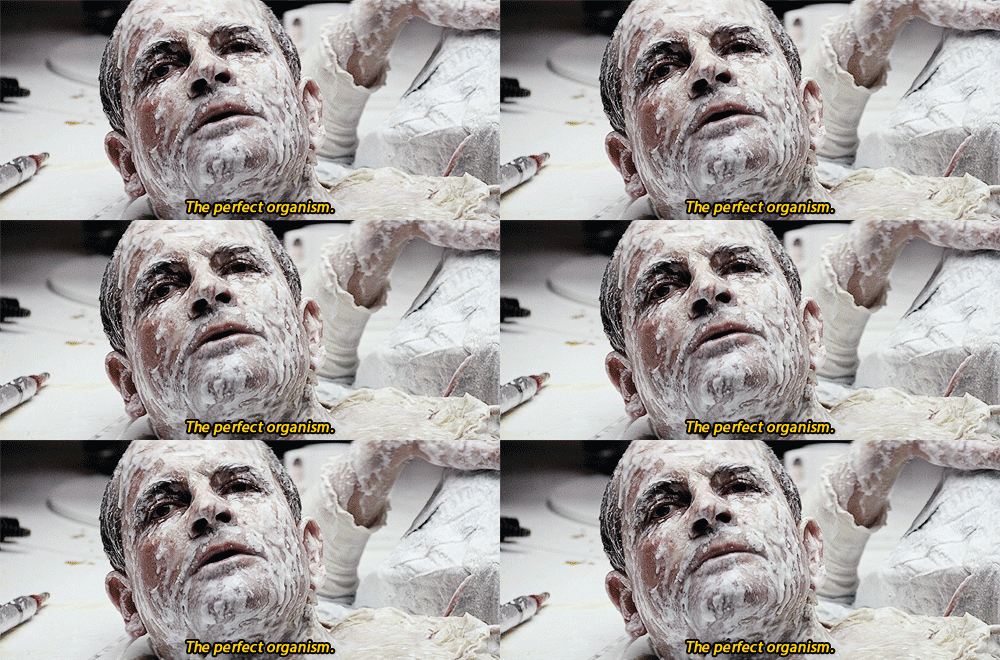
Ash: You still don’t understand what you’re dealing with, do you? The perfect organism. Its structural perfection is matched only by its hostility.
Ripley: You admire it.
Ash: I admire its purity. A survivor, unclouded by conscience, remorse, or delusions of morality.

Ash does not get any redemption; arguably, he is just as villainous as the Alien picking off the crewmates one by one. Ash goes out cheering for the alien, pure in his desires until the end.

Ash: I can’t lie to you about your chances, but… you have my sympathies.

It is possible that only the meanest of villains need help. Maybe Antagonist Assistants are just a feature of horror genres. But if you see brilliant heroes in dumb situations, look for who set the problem up. Often someone knowingly or unknowingly assists the bad guy.

A World Building Secret hidden in the opening Star Wars Title Crawl.

While researching my story structure book on Star Wars, something stuck out to me in the opening line of the title credits. It reads;

A long time ago in a galaxy far, far away…

STAR WARS
Episode IV
A NEW HOPE

It is a period of civil war. Rebel spaceships, striking from a hidden base, have won their first victory against the evil Galactic Empire. During the battle, Rebel spies managed to steal secret plans to the Empire’s ultimate weapon, the DEATH STAR, and space station with enough power to destroy an entire planet. 

Pursued by the Empire’s sinister agents, Princess Leia races home aboard her starship, custodian of the stolen plans that can save her people and restore freedom to the galaxy….

Wait a second. Let’s rewind.

It is a period of civil war.

Civil War.

But if Star Wars is a civil war, taking place inside the Empire’s borders, that should be in contrast to interstate war outside its borders. Star Wars’ central conflict is a civil war, which means other geo-political (or astro-political) entities border the galactic empire!

The evil Galactic Empire has neighbors.

And so did the Republic the Jedi protected. The Star Wars Universe is much bigger than a single galaxy. Our Milky Way Galaxy is part of the Star Wars Universe even if it is far, far away.

Even the name Star Wars is plural! This civil war is just one of many wars.

There are Extra-galactic aliens in the extended Star Wars Universe, but these are only half canon. But I think there is a gold mine of world-building opportunities in the opening few lines of Star Wars. How do the neighbors react to the death of the Emperor? What are their Jedi equivalents? The Force is much bigger than a single galaxy, after all. Was the Death Star designed to deter an intergalactic conflict? Are the other galaxies unified?

Vader tells Luke “With our combined strength, we can end this destructive conflict and bring order to the galaxy.” How surprising would it be if the Empire was more afraid of what lurked outside their Galaxy than the rebels inside? What if the Empire needs a Death Star to protect itself? What if other groups looked at the chaos in the Empire and saw an opportunity to attack?

A nice view of a galaxy at the end of the Empire Strikes Back

And what other types of war could there be? Here are some options:

  • Cold War – political, economic, propaganda, and espionage instead of military action
  • Invasion – Military Offensive that aggressively enters to conquer or liberate
  • Proxy War – armed conflict instigated on behalf of other parties
  • Undeclared War – A military conflict without either side issuing a formal declaration.
  • Total War – all civilians and resources become military targets.

Star Wars occurs during a civil war between remnants of the old republic and the current empire. Inspired by Rome’s transition from republic to empire under Julius Caesar in 31 BC, Star Wars combines that political setting with iconography from the World Wars, especially ace pilot combat footage.

But with Rome as an inspiration, there could be many options to keep the Star Wars engine moving! Egyptian Pharaos, Mithradites the Poison King, Successive Emperors, good and bad, Pompey, putting down the pirates in the Mediterranian! You could even have The Republic’s Hannibal resurface like Star Trek’s Khan in Star Punic Wars.

While we will likely never see the multiple Wars in Star Wars play out, I think it is fun to imagine the possibilities.

Archetypes vs Stereotypes, what is the Difference?

In college, my storyboarding professor asked the class, “What is the difference between archetypes and stereotypes?” I thought about it for a long time. After considerable reflection, I think I have an answer.

Stereotypes are cultural and external.
Archetypes are responsibilities and internal.

The tricky part is the terms dramatically cross over. A student is both an archetype and a stereotype.

A stereotypical student could be someone who is currently in school, studying hard for tests, worried about their grades, and trying to build a foundation for the rest of their life. They have a backpack, textbooks, and homework. Maybe some extra-curricular activities pad their college application.

Stereotypes compete and divide into groups. A stereotypical student differs from a stereotypical nerd obsessed with details. Stereotypes use patterns to divide groups of people up into more stereotypes. Stereotypical students often are not trying to learn.

An archetypal student, however, is someone with a responsibility to learn. An apprentice, a disciple, or someone learning on the job when they start a new career. Continued education for senior citizens is not what we think of stereotypical students or teachers. Still, the responsibilities of teachers and students are apparent even if the teacher is a twenty-year-old urban farmer and the class is silver-haired retirees.

So if you can find a group of people in similar situations, you have a stereotype. A stereotypical archeology professor differs from a stereotypical attractive professor who happens to teach archeology, like Indiana Jones. Stereotypes deal with group dynamics.

Archetypes deal with responsibilities and are based on the individual. A classical mother archetype must nurture her children, but it is only when that responsibility is accepted and carried out that the archetype manifests. A grandfather or an older sibling might mother children by accepting the nurturing responsibility.

If you classify by the groups, tropes, and patterns someone represents, you are looking at stereotypes.
If you look at the responsibilities carried by the individual, you are looking at archetypes.

Both are important. Both progress and change throughout life as well. Students can become masters. Daughters and sons can become mothers and fathers. But if we look at patterns we expect from a group of mothers, fathers, students, or teachers, I think that is a stereotypical analysis. If we analyze their individual responsibilities, we are looking at archetypes.

If you can continually divide the group into smaller groups, I think that is a good indication you are looking at stereotypes. On the flip side, if you can describe someone by all the groups they belong to you are also looking at stereotypes.

Describing someone as an only child, orphan, gang banger, Chinese-Mexican, and high school jock might conjure up a specific image representing all these groups. You might expect what car they drive, the fashion they wear, and the places they live.

But if their responsibility is protecting their neighborhood from an attack, they are an archetypal warrior.