Dinosaurs vs. Shapeshifting Alien Spiders, is Steven King’s IT scarier than Michael Crichton’s Jurassic Park?

Let’s compare the events in the opening sequence of the books Steven King’s ‘IT’ and Michael Crichton’s ‘Jurassic Park’. These openings have much more in common than I thought they would. Let’s start with Jurassic Park, the novel.

Jurassic Park introduces us to a different world of science than ours where genetic engineers create entertainment for a profit with small automated labs. There are no thoughts of restraint on their genetic experiments.

Then in the opening sequence, we meet Dr. Roberta “Bobbie” Carter, a visiting doctor in a Costa Rican village. During a raging storm, a helicopter makes a dangerous landing, and the passengers ask for medical assistance for a coworker injured in a construction accident. Dr. Carter is suspicious because the man’s defensive wounds indicate he was attacked. Probably by an animal. Dr. Carter takes photos of the wounds and the man mumbles, “raptor.” Her orderly, Manuel, explains that raptors are dangerous local ghosts. The patient then vomits, convulses, and dies. The workers take the body and steal Carter’s camera, leaving her no evidence about the encounter. Dr. Carter looks up “raptor” in the dictionary. It means “bird of prey.”

Now let’s do the opening of Steven King’s IT.

In 1957 George Denbrough, a six-year-old, floats a waxed paper boat down a rainy street. His ten-year-old brother Bill helped him make the boat, but Bill has the flu, so George floats the boat himself. The boat speeds up, and George tries to catch it but falls and scrapes his knees. The waxed paper boat goes down a storm drain. George looks in the storm drain, and a yellow-eyed clown pops up, holding his paper boat and some balloons. They talk, and when George reaches for his boat, the clown’s face changes and it rips George’s arm out of its socket. Neighbor Dave Gardner runs out to help Georgie, but is 45 seconds too late. George dies of blood loss, and his family mourns his death in the hospital.

Now let’s do a brutally short summary for each.

In a rain storm, a raptor attacks a construction worker at Jurassic Park, disemboweling him, and the crew life-flight him to Costa Rica. He dies in the hospital.

In a rain storm, a monster clown rips off a six-year-old’s arm, and he dies of blood loss in the hospital.

While I am nudging these summaries to be as similar as I can, the events are eerily alike. Both stories take place during historical rain storms. The monsters attack the victims but do not kill them immediately. Both victims live long enough to die under medical care.

But even if the events are similar, these stories feel so different! Michael Crichton focuses on science, medical terminology, and corporate secrets. He views the story mostly through the eyes of doctors and specialists. There is a mystery around the construction worker’s death.

But Steven King focuses on the young victim. We get to know his family, his love for his brother, and his fears. We meet the monster, and while initially its smell and yellow eyes scare George, the clown creature is friendly and charming. It even makes George laugh. Until George gets too close and the clown’s face changes, breaking George’s mind before it rips off his arm.

So while the events might be similar, the feel, the perspective, the focus, and the characters are quite different. The events of Georgie’s death could be viewed through the eye of a doctor trying to save George. Jurassic Park could start from the perspective of the construction worker attacked by a raptor.

This difference in perspective might indicate why Jurassic Park is a thriller, but IT is a horror novel. The events are equally gruesome in both books. If anything, the dinosaurs of Jurassic Park claim many more victims than the shape-shifting spider monster in IT. But the difference in perspective dramatically changes the experience. Horror puts us close enough to the monster for it to introduce itself. Sci-Fi thrillers include mysteries to solve and scientific questions.

The events may be similar, but the experience is different. We mentally become the characters to some extent when we read. So while in Jurassic Park we start as a visiting medical doctor in a small town who suspects something is off, in IT we are a six-year-old child who meets a monster.
The Antagonist Assistant, how to make intelligent heroes do dumb things.

There’s a shark in the water, an invisible hunter in the forest, an alien egg looking for romance, and hungry dinosaurs strolling through the park. These situations sound more dangerous than crossing the street blindfolded. But, there’s a simple solution; stay away. Let someone else handle it. Go home and take a nap. Only a fool would wander into trouble knowing terrible and painful death awaited them.

But great life choices often make terrible stories. So how can we make likable and intelligent heroes go into this kind of trouble when it is obviously a bad idea?

We need someone to orchestrate the whole mess. But, unfortunately, the monsters can’t manage it. They are marauding killing machines, so there is little chance they can ask nicely for more victims. So, no, we need someone to assist the monsters in bringing our heroes into trouble. I call these characters Antagonist Assistants, but if I can come up with a better term in the future, I’ll change the title.

Often these characters set up the most severe problems for the heroes but will not make it to the end of the story because their job is complete. It’s like an assist in basketball; they make the epic slam dunk possible.

Let’s look at four of these Antagonist Assistants and how they get our heroes in trouble; Mayor Larry Vaughn from Jaws, Security Expert Dennis Nedry from Jurassic Park, CIA officer Al Dillon from Predator, and Ash from Alien.

Jaws (1979) Mayor Larry Vaughn

Vaughn: Martin, i-it’s all psychological. You yell ‘barracuda’ everybody says ‘huh, wh t?’. You yell `shark!’ and we’ve got a panic on our hands on the fourth of July.

Mayer Vaughn knows the financial cost to Amity Island if they close down the beaches on Independence Day. Yes, a girl died, and it probably was a shark, but is that risk worth shutting the beaches down and missing out on re-election? The community needs open beaches and even hold a town meeting about it. Vaughn takes a risk, and people die for it. He even puts out a full shark watch to protect swimmers, and Bruce the Shark gets past them by eating a vacationer in the estuary. Vaughn realizes his mistake and signs the papers to hire Quin to hunt and kill the monster in the sea.

Vaughn: I was, I was, I was acting in the, in the town’s best interest. I
thought I was acting in the town’s best interest.

Martin: That’s right, you were acting in the town’s best interest. And that’s
why you’re going to do the right t ing! That’s why you’re gonna sign this, and
we’re gonna pay that guy what he wants!

Vaughn: Martin, Ma tin. My kids were on that beach too!
Martin: Sign it, Larry.

After Vaughn signs the papers, he is out of the film. His role in the plot was to give Bruce plenty of food and keep the beaches open! But his reasoning is understandable. The town needs business. But most of Bruce’s victims are thanks to Mayor Vaughn’s effort to keep the waters open and filled with swimmers.

Jurassic Park (1996) Dennis Nedry

Nedry: I got an eighteen-minute window. Eighteen minutes and your company catches up on ten years of research… Don’t get cheap on me, Dodgson. That was Hammond’s mistake.

Dennis Nedry is looking to make 1.5 million dollars with corporate espionage at Jurassic Park. He rehearsed everything. He will temporarily disable the security measures so he can break into the cryogenics lab and then drive to the dock to give his contact a shaving cream bottle filled with dinosaur embryos. But Nedry runs into a problem; a tropical rain storm. The ships must leave early, and it pushes his timetable up. He pulls off the embryo heist but gets lost in the storm. Nedry does not make it to the dock or return to his locked computer. The security remains disabled, which turns Jurassic Park’s visitors into dino-meals.

Nedry has no intention of physically hurting anyone in the park, but his actions cascade into every death in the movie, including his own. So while Ian Malcolm pontificates about Chaos Theory, the real culprit who helps the dinosaurs is less life finds a way, and more Nedry must get paid.

Predator (1989) – Colonel Al Dillon

Dutch: So you cooked up a story and dropped the six of us in a meat grinder.

Dutch leads an elite crew of six badass soldiers-of-fortune, but they have rules. As Dutch tells Dillon, “We’re a rescue team, not assassins.” But Dillon had already lost the first batch of Green Barrets he sent into the jungle to stop a group of Soviet-backed weapons traders. His cover story is a scam to bring in the best soldiers, even if he must lie to get them. But it was not insurgents who killed his Green Berets; it was an alien Predator. Once the Predator starts hunting Dutch’s team, Dillon is stuck with them. Knowing how much trouble he put them in, Dillon joins the fight and returns to help Mac kill the creature. Dutch warns him it is a death trap, but Dillon goes anyway.

Dutch: You can’t win this, Dillon.
Dillon: Maybe I can get even.

Dillon set up the situation and provided the best trophies the Predator could want. Unfortunately, Antagonist Assistants often do not know they are helping the big baddie. And when Dillon realizes it, he goes after the creature and dies a hero with probably the best human death scene in the movie.

Alien (1979) – Ash

Ripley: What was your special order?
Ash: You read it. I thought it was clear.
Ripley: What was it?
Ash: Bring back life form, priority one. All other priorities rescinded.
Parker: The damn company! What about our lives, you son of a bitch?!
Ash: I repeat, all other priorities are rescinded.

Ash is the most helpful and willing Antagonist Assistant in today’s post. He crosses the line and becomes a complete accomplice to the Alien creature, helping by bringing it on the ship and assisting its birth. He protects it until it no longer needs protection. Ripley realizes too late that Ash helped the creature. Not the crew. Ripley suspects the whole mission may have been a setup.

Parker: How come the company sent us a goddamn robot?
Ripley: They must have wanted the alien for the weapons division. He’s been protecting it all along.

Ash knows the alien is dangerous, but the Nostromo crewmates’ lives do not matter. It can kill all of them, and he would not care because Ash is not human. He is an android embedded with the crew, and none of them knew it until they tore his head off. This qualifies as a plot twist (or identity twist, as I call them), but there is so much horror going on it is hard to remember Ash compared to the hulking monster stalking the crew through the Nostromo’s narrow corridors.

Ash does not have human morality, but he is intelligent enough to pass as a human and seems to think deeply. If anything, he likes the Alien more than the crew. Maybe it is just his programming, but he believes in the creature.

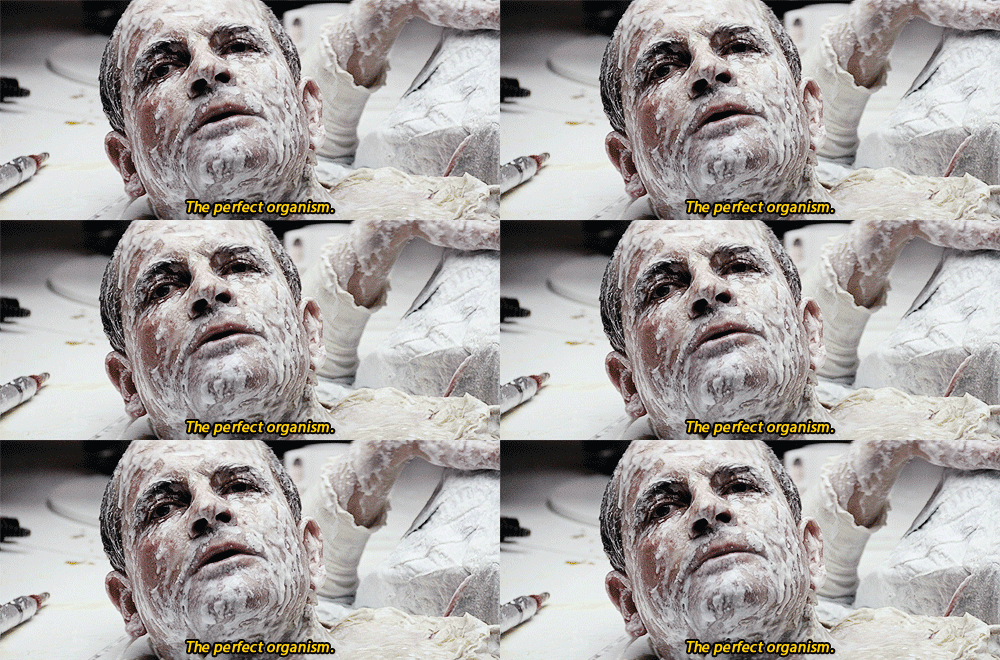
Ash: You still don’t understand what you’re dealing with, do you? The perfect organism. Its structural perfection is matched only by its hostility.
Ripley: You admire it.
Ash: I admire its purity. A survivor, unclouded by conscience, remorse, or delusions of morality.

Ash does not get any redemption; arguably, he is just as villainous as the Alien picking off the crewmates one by one. Ash goes out cheering for the alien, pure in his desires until the end.

Ash: I can’t lie to you about your chances, but… you have my sympathies.

It is possible that only the meanest of villains need help. Maybe Antagonist Assistants are just a feature of horror genres. But if you see brilliant heroes in dumb situations, look for who set the problem up. Often someone knowingly or unknowingly assists the bad guy.

How does a MONSTER enter a scene?

“Death awaits you all- with nasty, big, pointy teeth! ~ Tim the Enchanter Monty Python and the Holy Grail

We want our monsters to be scary. But what makes a monster scary? Is it their size? How loud they can roar? Their number of teeth? How good of a jump scare they give us?

I think the answer lies in how a monster enters a scene. For this, let’s look at 1979’s Alien.

How does the Alien make its appearances in the movie?

  • An Alien egg opens onto Kane, and the face-hugger jumps out of the egg onto his face
  • They cut away Kane’s helmet revealing the face hugger wrapped around his face.
  • The face-hugger disappears from Kane’s face in the lab, and the crew looks for it. The dead face-hugger drops from the ceiling onto Ripley’s shoulder.
  • The Chestburster explodes through Kane’s sternum during dinner
  • The Alien drops from the top of the frame behind Brett
  • Dallas turns his flashlight onto the alien in the air ducts, and it grabs him
  • The Alien’s shadow sneaks behind Lambert, highlighted in a shadow. She turns around, and it stands up into the frame. Parker tries to fend the creature off, but it kills him, and then its tail slowly creeps between Lambert’s legs
  • The Alien turns the corner in the Nostromo, blocking Ripley from her escape pod
  • The Alien reaches out from the wall in the escape pod.
  • Ripley climbs into a space suit and turns on all the toxic gasses she can kill it. The creature writhes on the floor. But when she turns her head, it is no longer below her on the floor; it is right behind her rearing to strike.

So how does the Alien enter the scene? It doesn’t have to because the Alien is already there. We just can’t see it. Yet. We are going into its territory.

And the characters certainly do not know it is there. More often than not, the characters are entering the monster’s lair. A loud roar from a distance might be scary, but a whisper from right behind you chills to the bone.

Seeing something emerge from just below the surface or from the side of the frame is as surprising as it gets. Jump scares can emulate this temporarily, but without that ongoing physical proximity, the monster’s presence dissipates. Our physical sensation of being right next to something so dangerous adds a tense anxiety to our fear and horror.

More important than how scary a monster looks might be the question, “how did it get so close with no one noticing?”