The final rooftop sequence of Blade Runner is one of my favorites. I want to focus on one aspect; the camera angles. Check to see if there is ground, or sky in the frame, and if so, how much? If you see a lot of ground, you are looking down. If you see a ceiling or a vast sky, you are looking up.
Let’s start with Deckard climbing onto the rooftop. He just slammed Roy in the head with a plumbing pipe and jumped out the bathroom window. Deckard dropped his gun while climbing up shelves from a previous floor. It bothered me when I was younger that Deckard didn’t go back and get his gun, but Roy dodged Deckard’s bullets twice, once at point blank range. His gun won’t help him against Roy, Deckard just needs to escape.
Roy is playing with Deckard, but Roy does not immediately follow because he is expiring. Deckard intended to retire Roy, but where he failed, time is quickly succeeding. Roy’s hand clenches uncontrollably as his engineered body dies. Roy desperately bites at his hand, trying to coax life back into it.
The first shot we see of Roy in the film is his hand clenching, as Roy asks himself, “Time? Enough.” We only know a Roy whose body is shutting down. He has been dying the entire film. What must Roy have been like before his expiration date? Even Tyrell praised his accomplishments. Roy must have been legendary. But his time is almost up. Roy grabs an old nail from the floor joists and impales it through his hand to eke out a few more minutes of life in agonizing pain.
Now onto the camera angles. We get a close-up of Deckard’s broken fingers reaching over the edge as he slowly and carefully climbs to the roof to escape from Roy. We are at eye level with Deckard looking straight on as he climbs. Here, eye level is almost on the floor.

We get a shot of Deckard swinging his leg onto the roof. The shot is from above angled down but does not emphasize that he is dangling off the top of a building. That will come soon.

Deckard rolls onto the roof and sprawls out, inspecting his fingers. The camera lays with him looking straight on. The camera is on the rooftop floor with him.

We see a shot of Roy cutting back and forth through the apartment rooms below. The camera is looking almost straight on but is about at knee height. Roy starts far away as he cuts towards us, but this low angle makes him tower above us as he resumes hunting Deckard.

Deckard stands up. The camera is at thigh height, looking straight on as he gathers himself and looks for a way off the roof.

Deckard stumbles across the roof between pipes, spinning fan blades and spotlights. He is looking for an exit. It looks like this shot is on a fairly long lens to give more depth to all the spinning fans, layers of smoke, and wandering searchlights. We are at shoulder height, looking straight at Deckard.

We see Deckard’s POV of an exit hatch shot on a wider lens, but same waist high angle and straight view. An escape!
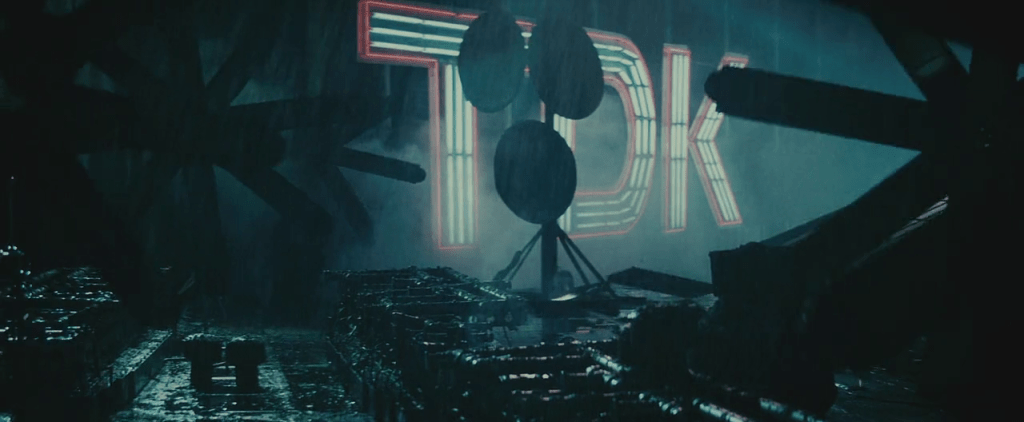
Deckard runs towards the camera and the hatch to get away from Roy. Because the lens on Deckard is long, the spinning blades blur as the focus pulls. The long lens also compresses space, giving the illusion that Deckard runs slower as he approaches the camera.
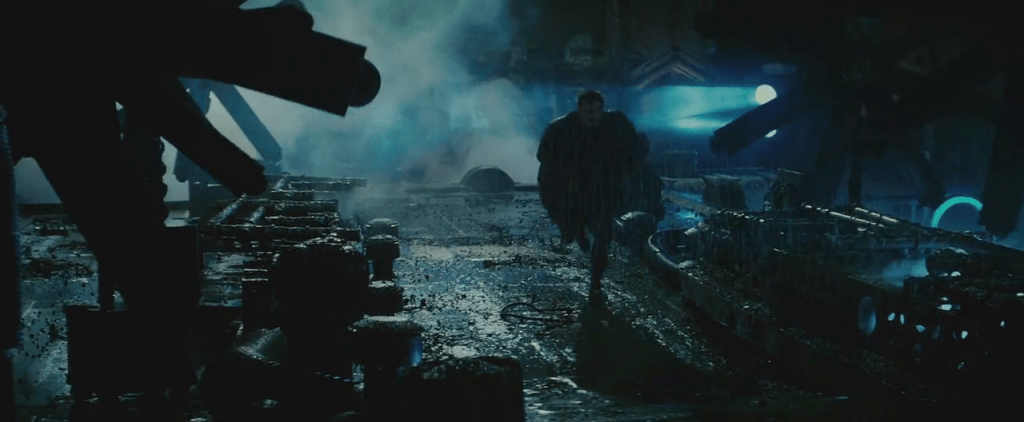
But then the exit hatch rips open. Someone is coming out of it.

Deckard slides to a stop coming towards the camera. Hunched over, and staring in disbelief, Deckard is slightly below the camera. The background has now completely blurred, and we see the horror on his face as he realizes his safe exit is now a death trap.

We cut to see Roy standing hunched forward, looking at Deckard. Roy hunches over, and the camera is below him, looking slightly up. Even hunched over, Roy is above us. We do not see Roy jump out of the roof hatch. In the time it took for Deckard to slide to a stop, Roy has already closed some distance from the hatch to Deckard. I think the temptation in a computer graphics production would show Roy’s superhuman powers here. But this quick film edit is amazing, leaving Roy’s speed to our imagination.
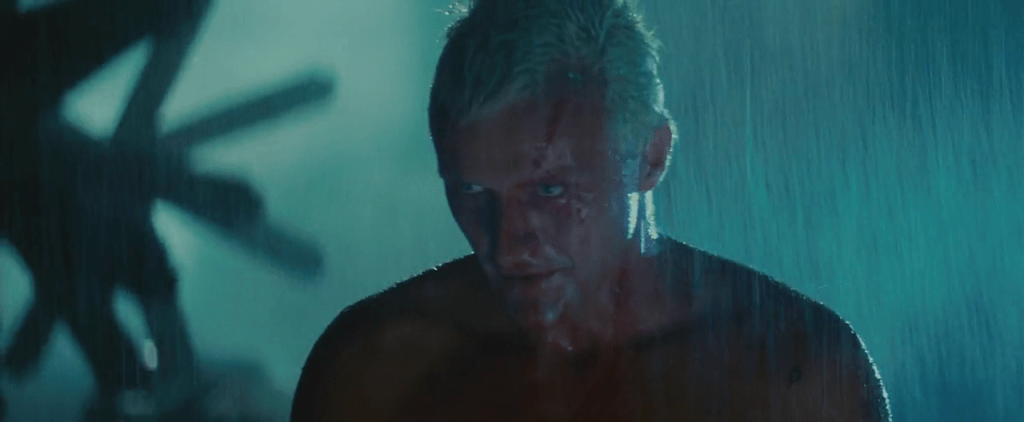
Deckard turns to run. We angle down on Deckard as we can see the top of his shoulders and the floor behind him. In the previous shots, Roy’s and Deckard’s eyes were close to the same location in the frame, but Roy is above us, and Deckard is below.
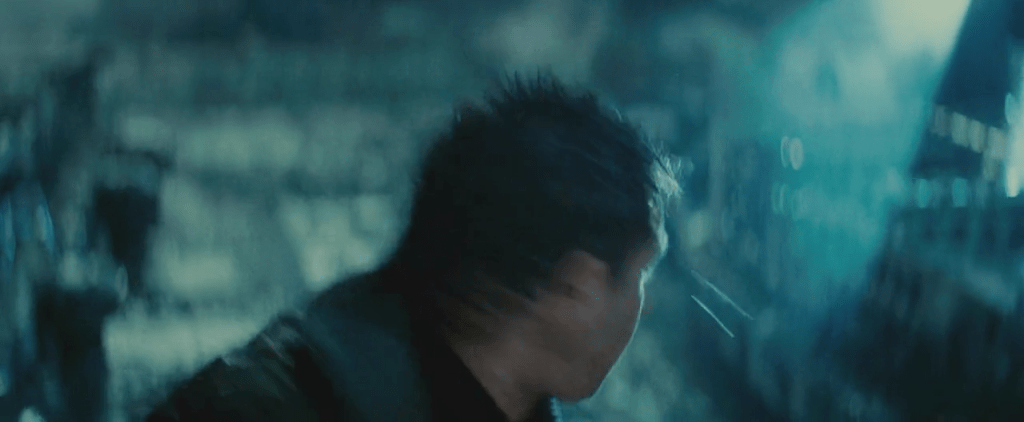
Deckard turns and runs towards the camera. We see both Roy and Deckard together in the frame. With the camera angles and how they positioned Roy, Deckard’s head comes up to the center of Roy’s chest.

Deckard runs back the way he came. The camera looks tilted down at him. When Deckard ran towards us before, it appeared he was running downhill. The horizon line is high in the frame. But now that he is running back, it looks like he has to run uphill.
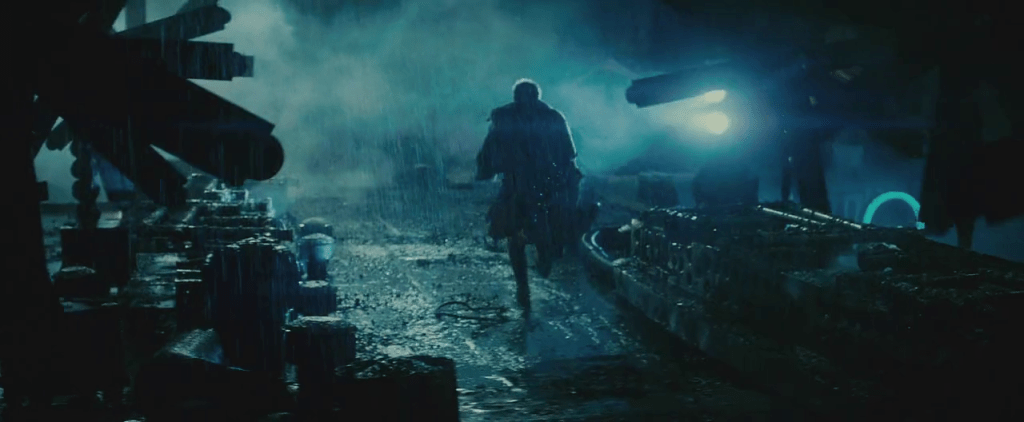
Roy gracefully leaps onto the pipes Deckard was running in between. Roy is even higher than us now.

Deckard leaps off the roof, over the city street, toward the neighboring building. We are looking down at this stunt. Deckard’s shoulders barely reach the camera’s height, even at his highest point. Then he slams into the metal studs.

We cross over to see Deckard crash towards us onto the metal. When he climbed up onto the roof before we were level with his eyes. But now we look down on him as he slips off the building, trying desperately not to fall. But the camera does not drop to his level this time. Instead, we dolly in closer as the camera moves over the edge of the building, tilting down more and more on Deckard. He is below the floor level, and we look down at him like we stare at our shoes.
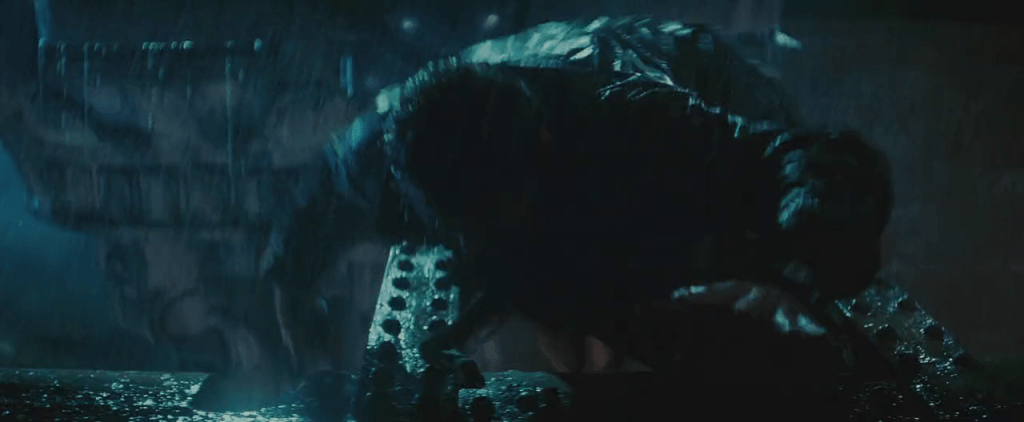

We cut to Roy, stepping towards the edge of the building to see what happened to Deckard. Roy is no longer running. He is carefully stepping forward to investigate. His game is over. Roy’s play-thing is now moments away from death, just like Roy himself. We are below the rooftop level, looking up at Roy. It’s like he’s on another floor above us.
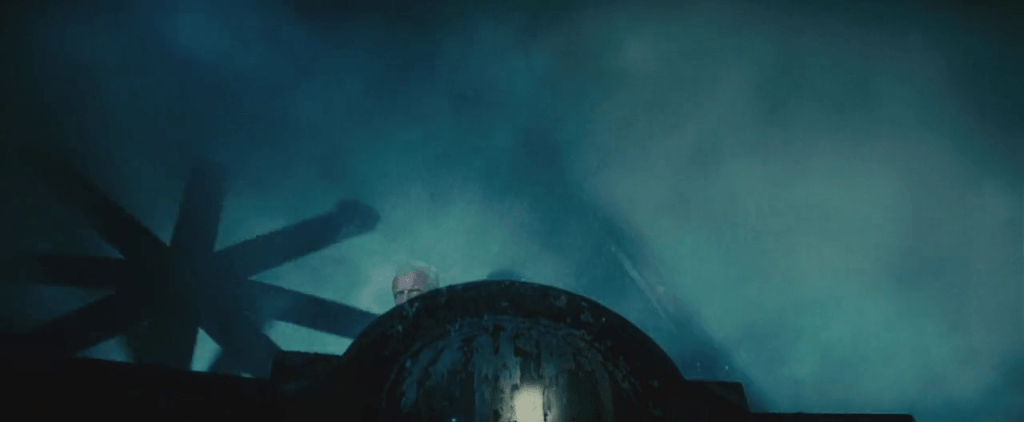

We cut back to Deckard, struggling to hold on in the same shot we had before.
Now we cut even closer to Roy. We are on his left side, and Roy fills the frame. We are still looking up at him, but it is not as dramatic as before. The lens is long, bringing us close to Roy, who takes deep breaths as he watches Deckard lose his grip.

Roy steps away from the ledge, back where he came, leaving Deckard behind. Deckard struggles and looks away from his hands as if he doesn’t want to watch his death arrive.


Now we get a shot with Roy crossing his arms, a nail sticking through one hand, a dove in the other, his back to Deckard. Roy covers Deckard in the frame. The camera is now above Roy, angled down. Roy has been above us for most of this sequence. Even when he opened the hatch, it was only a couple frames before he loomed over Deckard.

What will Roy do? I am reminded of the first question in the Voight-Kampff test Holden asks, “You reach down, you flip the tortoise over on its back Leon…The tortoise lies on its back, its belly baking in the hot sun, beating its legs, trying to turn itself over, but it can’t, not without your help, but you’re not helping.”
Roy’s game put Deckard into this situation. Does Deckard deserve to fall for killing Zhora and Pris when Roy has already broken Deckard’s fingers for that? What will Roy do?
Roy unfolds his arms and turns around, revealing Deckard in the frame behind him. Roy then attempts the jump that Deckard failed. The camera tracks along with Roy as he leaps over the edge. The camera has not tracked along with a character at any other point in this sequence. We are with Roy as he makes the jump, making it feel like we, too, are leaping over the edge.


We then get a shot looking up at Roy as he clears the gap. The camera is so far below Roy that we see the soles of his shoes as he soars above us. We might be a couple of stories below him.

We see Roy soar over Deckard from behind and below. It’s an over-the-shoulder telephoto shot. The camera looks up at Deckard from below, while Deckard is far below Roy, who disappears into the smoke. Roy clears the gap with so much extra space he disappears into the rain and fog. Even at the brink of death, he is physically superior to Deckard.

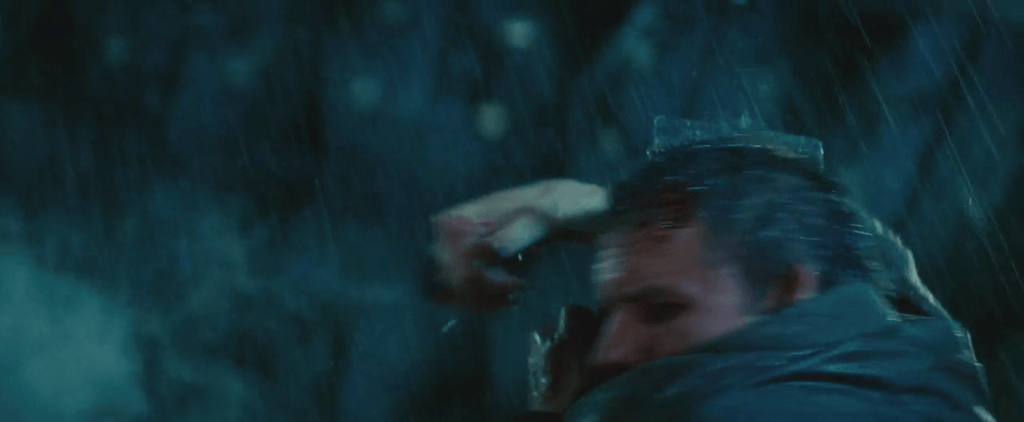
Now, we see the highest-angle shot possible. The camera is directly above Deckard, looking down at the street. The camera tilts slightly, giving the image an unbalanced look.

We cut back to an over-the-shoulder below Deckard as Roy emerges from the smoke above us and kneels down. Both of them are high above us, but Roy is so high above the camera that even kneeling only brings him closer to us.

We get a new angle on Deckard as his grip fails. We look down on Deckard and the camera tilts so the metal beam is pointing up in the frame, above 45 degrees. Deckard slips farther down. This gives the illusion that the building tilts up and away from Deckard, almost trying to shake him off. Roy leans into the frame over Deckard in this exact shot, and you can see his shoulder on the left of the frame.

Then we cut to Roy’s eyes, almost glowing in the darkness as he looks down on us and Deckard. Roy is looking towards us, but if you look at the raindrops, you can see that Roy is standing high above the camera. The telephoto shot is so tight to Roy that his face fills the entire frame. Roy grimaces as he watches Deckard struggle as if going back and forth between entertainment, fascination, and horror.

Looking down at Deckard, we get a tighter shot of his face. His hands are no longer in the frame as he struggles to keep his grip. The long camera lens puts us close to both characters, with Roy high above and Deckard far below us.
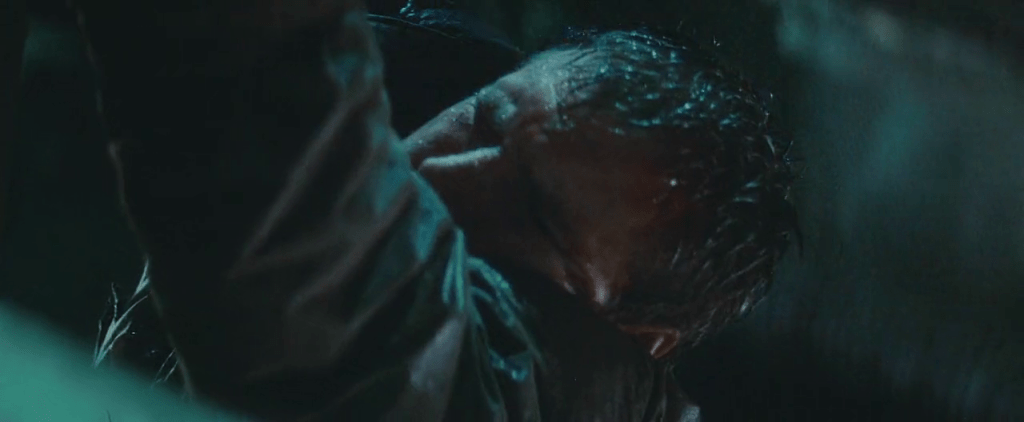
The images cut back and forth between these shots as Roy tells Deckard, “Quite an experience to live in fear, isn’t it? That’s what it is to be a slave.” Roy is still above us but looking directly at us through the camera.
We see a shot looking down at Deckard’s fingers as he slips farther off the building. They angle the metal beam even higher in the frame. We were at his level when Deckard climbed onto the roof, but now he hangs far below us.

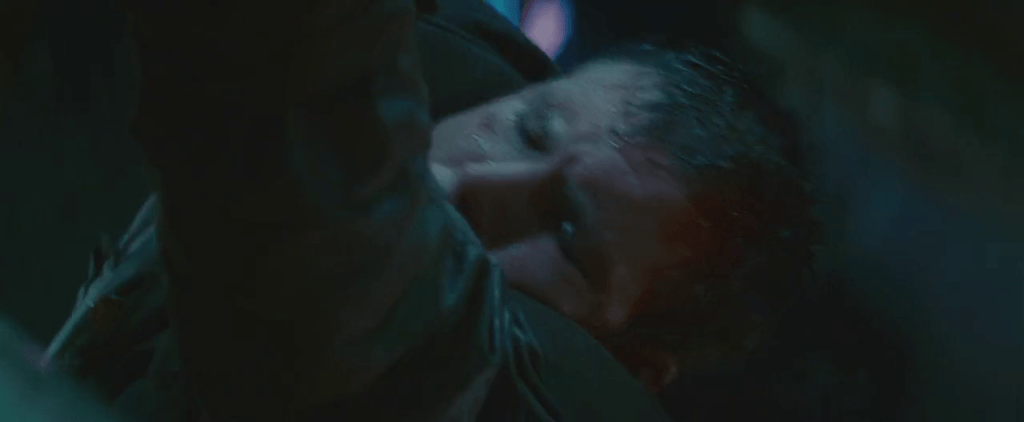

We cut back and forth to previous camera shots: a close-up looking down at Deckard’s hands as one hand slips, directly over Deckard as his grip fails, looking up at Roy, who smiles at Deckard. Deckard loses his grip completely and spits at Roy as he falls from the roof.


“Kinship!” shouts Roy as he catches Deckard’s wrist, saving Deckard from the fall. The camera looks down from Roy’s shoulder level. Roy dropped to catch Deckard. For his shoulder to be that low in the frame, Roy had to dive over the edge to catch Deckard. But we do not see Roy in that inferior position. Roy remains above us.
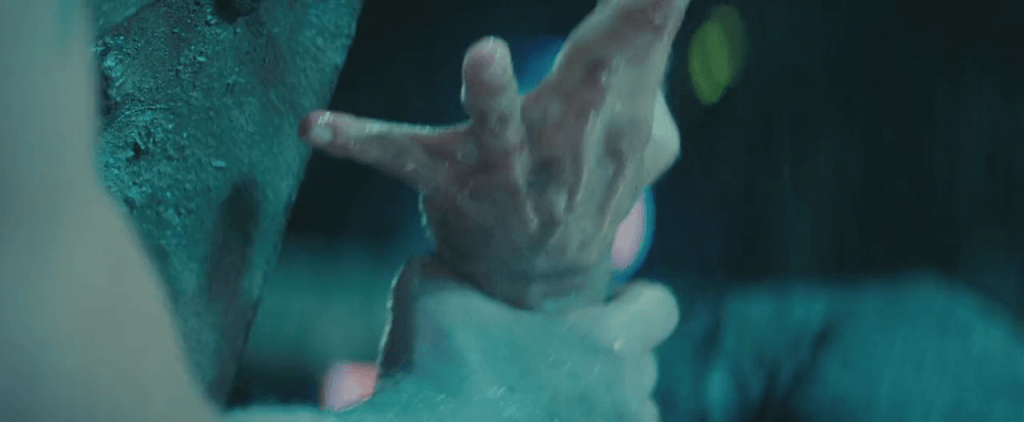
We get a low shot, looking up at Roy’s face as he struggles momentarily. This is the same hand that moments before had closed up as Roy’s body shut down.

We look down from above Deckard’s face as he grits his teeth like Roy is ripping his arm out of his socket. Roy is much stronger than Deckard, and even saving him hurts.

Roy purses his lips in determination as he lifts Deckard, the nail through Roy’s hand visible as he stands up, bringing Deckard onto the roof. Deckard holds onto his elbow, bracing himself, as Roy hoists him.
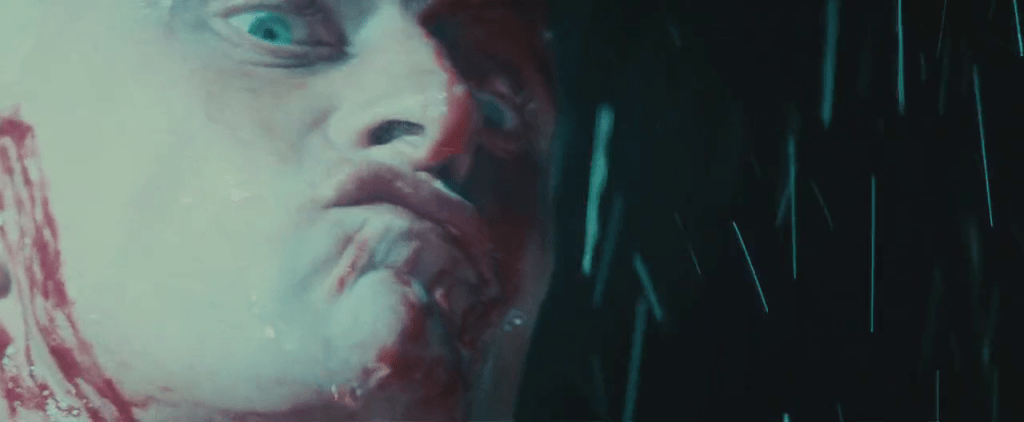

We get a shot from far below Roy and Deckard. Roy’s arm fully extends as he lifts Deckard up, showing just how strong Roy is. Deckard kicks his legs wide, trying to find some foothold to stand on.
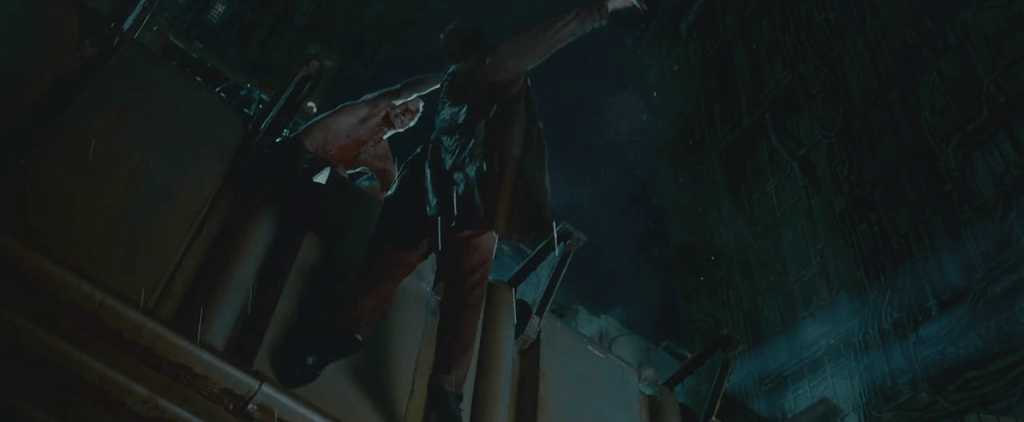
Roy flops Deckard down, his belly exposed to the rain. Deckard once again lays out completely, but now Roy stands directly above him. The extreme camera tilting is over. We will look a little up and down. But the character’s position in the frame tells the story here. Deckard lies at Roy’s feet. And Roy is standing so high in the frame that the edge of the frame cuts his head off. Deckard crawls away from Roy, coming towards the camera.
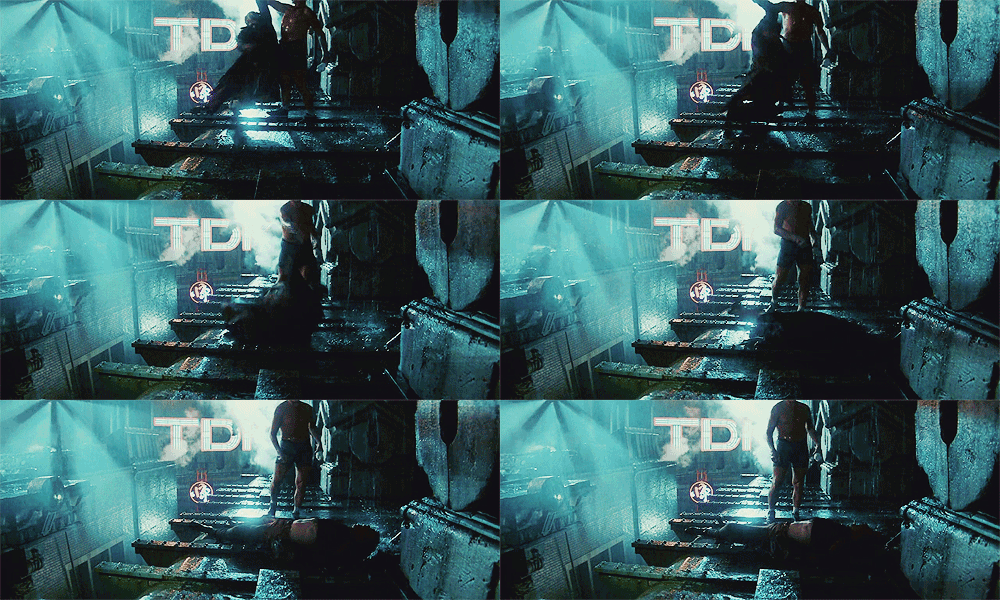
We get a reverse shot of Deckard crawling away from us. We are on Roy’s side now. The camera is at mid-thigh height, looking down on Deckard. Roy looms high above us, and most of his body clips out of frame. Deckard is completely visible in the frame, as if its edges trap him, but Roy is so big in frame he does not fit. We only see Roy’s knees, running shorts, and his hand with a nail through it as he steps towards Deckard, who crawls back into a pillar. Deckard has no way out now and squirms below Roy. And then Roy slowly sits down.

We get a reverse shot of Roy slowly sitting down. Moments before, Roy filled the entire frame; now, he sits just above eye level with the camera and gives the “tears in rain” monologue.
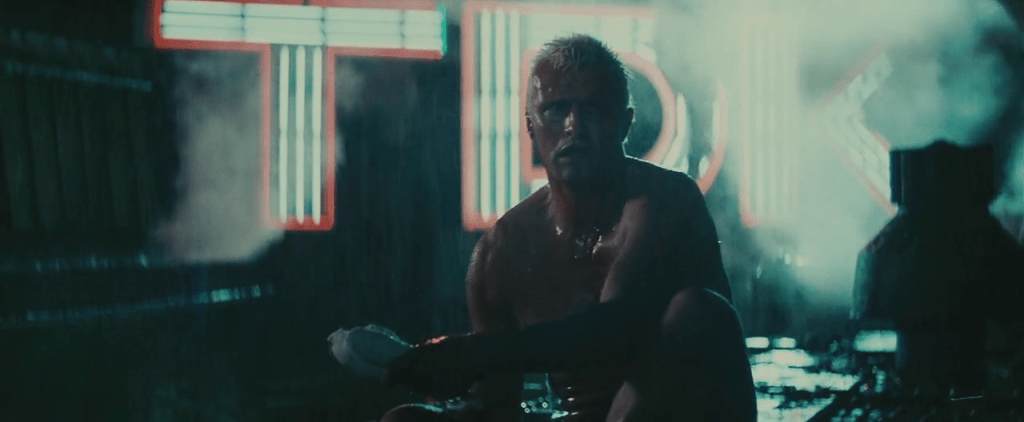
“I’ve seen things you people wouldn’t believe… Attack ships on fire off the shoulder of Orion… I watched C-beams glitter in the dark near the Tannhäuser Gate. All those moments will be lost in time, like tears in rain… Time to die.”
Roy remains above us, and Deckard stays below. But this might be as close as Roy can get to Deckard’s level because he might be more human than human.
I don’t know if it is possible to angle the camera higher up or lower down than this sequence shows. Deckard falls so far below us that we look straight down at the street below him. Roy jumps so high above us that we see the soles of his shoes.
There is tremendous power in the angle of a camera. If it took physical effort to climb to all the places the camera positions itself in this scene, we would have to climb up and down multiple stories in less than a minute. Emotionally, I think that happens here as well.
With all the fantastic special effects available, it is incredible how powerful the camera can be when pointing up and down.
As Roy dies, he releases the dove in his hand, and it flies up and away from us. We then get a shot of the clouds in the sky above 2019 Los Angeles.


 Daniel N. Blair