What is the Story Palette for Bladerunner?

The Story Palette for Bladerunner differs significantly from Star Wars or Indiana Jones. Star Wars has two competing teams, one chasing the other. Indiana Jones is a cycle of finding and losing something for all parties. But Bladerunner’s primary focus is more cerebral. It took me a while to identify the repeating pattern, and I documented my thought process, which I will include in a later post.

If the concept of a Story Palette will help others, I hope I can find tools to accelerate assembling and playing with story palettes. I hope Large Language Models and other AI tools will help. Until I figure those tools out, maybe the best thing I can do is communicate my discoveries.

So, what is the pattern of repeating actions in Bladerunner? Here they are:

  • Questions: Asking questions, investigating, trying to find answers.
  • Playing: Pretending, playful deception (usually harmless on its own), misleading, acting, toys, origami, and games, including chess.
  • Violence: threats, death, breaking fingers, killing butterflies, boiling dogs, etc.

That’s it. So, to explore how these points repeat throughout the film, let’s go through the scenes of Bladerunner. The Big Story Goals for Bladerunner are pretty simple, so I won’t highlight them in the scenes this time around as I do in my book for the Original Star Wars trilogy. Here are the Big Story Goals at a high level:

  • Replicants search for a genetic engineer to help them get more life, leading them from Holden to Chew, to Sebastien, to Tyrell. They fail to extend their lives.
  • Deckard hunts the replicants on his list.
  • Rachel is added to Deckard’s list. Rachel saves his life, and Deckard decides to save her in return. Then Roy saves Deckard before dying. The original replicants on Deckard’s list are retired, but Deckard continues to protect Rachel.

Now that the Big Story Goals are out of the way let’s get into how Questions, Play, and Violence repeat throughout the story, creating the feel of Bladerunner. Buckle up. This is a bit of a trip. The bolded text relates back to the Story Palette of repeating actions.

Holden questions Leon. Leon pretends to be human, trying to pass the Voight-Kampff test. Leon shoots Holden.

“They’re just questions, Leon. In answer to your query, they’re written down for me. It’s a test, designed to provoke an emotional response… Shall we continue?”

Gaff arrests Deckard and asks him to speak with Police Chief Bryant. Deckard pretends he can’t understand Gaff.

“He say, you under arrest, Mr. Deckard.”

Bryant asks Deckard to help with the Nexus-Six replicants. He pretends to be friendly, but Deckard has no choice. When he tries to leave, Bryant threatens him. Gaff folds an origami chicken.

“You wouldn’t have come if I’d just asked you to. Sit down, pal.”
“Stop right where you are. You know the score, pal. If you’re not cop, you’re little people.

Bryant describes how the replicants slaughtered their way to Earth. Deckard asks questions about the replicant’s motivations. Gaff folds an origami unicorn.

“Well, I don’t get it. What do they risk coming back to earth for? That’s unusual. Whywhat do they want out of the Tyrell Cooperation?”

At Tyrell’s office, Rachel introduces herself and asks Deckard about his job. Deckard questions Rachel with the Voight-Kampff test. Tyrell misleads Deckard, pretending Rachel is human. They discuss retiring replicants, killing a human by mistake, killing butterflies, cheating in a relationship, and boiled dog. They even discuss watching a stage play.

“I’m impressed. How many questions does it usually take to spot them?”

Deckard searches Leon’s apartment, finding Leon’s photos and fish scales. Gaff escorts Deckard and folds an origami statue of a man with an erection. Leon walks outside the apartment, watching Deckard and Gaff, but does not enter.

Roy asks Leon about his photos and the police. They break into Chew’s lab. Leon tears off Chew’s coat, freezing him. Roy questions Chew about morphology, longevity, and incept dates. Chew doesn’t know, so Roy asks who does. Leon plays with the cryogenic tanks and puts eyeballs on Chew’s shoulders like toys.

“Chew, if only you could see what I’ve seen with your eyes. Questions.”
“I don’t know answers.”
“Who does?”

Rachel hides in Deckard’s elevator, and he almost shoots her. She brings photos to prove she is human, but he questions her memories, calling out her memory of playing doctor with her brother.

Remember that? You ever tell anybody that? Your mother, Tyrell, anybody huh?

Pris pretends to meet J.F. Sebastian by accident, and Sebastian promises not to hurt her. Pris asks him about himself and his genetic creations, pretending not to know anything about genetic design, while Sebastion introduces his engineered toy friends.

“I make friends. They’re toys. My friends are toys. I make them. It’s a hobby. I’m a genetic designer. Do you know what that is?”
No.

Toys that greet you!

Deckard asks a fishmonger about the scale he found in Leon’s apartment. She tells him it’s a snake scale, leading him to Abdul ben Hassan. Deckard asks Abdul who bought the snake, but Abdul tries to evade. Deckard grabs him by his tie and gets the name Taffy Lewis.

“My work? Not too many could afford such quality.”

Deckard asks Taffy Lewis questions, and Taffy pretends he’s never seen the girl in the photo. Deckard threatens him, asking, “Your licenses in order, pal?” He calls Rachel and invites her to drink, but she refuses, acting like she hasn’t already run away from Tyrell Corp (we’ll find this out later).

Deckard pretends to be an agent from “The American Federation of Variety Artists” to ask Zhora some questions.

“Ha! Are you for real?”

Zhora lures Deckard in, chops him in the throat, and almost strangles him to death with his tie. Deckard chases her and shoots her in the back, retiring her.

Violence in slow motion

Gaff hits Deckard with his cane to get his attention, and Deckard says he’s going home. Bryant tells Deckard there are four more to go and informs Deckard that Rachel has been added to his hit list.

Note: This scene doesn’t fit the Palette as well as others, but it is necessary exposition for the rest of the film. Star Wars had this, too, with Obi-Wan introducing the lightsaber to Luke and again when they introduced the Death Star trench run to the pilots. Brief exposition scenes build up the following Big Story Goals that guide the characters.

Deckard sees Rachel on the street and tries to find her but is intercepted by Leon, who is much stronger than him. Leon asks, “How old am I?” Deckard lies and pretends he doesn’t know. Leon asks how long he will live. Leon slaps Deckard’s gun out of his hand and throws him around like a doll. Rachel shoots and kills Leon with Deckard’s gun.

Wake up! Time to die.

Deckard takes Rachel back to his apartment, where she asks him how she can survive. Deckard won’t chase her, but another Bladerunner will. She plays piano, and they get romantic, but then Deckard gets violent, throwing her against the window blinds.

Pris puts on makeup and does a cartwheel before she asks J.F. Sebastian many questions about how she looks, his health, and why he’s still on earth. Roy enters and informs Pris they are the only two left.

“Then we’re stupid, and we’ll die.”

Roy plays with Sebastian’s chess pieces. Pris plays with a dismembered doll. Sebastian asks, “What generation are you?” Pris does a backward cartwheel and puts her hand into boiling water to grab an egg, which she throws at Sebastian, who can’t hold it.

Roy asks about Sebastien’s opponent in chess, trying to get access to Tyrell. Roy squeezes Sebastien, who initially refuses but, under pressure, agrees to help them.

“Will you help us?”

Sebastien and Roy go to Tyrell’s apartment and play chess to get in. Roy asks for more life and about the possible ways to extend his longevity. Roy kills Tyrell and Sebastien.

“Would you like to be modified?”

Deckard hears a bulletin about Sebastien’s death, and a police car buzzes by, asking what he is doing and threatening to arrest him. Deckard confirms his police ID and calls Sebastien’s apartment. Pris answers, asking who’s calling. Deckard pretends to be a friend of Sebastien’s, and Pris hangs up.

“That’s no way to treat a friend.”

Deckard investigates the apartment. Pris pretends to be one of Sebastien’s toys. When Deckard gets close, she attacks him. He shoots and kills her.

Roy returns and dodges Deckard’s bullets twice. He asks Deckard, “Aren’t you the good man?” and “Proud of yourself, little man?” Roy breaks Deckard’s fingers and instigates a game of cat and mouse.
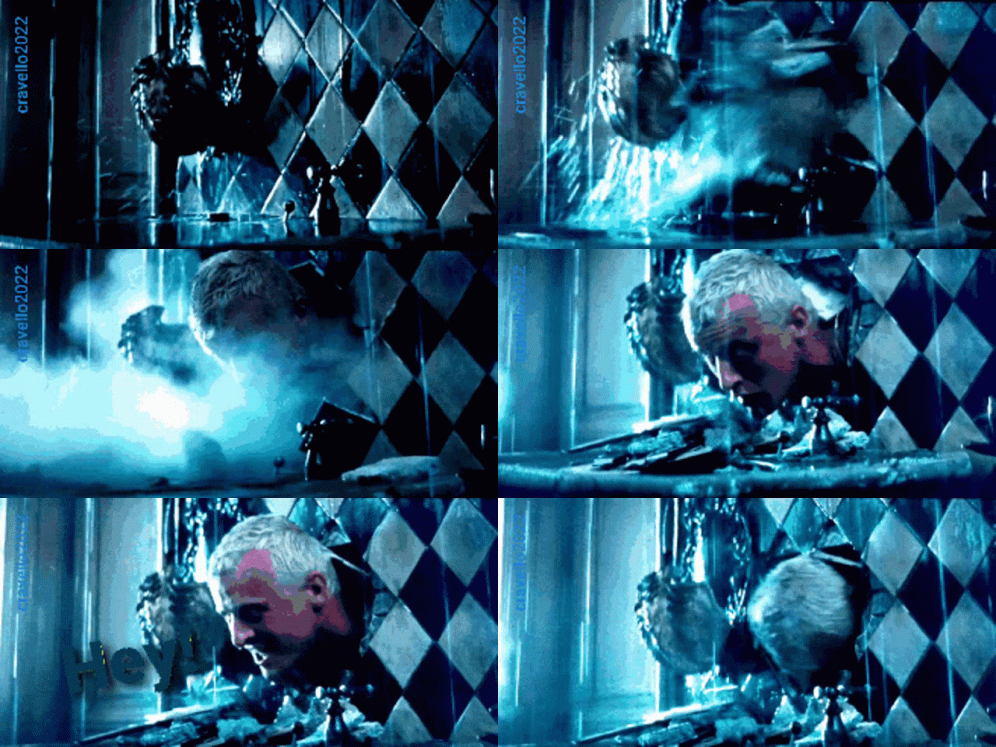
“You better get it up, or I’m gonna have to kill ya! Unless you’re alive, you can’t play, and if you don’t play…”

Deckard hits Roy with a pipe, and Roy drives a nail through his own hand as his longevity runs out. As Deckard’s grip slips from the roof, Roy asks his last question, “Quite an experience to live in fear, isn’t it?”

Then Roy saves Deckard’s life before his own life runs out.

Gaff returns Deckard’s gun to him, saying, “It’s too bad she won’t live. But then again, who does?

Deckard returns to his apartment, asking, “Rachel? Rachel? Rachel?” looking for her. He finds her in bed, and it seems like she might be dead, but she is only sleeping. He asks, “Do you love me? Do you trust me?” as they leave, he finds a paper unicorn on the floor.

So, that is the repeating pattern that drives Bladerunner’s mood. Lots of questions, playing pretend, toys, and games, punctuated by threats, violence, and death. I was surprised by how playful the dark story is, but it profoundly contrasts the deep questions about life and the violence surrounding the characters.

Does this cover everything in the story? Definitely not. There’s a lot of world-building and themes that are not included in the Story Palette. For instance, the movie mentions and shows many animals: owls, snakes, doves, pigeons, rats, ostriches, dogs, butterflies, unicorns, and tortoises. Rescue appears like an exclamation point in Bladerunner when Rachel and Roy save Deckard, but it is not a repeating action throughout the film. And maybe in some examples, I am stretching trying to prove my point.

But Bladerunner would not be Bladerunner if you removed the questions, the playful pretend, or the violence. The plot points could be almost identical, but the story could focus on rescues, escapes, and fights like Star Wars. The whole mood would change. I believe these repeating actions are the heartbeat of the story’s mood and feel. The creativity comes in combining the elements from the palette into the scenes, almost like mixing paint. How many ways can characters play and pretend? What questions could they ask? And how can you thread violence and threats into most scenes in new and exciting ways?

So, if you want a story to feel more like Bladerunner, have the characters ask lots of questions and search for answers, play pretend and play some games, and then delve into threats and violence to punctuate each scene. Then, throw in lots of animal and animal references and beautiful visuals for good measure.
Dinosaurs vs. Shapeshifting Alien Spiders, is Steven King’s IT scarier than Michael Crichton’s Jurassic Park?

Let’s compare the events in the opening sequence of the books Steven King’s ‘IT’ and Michael Crichton’s ‘Jurassic Park’. These openings have much more in common than I thought they would. Let’s start with Jurassic Park, the novel.

Jurassic Park introduces us to a different world of science than ours where genetic engineers create entertainment for a profit with small automated labs. There are no thoughts of restraint on their genetic experiments.

Then in the opening sequence, we meet Dr. Roberta “Bobbie” Carter, a visiting doctor in a Costa Rican village. During a raging storm, a helicopter makes a dangerous landing, and the passengers ask for medical assistance for a coworker injured in a construction accident. Dr. Carter is suspicious because the man’s defensive wounds indicate he was attacked. Probably by an animal. Dr. Carter takes photos of the wounds and the man mumbles, “raptor.” Her orderly, Manuel, explains that raptors are dangerous local ghosts. The patient then vomits, convulses, and dies. The workers take the body and steal Carter’s camera, leaving her no evidence about the encounter. Dr. Carter looks up “raptor” in the dictionary. It means “bird of prey.”

Now let’s do the opening of Steven King’s IT.

In 1957 George Denbrough, a six-year-old, floats a waxed paper boat down a rainy street. His ten-year-old brother Bill helped him make the boat, but Bill has the flu, so George floats the boat himself. The boat speeds up, and George tries to catch it but falls and scrapes his knees. The waxed paper boat goes down a storm drain. George looks in the storm drain, and a yellow-eyed clown pops up, holding his paper boat and some balloons. They talk, and when George reaches for his boat, the clown’s face changes and it rips George’s arm out of its socket. Neighbor Dave Gardner runs out to help Georgie, but is 45 seconds too late. George dies of blood loss, and his family mourns his death in the hospital.

Now let’s do a brutally short summary for each.

In a rain storm, a raptor attacks a construction worker at Jurassic Park, disemboweling him, and the crew life-flight him to Costa Rica. He dies in the hospital.

In a rain storm, a monster clown rips off a six-year-old’s arm, and he dies of blood loss in the hospital.

While I am nudging these summaries to be as similar as I can, the events are eerily alike. Both stories take place during historical rain storms. The monsters attack the victims but do not kill them immediately. Both victims live long enough to die under medical care.

But even if the events are similar, these stories feel so different! Michael Crichton focuses on science, medical terminology, and corporate secrets. He views the story mostly through the eyes of doctors and specialists. There is a mystery around the construction worker’s death.

But Steven King focuses on the young victim. We get to know his family, his love for his brother, and his fears. We meet the monster, and while initially its smell and yellow eyes scare George, the clown creature is friendly and charming. It even makes George laugh. Until George gets too close and the clown’s face changes, breaking George’s mind before it rips off his arm.

So while the events might be similar, the feel, the perspective, the focus, and the characters are quite different. The events of Georgie’s death could be viewed through the eye of a doctor trying to save George. Jurassic Park could start from the perspective of the construction worker attacked by a raptor.

This difference in perspective might indicate why Jurassic Park is a thriller, but IT is a horror novel. The events are equally gruesome in both books. If anything, the dinosaurs of Jurassic Park claim many more victims than the shape-shifting spider monster in IT. But the difference in perspective dramatically changes the experience. Horror puts us close enough to the monster for it to introduce itself. Sci-Fi thrillers include mysteries to solve and scientific questions.

The events may be similar, but the experience is different. We mentally become the characters to some extent when we read. So while in Jurassic Park we start as a visiting medical doctor in a small town who suspects something is off, in IT we are a six-year-old child who meets a monster.

Money in Story, is there any escape from cold hard cash?

Is story all about money? Even when there is not a bag of money to motivate the characters, are we dealing with wealthy characters? Are movies secretly about the Lifestyles of the Rich and Famous? Characters can quickly become wealthy and barely notice it, like Harry Potter, who went from sleeping in a closet under the stairs to inheriting a mountain of gold at Gringotts in chapter 5 of the first book.

Let’s take a look at IMDB’s top 25 rated movies to see. It’s not a fair sampling of all stories, but it might be enough to run a simple test.

  1. The Shawshank Redemption (1994): Andy Dupree withdraws $370,000 of laundered money in 1966, or about $3.3 million today.
  2. The Godfather (1972): The Corleone family is worth a billion, possibly more. We don’t see stacks of money lying around, but killing off your competitors for the family has a solid profit margin.
  3. The Dark Knight (2008), Bruce Wayne is the quintessential billionaire worth an estimated $50 billion.
  4. The Godfather Part II (1974): The billionaire Corleone family again.
  5. 12 Angry Men (1957): Unknown. Juror #4 seems to be a man of wealth and position, but we do not know most of the jurors’ names, let alone their income.
  6. Schindler’s List (1993): Oskar Schindler, a wealthy German industrialist and entrepreneur is a millionaire who uses his fortune to save Jews during WW2.
  7. The Lord of the Rings: The Return of the King (2003): Aragorn, crowned as High King Elessar, reunites Arnor’s and Gondor’s kingdoms. While his net worth may be difficult to judge, there would be few in middle earth with more power and resources.
  8. Pulp Fiction (1994) Crimelord Marsellus Wallace is a millionaire with influence from the world of boxing to drugs and smuggling.
  9. The Lord of the Rings: The Fellowship of the Ring (2001), Bilbo is the wealthiest hobbit in all the Shire. The Mithril armor he gifts Frodo is worth more than the whole Shire combined. Estimated fantasy armor millionaire.
  10. The Good, the Bad, and the Ugly (1966) Blondie walks away with 200,000 gold dollars, or about 16.5 million in today’s currency.
  11. Forrest Gump (1994) Forrest Gump is a billionaire and possibly a gozillionaire thanks to Bubba Gump Shrimp and Hurricane Andrew.
  12. Fight Club (1999): Tyler Durden may not be wealthy, but he destroys all the credit card records worth, gifting debt holders $480 billion in 1999 or $887 billion today. Project Mayhem is all about debt and money.
  13. Inception (2010): Fischer and Saito are billionaires keeping the dream alive.
  14. The Lord of the Rings: The Two Towers (2002) I am going with Galadriel this time, who surpasses all other elves in beauty, knowledge, and power. Not all about money, but she did get one of the three elf rings of power.
  15. Star Wars: Episode V – The Empire Strikes Back (1980) – Lando might be the wealthiest member of this film; he owns Cloud City and lives in luxury. Estimated Cloud City millionaire, but Vader definitely is more powerful. Leia probably lost much of her wealth when Alderan blew up, otherwise, she would top the list.
  16. The Matrix (1999) – This is not all about money because the world is a simulation. It’s hard to worry about money when humans are batteries, and you eat amino goop for every meal.
  17. Goodfellas (1990) – When you measure money by inches, not amount, it just might be about the money. Henry’s biggest frustration in leaving organized crime is he’s just an average nobody, like everyone else.
  18. One Flew Over the Cuckoo’s Nest (1975) – There are no millions here, but gambling, betting, and games like Monopoly make appearances teaching inmates about their agency. Not about the money, but money makes some great arguments here.
  19. Se7en (1995) – John Doe targets his second victim, wealthy and amoral attorney Eli Gould, for his sin of greed. Not sure about the amount, but Gould has lots of ill-gotten money.
  20. Seven Samurai (1954): Poor farmers look for impoverished Samurai who will take rice as their payment for defending the village from bandits. No millionaires here, but rice motivates everything in this Japanese period epic.
  21. It’s a Wonderful Life (1946) Mr. Potter is the wealthiest and meanest man in Bedford Falls and owns most businesses, including the Bank. He offers George a $20K salary in 1936, more than $350K today. Definitely a millionaire, possibly a billionaire.
  22. The Silence of the Lambs (1991): The most influential person is probably Senator Ruth Martin. Buffalo Bill has the FBI after him because he kidnapped the Senator’s daughter. Dr. Lector was wealthy, but I have difficulty putting money first in this psychological thriller.
  23. City of God (2002) – Drug lords fighting for control in a Brazilian favela. I’m not sure about the exchange rate, but the crime war involves most of the drug money in town.
  24. Saving Private Ryan (1998) – Not much money here, just world war two combat up close and personal.
  25. Life is Beautiful (1997) – Another world war two film focused on the Holocaust. Hard to say this one is about money even if the family wins a tank in the end.

Well, it’s hard for me to count this one clearly, especially where we have Middle Earth, the Star Wars universe, and the postapocalyptic world of the Matrix to calculate finances. But even in those fantasy worlds, we often deal with their wealthiest and most powerful characters. Morpheus owns a sweet hovercraft!

By my count, 18 have millionaires, billionaires, kings, senators, and drug lords. And why shouldn’t they? Money is a major motivator in our lives, why should fictional characters be different? And even when the characters have nothing but the rice they grow themselves, it is a major focus of the movie. You don’t have to have many resources to find motivation.

So is there an escape from money in stories? Yes! But the authors probably have to kill characters to make it happen.

Speaking of death, murders, and war, how many of those movies don’t have violent death? None of them.

I thought It’s a Wonderful Life came the closest, except it has a montage of World War Two where Navy fighter pilot Ace Harry Bailey shoots down 15 enemy planes. Joe Baley prepares for suicide to collect life insurance money. Inception deaths besides Mal’s suicide are dream projections, but we still get plenty of murder and mayhem on screen.

Maybe money as a motivator is the safer option in the end.

The Antagonist Assistant, how to make intelligent heroes do dumb things.

There’s a shark in the water, an invisible hunter in the forest, an alien egg looking for romance, and hungry dinosaurs strolling through the park. These situations sound more dangerous than crossing the street blindfolded. But, there’s a simple solution; stay away. Let someone else handle it. Go home and take a nap. Only a fool would wander into trouble knowing terrible and painful death awaited them.

But great life choices often make terrible stories. So how can we make likable and intelligent heroes go into this kind of trouble when it is obviously a bad idea?

We need someone to orchestrate the whole mess. But, unfortunately, the monsters can’t manage it. They are marauding killing machines, so there is little chance they can ask nicely for more victims. So, no, we need someone to assist the monsters in bringing our heroes into trouble. I call these characters Antagonist Assistants, but if I can come up with a better term in the future, I’ll change the title.

Often these characters set up the most severe problems for the heroes but will not make it to the end of the story because their job is complete. It’s like an assist in basketball; they make the epic slam dunk possible.

Let’s look at four of these Antagonist Assistants and how they get our heroes in trouble; Mayor Larry Vaughn from Jaws, Security Expert Dennis Nedry from Jurassic Park, CIA officer Al Dillon from Predator, and Ash from Alien.

Jaws (1979) Mayor Larry Vaughn

Vaughn: Martin, i-it’s all psychological. You yell ‘barracuda’ everybody says ‘huh, wh t?’. You yell `shark!’ and we’ve got a panic on our hands on the fourth of July.

Mayer Vaughn knows the financial cost to Amity Island if they close down the beaches on Independence Day. Yes, a girl died, and it probably was a shark, but is that risk worth shutting the beaches down and missing out on re-election? The community needs open beaches and even hold a town meeting about it. Vaughn takes a risk, and people die for it. He even puts out a full shark watch to protect swimmers, and Bruce the Shark gets past them by eating a vacationer in the estuary. Vaughn realizes his mistake and signs the papers to hire Quin to hunt and kill the monster in the sea.

Vaughn: I was, I was, I was acting in the, in the town’s best interest. I
thought I was acting in the town’s best interest.

Martin: That’s right, you were acting in the town’s best interest. And that’s
why you’re going to do the right t ing! That’s why you’re gonna sign this, and
we’re gonna pay that guy what he wants!

Vaughn: Martin, Ma tin. My kids were on that beach too!
Martin: Sign it, Larry.

After Vaughn signs the papers, he is out of the film. His role in the plot was to give Bruce plenty of food and keep the beaches open! But his reasoning is understandable. The town needs business. But most of Bruce’s victims are thanks to Mayor Vaughn’s effort to keep the waters open and filled with swimmers.

Jurassic Park (1996) Dennis Nedry

Nedry: I got an eighteen-minute window. Eighteen minutes and your company catches up on ten years of research… Don’t get cheap on me, Dodgson. That was Hammond’s mistake.

Dennis Nedry is looking to make 1.5 million dollars with corporate espionage at Jurassic Park. He rehearsed everything. He will temporarily disable the security measures so he can break into the cryogenics lab and then drive to the dock to give his contact a shaving cream bottle filled with dinosaur embryos. But Nedry runs into a problem; a tropical rain storm. The ships must leave early, and it pushes his timetable up. He pulls off the embryo heist but gets lost in the storm. Nedry does not make it to the dock or return to his locked computer. The security remains disabled, which turns Jurassic Park’s visitors into dino-meals.

Nedry has no intention of physically hurting anyone in the park, but his actions cascade into every death in the movie, including his own. So while Ian Malcolm pontificates about Chaos Theory, the real culprit who helps the dinosaurs is less life finds a way, and more Nedry must get paid.

Predator (1989) – Colonel Al Dillon

Dutch: So you cooked up a story and dropped the six of us in a meat grinder.

Dutch leads an elite crew of six badass soldiers-of-fortune, but they have rules. As Dutch tells Dillon, “We’re a rescue team, not assassins.” But Dillon had already lost the first batch of Green Barrets he sent into the jungle to stop a group of Soviet-backed weapons traders. His cover story is a scam to bring in the best soldiers, even if he must lie to get them. But it was not insurgents who killed his Green Berets; it was an alien Predator. Once the Predator starts hunting Dutch’s team, Dillon is stuck with them. Knowing how much trouble he put them in, Dillon joins the fight and returns to help Mac kill the creature. Dutch warns him it is a death trap, but Dillon goes anyway.

Dutch: You can’t win this, Dillon.
Dillon: Maybe I can get even.

Dillon set up the situation and provided the best trophies the Predator could want. Unfortunately, Antagonist Assistants often do not know they are helping the big baddie. And when Dillon realizes it, he goes after the creature and dies a hero with probably the best human death scene in the movie.

Alien (1979) – Ash

Ripley: What was your special order?
Ash: You read it. I thought it was clear.
Ripley: What was it?
Ash: Bring back life form, priority one. All other priorities rescinded.
Parker: The damn company! What about our lives, you son of a bitch?!
Ash: I repeat, all other priorities are rescinded.

Ash is the most helpful and willing Antagonist Assistant in today’s post. He crosses the line and becomes a complete accomplice to the Alien creature, helping by bringing it on the ship and assisting its birth. He protects it until it no longer needs protection. Ripley realizes too late that Ash helped the creature. Not the crew. Ripley suspects the whole mission may have been a setup.

Parker: How come the company sent us a goddamn robot?
Ripley: They must have wanted the alien for the weapons division. He’s been protecting it all along.

Ash knows the alien is dangerous, but the Nostromo crewmates’ lives do not matter. It can kill all of them, and he would not care because Ash is not human. He is an android embedded with the crew, and none of them knew it until they tore his head off. This qualifies as a plot twist (or identity twist, as I call them), but there is so much horror going on it is hard to remember Ash compared to the hulking monster stalking the crew through the Nostromo’s narrow corridors.

Ash does not have human morality, but he is intelligent enough to pass as a human and seems to think deeply. If anything, he likes the Alien more than the crew. Maybe it is just his programming, but he believes in the creature.

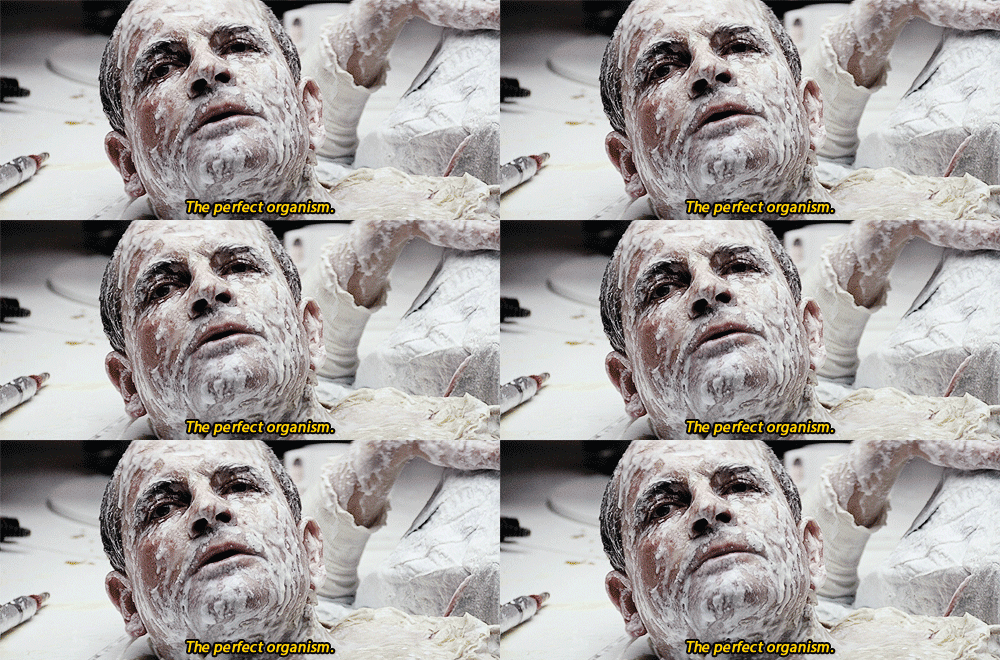
Ash: You still don’t understand what you’re dealing with, do you? The perfect organism. Its structural perfection is matched only by its hostility.
Ripley: You admire it.
Ash: I admire its purity. A survivor, unclouded by conscience, remorse, or delusions of morality.

Ash does not get any redemption; arguably, he is just as villainous as the Alien picking off the crewmates one by one. Ash goes out cheering for the alien, pure in his desires until the end.

Ash: I can’t lie to you about your chances, but… you have my sympathies.

It is possible that only the meanest of villains need help. Maybe Antagonist Assistants are just a feature of horror genres. But if you see brilliant heroes in dumb situations, look for who set the problem up. Often someone knowingly or unknowingly assists the bad guy.

A World Building Secret hidden in the opening Star Wars Title Crawl.

While researching my story structure book on Star Wars, something stuck out to me in the opening line of the title credits. It reads;

A long time ago in a galaxy far, far away…

STAR WARS
Episode IV
A NEW HOPE

It is a period of civil war. Rebel spaceships, striking from a hidden base, have won their first victory against the evil Galactic Empire. During the battle, Rebel spies managed to steal secret plans to the Empire’s ultimate weapon, the DEATH STAR, and space station with enough power to destroy an entire planet. 

Pursued by the Empire’s sinister agents, Princess Leia races home aboard her starship, custodian of the stolen plans that can save her people and restore freedom to the galaxy….

Wait a second. Let’s rewind.

It is a period of civil war.

Civil War.

But if Star Wars is a civil war, taking place inside the Empire’s borders, that should be in contrast to interstate war outside its borders. Star Wars’ central conflict is a civil war, which means other geo-political (or astro-political) entities border the galactic empire!

The evil Galactic Empire has neighbors.

And so did the Republic the Jedi protected. The Star Wars Universe is much bigger than a single galaxy. Our Milky Way Galaxy is part of the Star Wars Universe even if it is far, far away.

Even the name Star Wars is plural! This civil war is just one of many wars.

There are Extra-galactic aliens in the extended Star Wars Universe, but these are only half canon. But I think there is a gold mine of world-building opportunities in the opening few lines of Star Wars. How do the neighbors react to the death of the Emperor? What are their Jedi equivalents? The Force is much bigger than a single galaxy, after all. Was the Death Star designed to deter an intergalactic conflict? Are the other galaxies unified?

Vader tells Luke “With our combined strength, we can end this destructive conflict and bring order to the galaxy.” How surprising would it be if the Empire was more afraid of what lurked outside their Galaxy than the rebels inside? What if the Empire needs a Death Star to protect itself? What if other groups looked at the chaos in the Empire and saw an opportunity to attack?

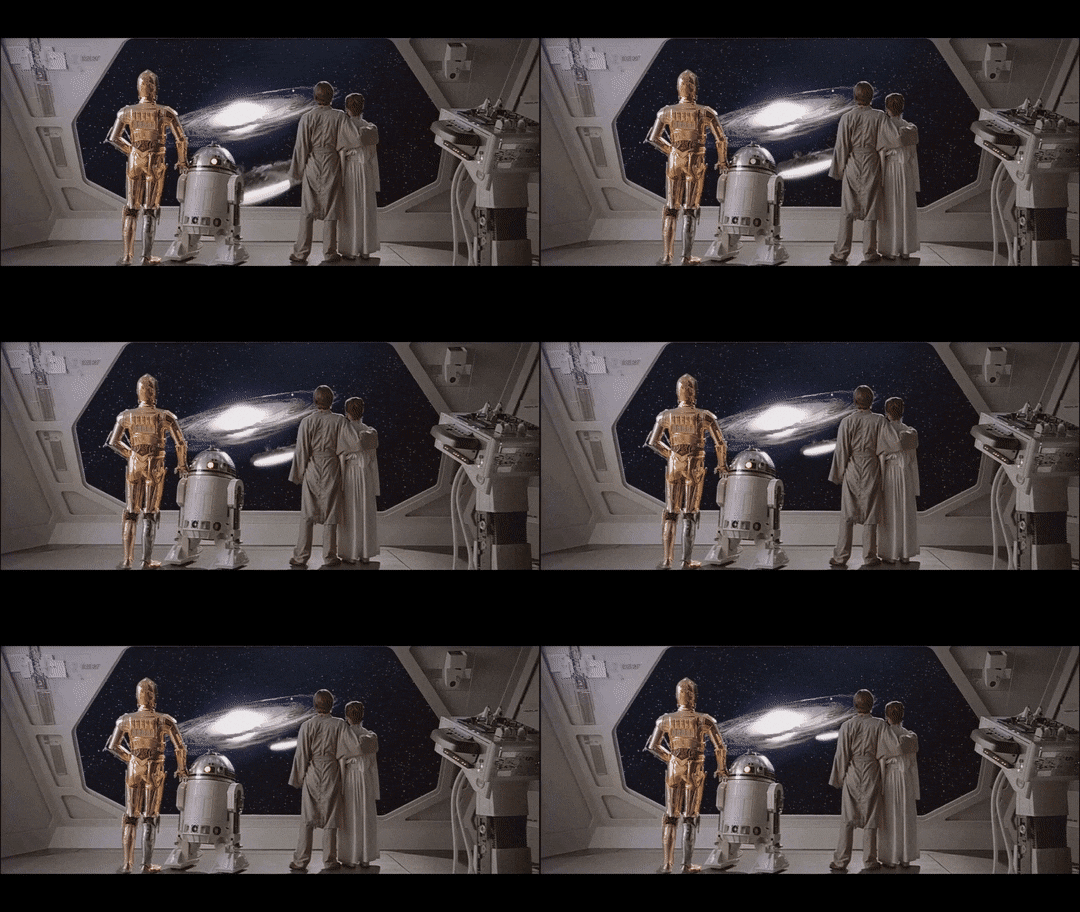
A nice view of a galaxy at the end of the Empire Strikes Back

And what other types of war could there be? Here are some options:

  • Cold War – political, economic, propaganda, and espionage instead of military action
  • Invasion – Military Offensive that aggressively enters to conquer or liberate
  • Proxy War – armed conflict instigated on behalf of other parties
  • Undeclared War – A military conflict without either side issuing a formal declaration.
  • Total War – all civilians and resources become military targets.

Star Wars occurs during a civil war between remnants of the old republic and the current empire. Inspired by Rome’s transition from republic to empire under Julius Caesar in 31 BC, Star Wars combines that political setting with iconography from the World Wars, especially ace pilot combat footage.

But with Rome as an inspiration, there could be many options to keep the Star Wars engine moving! Egyptian Pharaos, Mithradites the Poison King, Successive Emperors, good and bad, Pompey, putting down the pirates in the Mediterranian! You could even have The Republic’s Hannibal resurface like Star Trek’s Khan in Star Punic Wars.

While we will likely never see the multiple Wars in Star Wars play out, I think it is fun to imagine the possibilities.

Archetypes vs Stereotypes, what is the Difference?

In college, my storyboarding professor asked the class, “What is the difference between archetypes and stereotypes?” I thought about it for a long time. After considerable reflection, I think I have an answer.

Stereotypes are cultural and external.
Archetypes are responsibilities and internal.

The tricky part is the terms dramatically cross over. A student is both an archetype and a stereotype.

A stereotypical student could be someone who is currently in school, studying hard for tests, worried about their grades, and trying to build a foundation for the rest of their life. They have a backpack, textbooks, and homework. Maybe some extra-curricular activities pad their college application.

Stereotypes compete and divide into groups. A stereotypical student differs from a stereotypical nerd obsessed with details. Stereotypes use patterns to divide groups of people up into more stereotypes. Stereotypical students often are not trying to learn.

An archetypal student, however, is someone with a responsibility to learn. An apprentice, a disciple, or someone learning on the job when they start a new career. Continued education for senior citizens is not what we think of stereotypical students or teachers. Still, the responsibilities of teachers and students are apparent even if the teacher is a twenty-year-old urban farmer and the class is silver-haired retirees.

So if you can find a group of people in similar situations, you have a stereotype. A stereotypical archeology professor differs from a stereotypical attractive professor who happens to teach archeology, like Indiana Jones. Stereotypes deal with group dynamics.

Archetypes deal with responsibilities and are based on the individual. A classical mother archetype must nurture her children, but it is only when that responsibility is accepted and carried out that the archetype manifests. A grandfather or an older sibling might mother children by accepting the nurturing responsibility.

If you classify by the groups, tropes, and patterns someone represents, you are looking at stereotypes.
If you look at the responsibilities carried by the individual, you are looking at archetypes.

Both are important. Both progress and change throughout life as well. Students can become masters. Daughters and sons can become mothers and fathers. But if we look at patterns we expect from a group of mothers, fathers, students, or teachers, I think that is a stereotypical analysis. If we analyze their individual responsibilities, we are looking at archetypes.

If you can continually divide the group into smaller groups, I think that is a good indication you are looking at stereotypes. On the flip side, if you can describe someone by all the groups they belong to you are also looking at stereotypes.

Describing someone as an only child, orphan, gang banger, Chinese-Mexican, and high school jock might conjure up a specific image representing all these groups. You might expect what car they drive, the fashion they wear, and the places they live.

But if their responsibility is protecting their neighborhood from an attack, they are an archetypal warrior.

The Secret of Plot Twists, what are they?

The phrase ‘plot twist’ makes it sound like there was an unexpected development in the series of events in the story. Something startling took place, and now the story direction will go a different way, like running into a road-closed sign and taking a detour.

But I don’t think plot twists usually have much to do with the plot; that is, the series of events in a story. Often the plot twists make us rethink what has already happened. Unexpected things often happen in stories, but we do not call them plot twists. Take jump scares, for instance. Is it a plot twist if we go to a haunted house? I don’t think so.

So if plot twists are not just about the unexpected, do they change the events? Usually not. The past events remain the same, but the reasoning and intention behind the events changes. The plot isn’t twisted, our minds are. So if the plot remains mostly unchanged, what twists? I think I have an idea.

Plot twists are identity twists. That person or object you thought was one thing is really something else. That is the secret. But it’s a bit of a magic trick. You want to ensure the audience does not realize the illusion until it is too late.

How did you do that?!

So what identities can twist into plot twists? Let’s go through a few famous film plot twists and see where the surprise lies.

Psycho (1960)
District Attorney: Did he talk to you?
Simon: No. I got the whole story… but not from Norman. I got it from… his mother.

Bate’s mother is not the killer, even if we have ‘seen’ her kill. It was not actually her. Norman Bates, dressed as his mother, is the killer. He has multiple personalities.

Multiple personalities are a good way to think about plot twists because even if the medical condition is not part of the story, the audience has to reconcile two unique identities competing. Simon even describes this struggle in Psycho.

Simon: When the mind houses two personalities, there is always a battle. In Norman’s case, the battle is over… and the dominant personality has won.

Is this mental battle between two personalities what a plot twist really is? I think the battle of rethinking identities is what leaves the audience reeling. And there does not always have to be a winning identity.

Star Wars: Episode V – The Empire Strikes Back (1980)
Darth Vader: If you only knew the power of the dark side. Obi-Wan never told you what happened to your father.
Luke: He told me enough! He told me you killed him.
Darth Vader: No, I am your father.

The villain from the first two movies, who Luke thinks killed his father, is his father. Obi-Wan Kenobi misleads Luke.

Family is another good way to twist an identity. That person who tried to kill you? They are really your family. That person who died? Actually, they were your family, too. Family is a unique biological relationship because even if someone is terrible, you have a connection to them that death will not change. Siblings, parents, and children seem to be the strongest in the family twist area. Cousins, aunts, uncles, and grandparents don’t seem to have the same impact.

The Usual Suspects (1995)
Kujan:
WHERE IS HE? DID YOU SEE HIM?
Cop: The Cripple? He went that way.

Verbal Kint is Keyser Soze. He does not have cerebral palsy. He was playing the role of a crippled thug to hide his real identity as the dark mastermind behind everything. As Verbal says,

Verbal: A man can’t change what he is. He can convince anyone he’s someone else, but never himself. The greatest trick the devil ever pulled was convincing the world he didn’t exist.

Verbal does not have multiple personality disorder. Verbal is an act and an intentional deception. But the idea of being two people, or having two identities that must fight it out, is still here. We have to rethink everything that happened with this new information. The series of events may not change, but we now rethink everything that happened, knowing that Verbal was probably the mastermind of everything, and very little of what he said is true.

Fight Club (1997)
Jack: What did you just call me? Say my name.
Marla: Tyler Durden! Tyler Durden, you fucking freak. What’s going on? I’m coming over…

Tyler Durden is not Jack’s friend turned enemy. Jack is Tyler Durden. Jack has multiple personalities. Here we have the raw multiple personality disorder diagnosis again. But because it is done well, and we must rethink the story knowing Jack did everything, we put the whole puzzle back together again, enjoying every moment. A little montage often helps us rethink the events. Tyler joins Jack in a hotel room to flip through previous events to help Jack, and the audience, make sense of it all.

Planet of the Apes (1968)
George Taylor: You Maniacs! You blew it up! Ah, damn you! God damn you all to hell!

The planet of the Apes is not an alien planet. It is Earth, years after a nuclear war. The astronauts did not make it to a distant world in their millennia of cryo-sleep. Here, the identity that twists is the planet itself. George thinks he might escape this alien place and get back to earth. But he is mistaken because he is already on earth. This time, it is not a character with multiple identities; it is the setting.

Se7en (1995)
John Doe: It seems that envy is my sin. Become vengeance, David. Become wrath.

John Doe is Envy. David is Wrath.

Se7en follows a serial killer who targets victims using the seven deadly sins as a template. The twist is that the investigator David becomes the ultimate killer completing the seven crimes. John Doe is the killer and a victim of his plot. John Doe must die for his sin of Envy, and David and his wife are who John Doe envied.

The setup for se7evn is more complex than many other twists because you need to understand and expect the final two victims. Identity sharing fits into the crimes. Where every other crime, they find new victims for each of the seven sins at the crime scene; we already know the victims of the final two sins. We just don’t know their identity, until the end.

Saw (2004)
John: Most people are so ungrateful to be alive. But not you. Not anymore. GAME OVER.

That is not a corpse lying in the middle of the room. That is Jigsaw, the killer who orchestrated the whole situation, and he is not dead. Not a victim, but the killer and not dead, but still alive.

The Sixth Sense (1999)
Anna: Why did you leave me?
Malcolm: I didn’t leave you.

Probably the most famous twist in movie history. Malcolm isn’t just a psych helping Cole with his ghost problems. Malcolm is a ghost himself. Malcolm has been dead most of the movie and did not know it. Having two identities compete does not require multiple personality disorder. For the sixth sense, it is living and dead, which most of the movie has dealt with because Cole can see the dead.

Do any of the events change with this realization? Technically no, but as we go through Malcolm’s flashbacks, we see the previous events in a new light. We even get a montage to help us understand it all. Malcolm’s wife was not cheating on him. She was trying to move on after his death. Cole even gives us the reason Malcolm does not know he’s dead.

Cole: I see people. They don’t know they’re dead. They’re everywhere. They only see what they want to see.

Now let’s do a couple of sad ones.

The Mist (2007) – David Drayton’s car runs out of gas, and he shoots his family to spare them from a grisly death from the monsters hiding outside in the mist. What he thinks is an act of mercy changes to an act of horror, when he sees the military arrive. The situation was not hopeless.

The situation, the mist, is what David and the audience misidentify. He thought it was the end of the world, but he was wrong. If it were a hopeless situation, his act might make sense given the horrors he has seen. But because David was wrong, he will never stop screaming.

Chinatown (1974)
EVELYN: She’s my sister— she’s my daughter — my sister — My daughter, my sister—
GITTES: I said I want the truth.
EVELYN: She’s my sister and my daughter!

Here we have another family identity crisis. This time there is not an identity that wins. Both of Katherine’s identities are true. Katherine is Evelyn’s daughter and sister, and Katherine’s father is also her grandfather. Multiple personalities might be the most famous plot twist trope, but multiple identities seem to be the most important.

Let’s end on a happy note!

Charlie Kaufman makes fun of the idea of serial killers with multiple personalities in the semi-autobiographical film Adaptation (2002), where his fictional twin, Donald, pitches a script idea.

DONALD: Okay, but there’s a twist. See, we find out the killer suffers from multiple personality disorder. Okay? See, he’s really also the cop and the girl. All of them. It’s all him! Isn’t that crazy?
KAUFMAN: Look, the only idea more overused than serial killers, is multiple personality.

Nothing like having two personalities talk about how weird it would be to have three personalities.

So multiple personalities are the classic identity twist. Killer’s identities and Family relationships are high up there too. You can twist the setting and the situation.

Some of the strongest plot twists set up their rules in the story and then twist those patterns, like in The Sixth Sense and Se7en. These might qualify as twisting plots and identities because the identities are tied so closely to the story’s series of events and rules.

But twisting identity is not enough. Just because the characters mistake an identity, does not mean the audience will. Let’s look at a classic example of mistaken identity that is not a plot twist.

Star Wars (1977)
Luke: Look at him. He’s headed for that small moon.
Han: I think I can get him before he gets there… he’s almost in range.
Ben: That’s no moon, that’s a space station.

Obi-Wan Kenobi and the crew of the Millennium Falcon mistake the Death Star for a moon. But the audience does not. This is one of the film’s most famous lines. It looks like it could be a plot twist, but it didn’t catch us off guard. We already know about the Death Star and have even seen it destroy a planet.

It’s not just the trick of twisting identities but the audience’s reaction that makes a plot twist magic. The audience’s understanding of identities must change for a plot twist to land a knock-out punch.

Murder mysteries seem to be the genre most prone to twisting, but I’ll talk about that later.

Who is the Ultimate Bad Guy in Back to the Future?

What are our options for the big baddie?

  • The Libyan terrorists who shoot Doc for not making them a nuclear bomb. It’s difficult to get hold of plutonium, even in 1985.
  • George and Lorraine’s relationship. If they don’t fall in love, Marty disappears.
  • Biff, who bullies George, Lorraine, and Marty.
  • The nature of time itself.

There might be others, but this is all I can come up with for now. I thought about including Principal Strickland but he’s not really an antagonist as much as he is commentary on the McFly’s sad state through time.

All of those seem like viable options. Marty needs to warn Doc about the Libyans, which is why he wrote the letter. But Marty can’t tell Doc before he has to get to the starting line for their ballet of lightning bolt time travel. And Marty does not make it back in time to warn Doc. Instead, Doc pieces the letter together and reads it himself. Marty has already defeated the Libyan threat before he gets in the Delorean. He doesn’t know until Doc pops up from the parking lot with a bulletproof vest.

What about George and Loraine’s relationship? Marty already solved this one at the dance. Once they kiss to Earth Angel, Marty’s hand reappears. He has repaired the timeline. Their relationship is no longer a threat.

What about Biff? George already knocked him out. Biff won’t be a problem until the sequel.

The nature of time itself? Marty fixed his parent’s relationship and just has to follow Doc’s plan and get back to the future. Time will not betray him, but he must get to the wire as the lightning bolt hits. So what is preventing Marty from doing that? What is the challenge?

The ultimate boss in Back to the Future is a tree branch.

Yes, really. The whole exciting sequence of events is because a tree branch falls on Doc’s power line and he has to plug it back in, braving storm winds, heights, and crumbling old buildings.

The Delorean’s engine also gets an honorable mention as a mini-boss. It dies right as Marty finishes his time travel checklist. How do Marty and Doc defeat these bad guys? Marty hits his head into the steering wheel, and the car starts and Doc plugs the power line back in just in time.

But, when you look at it like that, it does not do justice to this ending. Back to the Future has one of the best endings in cinematic history! You know exactly how little time Doc has to plug everything back in. The old tower crumbles under his feet, and he slips from the clock face, the plug catching on his pant leg. Doc might die trying to plug this back in, and Marty has already started his run. But Doc finally gets both ends of the cable in his hands, but they won’t reach because of the tree branch! So he pulls to get more slack, and the other side unplugs!

Doc doesn’t have enough time to walk, so he wraps the line around the clock arm and turns the power line into a zipline to get down! The tree branch that caused all the problems now helps Doc make it back to the ground! Then Doc frees the cable and plugs it back in, just as the lightning strikes.

When you think of a movie finale or a cinematic set piece, you probably do not imagine someone plugging in an electrical socket or moving a tree branch. But that is exactly what Back to the Future’s finale is about.

I think part of the reason it is so exciting is we are prepared for what to expect. Doc showed us using models how the final sequence would play out. The music plays a big part, too. We worry for Doc as he scrambles high above Hill Valley’s town square. We feel Marty’s frustration when the Delorean won’t start. The actors also do a great job. You probably can hear Doc screaming in frustration in the back of your mind.

So how can this boring bad guy make for one of the most exciting endings in film history? I think part of it is the ticking clock. It isn’t just one clock. The clock tower ticking behind Doc, Marty’s alarm clock, and we see the Delorean racing down the street along with its speedometer. Doc only has the time it takes for Marty to get up to 88 miles per hour.

But I think the stand-out portion of the finale is the clear series of problems Doc has to solve. It is all communicated clearly and visually. We know when that giant plug disconnects. So here are all the problems our heroes have to solve for the finale.

  • Doc has to climb around a gargoyle while holding the plug in one hand. He slips.
  • Doc inches around the clock face but can’t quite reach the plug. Then the ledge below him breaks, and he falls, dropping the plug in his off-hand. Luckily, the plug catches on his pant leg.
  • The Delorean dies on Marty.
  • Doc grabs the plug hanging from the clock tower to pull himself up, but the one attached to his pant leg rips his pants as it almost slips away.
  • Marty’s alarm clock goes off. The Delorean still won’t start. He hits his head against the steering wheel, and the engine roars. Marty starts his run.
  • Doc climbs back onto the ledge, but the two connectors won’t reach. He pulls, and the street connection unplugs. Doc screams.
  • Doc plugs the clock tower side back in, loops the power cable to make a zip line, and slides back to the street.
  • Doc Wrestles the street plug back away from the street and plugs it in just as the lightning strikes, sending Marty back to the future!

Doc already devised a plan to get Marty back earlier in the movie. Nothing in the plan changes in the finale, except a tree branch falls on his power line, and Doc has to plug it back in. The Delorean shuts off for a moment, but it starts up in time for Marty to make his run. Marty does not have that many problems to solve. It’s mostly on Doc. But because we understand the plan so clearly, we are on the edge of our seats watching Doc struggle to plug the cable back in. He could die trying to plug in this electrical socket! And if Doc fails, Marty will be stuck in high school with his parents until Doc can steal more Uranium.

But Marty won’t die. His life isn’t at risk; just his 1985 high school career would be over. But because things are moving so quickly, and we have so many ticking clocks and problems for Doc to solve, we are all in on this time travel experiment. Marty must get back to the future! It’s like watching a launch sequence for a rocket.

And to top it all off, you have Marty and Doc’s friendship. Doc cheers for Marty when he starts his run. Marty sees Doc plugging in the socket and is worried for him. And after Marty leaves, Doc cheers in the street. Doc already knew his time machine worked when Marty showed him the Flux capacitor, which Doc designed just before Marty arrived. But seeing it all work, Doc is ecstatic, and so are we.

It’s hard to believe a wayward tree branch makes such an extraordinary ending possible, but it does. For me, Back to the Future’s ending shows that solving simple problems with some old-school stunts can be more exciting than any special effects extravaganza.

How Back to the Future and Star Wars prepares the audience to love the climax using models.

Everything speeds up at the end of a story. There is no more time for explanations or questions and answers. Events will flash by. So how can you make sure the audience knows what is going on? One solution is to walk them through it slowly, using a rough model with a basic simulation.

Then the audience knows what to expect, and a little twist, here or there, won’t spin them in circles. Instead, those little twists might be the most exciting parts of the entire story. The audience must know what to expect for an ending to surprise them when things go awry, making things more exciting. Both Back to the Future and Star Wars Episode IV: A New Hope uses simple models to prepare the audience for some of the most exciting endings in film history.

Doc Brown builds a complete model of downtown Hill Valley to show us what will happen. “Let me show you my plan for sending you home.” Doc tells Marty. “Please excuse the crudity of this model. I didn’t have time to build it to scale or paint it.”

Now we can carefully walk through everything that needs to happen for the ending. Marty winds up a toy car, and Doc prepares a lead acid battery to shock it at just the right time, playing their respective roles. Sure, the toy car bursts into flames, and the simulation goes poorly overall, but it successfully tells us precisely what to expect. Later, when we see Doc setting up the power line over the road, we see this scale model become real. We know what is going to happen. On Saturday, November 12, 1955, at 10:04 p.m., lighting will strike the clock tower providing 1.21 gigawatts of power to send Marty back to the future. He needs to be going 88 miles per hour at that exact moment.

So when the power cord disconnects and the Delorean’s engine dies, we are on the edge of our seats. This will ruin their entire plan! It is a complex situation, with multiple pieces that have to be hit at the same time. But we understand because we have already walked through a scale model of the situation. We know what Doc and Marty must do. There is no time to go back now; they are racing the clock!

So when Marty tries to tell Doc about the Libyans shooting him in 1985, there are enough pieces in play we that understand why Marty can’t stop everything to warn Doc.

Doc shouts, “Look at the time, you’ve got less than 4 minutes, please hurry!”

The stunt driving is more exciting than the cardboard and toy car model, but because of that crude model, we understand everything going on. Adding some complication to the situation now doesn’t throw us off completely.

Marty tries to figure out how to save Doc, talking to himself, saying, “Dammit, Doc, why did you have to tear up that letter? If only I had more time. Wait a minute; I got all the time I want! I got a time machine! I’ll just go back and warn him. 10 minutes oughta do it.”

Marty solved the problem for now. It’s an imperfect solution, but at least now he doesn’t have to worry about saving Doc. He can focus on getting back to the future. Then Marty runs through his checklist for time travel. We’ve seen the time travel launch process before, but walking through the steps again ensures we are all on the same page for the extra challenges Marty must face. “Time-circuits on, flux-capacitor fluxing, engine running, alright.”

But then the Delorean dies. “No, no, no, no, no,” Marty chants, trying to get the engine to turn over. This makes for one of the most exciting endings in film history, and I think one reason is we so clearly understand what Doc and Marty need to do in the end.

We are not thinking about the model town in Doc’s garage as lightning strikes, but it has already served its purpose of preparing us for the grand finale. If Marty is finally returning to the future, he must take the audience with him.

Star Wars also uses a rough model to prepare the audience for the ending. And the model is cruder than Doc Brown’s model of Hill Valley, although it is pretty cool to see early computer graphics.

General Dodonna tells the Rebel Pilots, “The approach will not be easy. You are required to maneuver straight down this trench and skim the surface to this point. The target area is only two meters wide. It’s a small thermal exhaust port, right below the main port. The shaft leads directly to the reactor system. A precise hit will start a chain reaction which should destroy the station.”

This plan is why the Rebels wanted the Death Star blueprints. Artoo carried the schematics throughout the movie and finally passed them off. After looking over the Death Star schematics, this is their best chance to take out the Imperial battle station. But the plan worries the pilots.

“That’s impossible, even for a computer.” Wedge says in disbelief.

“It’s not impossible,” Luke says. “I used to bull’s-eye womp rats in my T-sixteen back home. They’re not much bigger than two meters.” But that is all the preparation time the pilots get. It is time to sprint to the finale!

But the Star Wars model is not as complete as Back to the Futures. We can’t run through the simulation to build up our expectations with these white pixels. We know what will happen, but we have not seen it.

So the brilliant thing Star Wars does is have multiple pilots try the run to get the audience ready for the finale. Red Leader even runs through the entire process and misses. So with the added complexity of Darth Vader and his wingmen shooting down Rebel Fighters ship to ship, we know exactly what is waiting for Luke, Wedge and Biggs because we have seen it! When these three rookie Rebel pilots start their trench run, we know exactly how things can go wrong. Vader hits Wedge, and he has to Bail. Then Vader kills Biggs. Luke is alone.

The Death Star readies its planet-destroying laser beam, which we have also seen before when the Empire destroys Alderaan. We know what will happen to the Rebel Base and what can happen to Luke. It is not just our imagination. We have already seen planets and rebel fighters explode! Luke will not have time to make the shot!

So when the Millenium Falcon shoots Vader’s wingman and saves Luke from their chase, Luke has time to make the shot, and the audience goes wild.

Multiple events throughout the movie have prepared us for this ending. We’ve seen the Death Star blow up a planet and know the firing sequence and accompanying sound effects. We know Luke can use the force to guide his hands from the blaster shield training he did with Obi-Wan. And we know precisely how the trench run will go because we saw other rebel fighters attempt it. The computer graphics model is not quite enough to prepare us for the finale, but it helps set the stage.

Back to the Future and Star Wars do an incredible job of preparing the audience for the grand finale. We are dealing with complex science fiction processes that have to go just right, but the audience follows along with the characters because we know what to expect.

It might seem like a waste of time to put in a slow explanation, or a scale model, of what is about to happen at the end of a movie, but that preparation pays off multiple times over. It is a bit like a slow climb to the top of a roller coaster. The ending can speed up by building the anticipation, leaving the audience cheering.