
The Story Palette for Bladerunner differs significantly from Star Wars or Indiana Jones. Star Wars has two competing teams, one chasing the other. Indiana Jones is a cycle of finding and losing something for all parties. But Bladerunner’s primary focus is more cerebral. It took me a while to identify the repeating pattern, and I documented my thought process, which I will include in a later post.
If the concept of a Story Palette will help others, I hope I can find tools to accelerate assembling and playing with story palettes. I hope Large Language Models and other AI tools will help. Until I figure those tools out, maybe the best thing I can do is communicate my discoveries.
So, what is the pattern of repeating actions in Bladerunner? Here they are:
- Questions: Asking questions, investigating, trying to find answers.
- Playing: Pretending, playful deception (usually harmless on its own), misleading, acting, toys, origami, and games, including chess.
- Violence: threats, death, breaking fingers, killing butterflies, boiling dogs, etc.
That’s it. So, to explore how these points repeat throughout the film, let’s go through the scenes of Bladerunner. The Big Story Goals for Bladerunner are pretty simple, so I won’t highlight them in the scenes this time around as I do in my book for the Original Star Wars trilogy. Here are the Big Story Goals at a high level:
- Replicants search for a genetic engineer to help them get more life, leading them from Holden to Chew, to Sebastien, to Tyrell. They fail to extend their lives.
- Deckard hunts the replicants on his list.
- Rachel is added to Deckard’s list. Rachel saves his life, and Deckard decides to save her in return. Then Roy saves Deckard before dying. The original replicants on Deckard’s list are retired, but Deckard continues to protect Rachel.
Now that the Big Story Goals are out of the way let’s get into how Questions, Play, and Violence repeat throughout the story, creating the feel of Bladerunner. Buckle up. This is a bit of a trip. The bolded text relates back to the Story Palette of repeating actions.
Holden questions Leon. Leon pretends to be human, trying to pass the Voight-Kampff test. Leon shoots Holden.
“They’re just questions, Leon. In answer to your query, they’re written down for me. It’s a test, designed to provoke an emotional response… Shall we continue?”
Gaff arrests Deckard and asks him to speak with Police Chief Bryant. Deckard pretends he can’t understand Gaff.
“He say, you under arrest, Mr. Deckard.”
Bryant asks Deckard to help with the Nexus-Six replicants. He pretends to be friendly, but Deckard has no choice. When he tries to leave, Bryant threatens him. Gaff folds an origami chicken.
“You wouldn’t have come if I’d just asked you to. Sit down, pal.”
“Stop right where you are. You know the score, pal. If you’re not cop, you’re little people.“
Bryant describes how the replicants slaughtered their way to Earth. Deckard asks questions about the replicant’s motivations. Gaff folds an origami unicorn.
“Well, I don’t get it. What do they risk coming back to earth for? That’s unusual. Why— what do they want out of the Tyrell Cooperation?”
At Tyrell’s office, Rachel introduces herself and asks Deckard about his job. Deckard questions Rachel with the Voight-Kampff test. Tyrell misleads Deckard, pretending Rachel is human. They discuss retiring replicants, killing a human by mistake, killing butterflies, cheating in a relationship, and boiled dog. They even discuss watching a stage play.
“I’m impressed. How many questions does it usually take to spot them?”
Deckard searches Leon’s apartment, finding Leon’s photos and fish scales. Gaff escorts Deckard and folds an origami statue of a man with an erection. Leon walks outside the apartment, watching Deckard and Gaff, but does not enter.
Roy asks Leon about his photos and the police. They break into Chew’s lab. Leon tears off Chew’s coat, freezing him. Roy questions Chew about morphology, longevity, and incept dates. Chew doesn’t know, so Roy asks who does. Leon plays with the cryogenic tanks and puts eyeballs on Chew’s shoulders like toys.
“Chew, if only you could see what I’ve seen with your eyes. Questions.”
“I don’t know answers.”
“Who does?”
Rachel hides in Deckard’s elevator, and he almost shoots her. She brings photos to prove she is human, but he questions her memories, calling out her memory of playing doctor with her brother.
“Remember that? You ever tell anybody that? Your mother, Tyrell, anybody huh?“

Pris pretends to meet J.F. Sebastian by accident, and Sebastian promises not to hurt her. Pris asks him about himself and his genetic creations, pretending not to know anything about genetic design, while Sebastion introduces his engineered toy friends.
“I make friends. They’re toys. My friends are toys. I make them. It’s a hobby. I’m a genetic designer. Do you know what that is?”
“No.“

Toys that greet you!
Deckard asks a fishmonger about the scale he found in Leon’s apartment. She tells him it’s a snake scale, leading him to Abdul ben Hassan. Deckard asks Abdul who bought the snake, but Abdul tries to evade. Deckard grabs him by his tie and gets the name Taffy Lewis.
“My work? Not too many could afford such quality.”
Deckard asks Taffy Lewis questions, and Taffy pretends he’s never seen the girl in the photo. Deckard threatens him, asking, “Your licenses in order, pal?” He calls Rachel and invites her to drink, but she refuses, acting like she hasn’t already run away from Tyrell Corp (we’ll find this out later).
Deckard pretends to be an agent from “The American Federation of Variety Artists” to ask Zhora some questions.
“Ha! Are you for real?”
Zhora lures Deckard in, chops him in the throat, and almost strangles him to death with his tie. Deckard chases her and shoots her in the back, retiring her.

Violence in slow motion
Gaff hits Deckard with his cane to get his attention, and Deckard says he’s going home. Bryant tells Deckard there are four more to go and informs Deckard that Rachel has been added to his hit list.
Note: This scene doesn’t fit the Palette as well as others, but it is necessary exposition for the rest of the film. Star Wars had this, too, with Obi-Wan introducing the lightsaber to Luke and again when they introduced the Death Star trench run to the pilots. Brief exposition scenes build up the following Big Story Goals that guide the characters.
Deckard sees Rachel on the street and tries to find her but is intercepted by Leon, who is much stronger than him. Leon asks, “How old am I?” Deckard lies and pretends he doesn’t know. Leon asks how long he will live. Leon slaps Deckard’s gun out of his hand and throws him around like a doll. Rachel shoots and kills Leon with Deckard’s gun.

Wake up! Time to die.
Deckard takes Rachel back to his apartment, where she asks him how she can survive. Deckard won’t chase her, but another Bladerunner will. She plays piano, and they get romantic, but then Deckard gets violent, throwing her against the window blinds.
Pris puts on makeup and does a cartwheel before she asks J.F. Sebastian many questions about how she looks, his health, and why he’s still on earth. Roy enters and informs Pris they are the only two left.
“Then we’re stupid, and we’ll die.”
Roy plays with Sebastian’s chess pieces. Pris plays with a dismembered doll. Sebastian asks, “What generation are you?” Pris does a backward cartwheel and puts her hand into boiling water to grab an egg, which she throws at Sebastian, who can’t hold it.
Roy asks about Sebastien’s opponent in chess, trying to get access to Tyrell. Roy squeezes Sebastien, who initially refuses but, under pressure, agrees to help them.

“Will you help us?”
Sebastien and Roy go to Tyrell’s apartment and play chess to get in. Roy asks for more life and about the possible ways to extend his longevity. Roy kills Tyrell and Sebastien.

“Would you like to be modified?”
Deckard hears a bulletin about Sebastien’s death, and a police car buzzes by, asking what he is doing and threatening to arrest him. Deckard confirms his police ID and calls Sebastien’s apartment. Pris answers, asking who’s calling. Deckard pretends to be a friend of Sebastien’s, and Pris hangs up.
“That’s no way to treat a friend.”
Deckard investigates the apartment. Pris pretends to be one of Sebastien’s toys. When Deckard gets close, she attacks him. He shoots and kills her.
Roy returns and dodges Deckard’s bullets twice. He asks Deckard, “Aren’t you the good man?” and “Proud of yourself, little man?” Roy breaks Deckard’s fingers and instigates a game of cat and mouse.
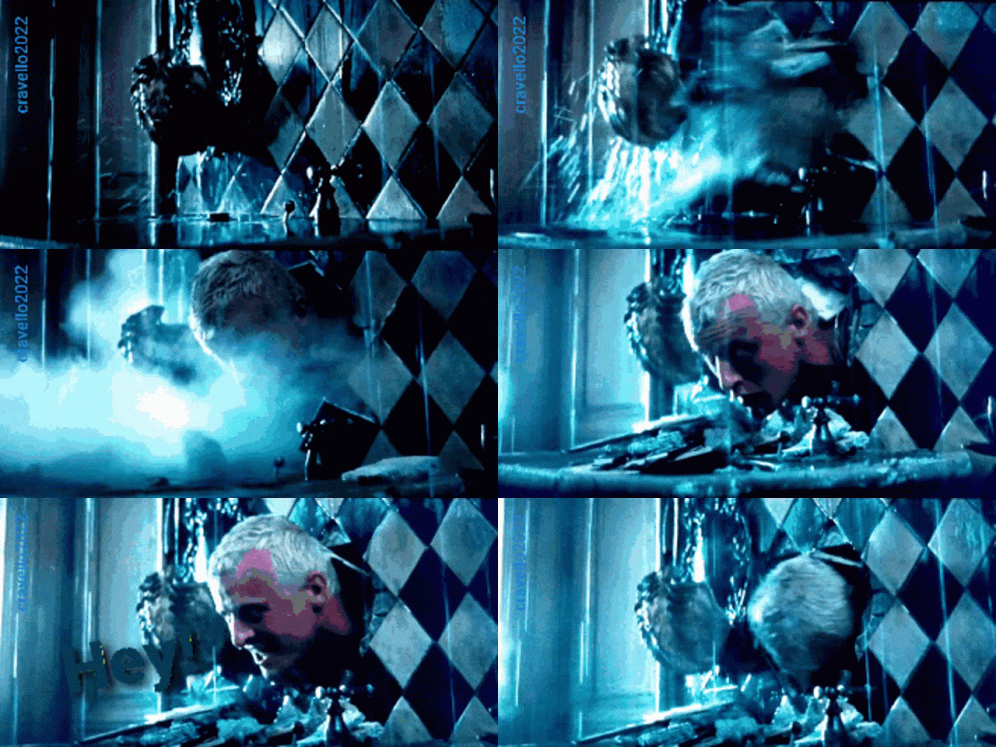
“You better get it up, or I’m gonna have to kill ya! Unless you’re alive, you can’t play, and if you don’t play…”
Deckard hits Roy with a pipe, and Roy drives a nail through his own hand as his longevity runs out. As Deckard’s grip slips from the roof, Roy asks his last question, “Quite an experience to live in fear, isn’t it?”
Then Roy saves Deckard’s life before his own life runs out.
Gaff returns Deckard’s gun to him, saying, “It’s too bad she won’t live. But then again, who does?”

Deckard returns to his apartment, asking, “Rachel? Rachel? Rachel?” looking for her. He finds her in bed, and it seems like she might be dead, but she is only sleeping. He asks, “Do you love me? Do you trust me?” as they leave, he finds a paper unicorn on the floor.

So, that is the repeating pattern that drives Bladerunner’s mood. Lots of questions, playing pretend, toys, and games, punctuated by threats, violence, and death. I was surprised by how playful the dark story is, but it profoundly contrasts the deep questions about life and the violence surrounding the characters.
Does this cover everything in the story? Definitely not. There’s a lot of world-building and themes that are not included in the Story Palette. For instance, the movie mentions and shows many animals: owls, snakes, doves, pigeons, rats, ostriches, dogs, butterflies, unicorns, and tortoises. Rescue appears like an exclamation point in Bladerunner when Rachel and Roy save Deckard, but it is not a repeating action throughout the film. And maybe in some examples, I am stretching trying to prove my point.
But Bladerunner would not be Bladerunner if you removed the questions, the playful pretend, or the violence. The plot points could be almost identical, but the story could focus on rescues, escapes, and fights like Star Wars. The whole mood would change. I believe these repeating actions are the heartbeat of the story’s mood and feel. The creativity comes in combining the elements from the palette into the scenes, almost like mixing paint. How many ways can characters play and pretend? What questions could they ask? And how can you thread violence and threats into most scenes in new and exciting ways?
So, if you want a story to feel more like Bladerunner, have the characters ask lots of questions and search for answers, play pretend and play some games, and then delve into threats and violence to punctuate each scene. Then, throw in lots of animal and animal references and beautiful visuals for good measure.

 Daniel N. Blair