I have recently been obsessed with miniature models in Hollywood movies, mostly watching behind the scene footage from the piercefilm production youtube channel.
The behind-the-scenes footage surprised me because I did not understand how many miniatures Hollywood used. In my mind, those miniatures were real places, full-scale, and awe-inspiring. The visual effect magic worked on me, and I believed. I remember looking around Los Angeles the first time I visited the city, wondering, “Where are all those movie locations?”
I have since realized that while those locations exist in the minds and hearts of audiences worldwide, they are not physical locations.
Miniatures can feel so big!
But after watching hours of miniature special effects footage, a switch flipped in my mind. Suddenly, I could see things I looked at in real life as miniatures. Cars could fit in my hand, houses were cardboard cutouts, and trees were twigs. I imagined behind-the-scenes teams of model builders constructing the world around me. It was a strange experience.
But while the world looked like models, I noticed something else; I could interact with those models with much more freedom than I could with how I imagined the real world, despite both views being in my imagination.
I want you to try a mental experiment. Imagine the home you know best. Maybe it is where you currently live or a childhood abode. You probably know it well enough that you could navigate it in the dark. You can feel your way through that memory.
Now, mentally, go outside your home and walk around it. Can you also fly around it mentally? For me, flying takes a little bit more effort, almost like I have to energize my imagination.
Now, pick up your home and spin it around. Can you feel the resistance? I have to justify this action much more than flying around. Maybe I mentally bring in a crane or an earth mover. Perhaps I have to disable gravity. I can do it, but I have to find an excuse. What’s strange is that I can do this with buildings in my neighborhood that I do not know well. They are just like paper cutouts. But a structure I know resists flippant manipulation in my imagination. All my memories of the place tie that image to realistic behavior.
Now, rewind the home back to the starting position.
Rewind that mental image
This time, create a home model that fits your hand, like a diorama. It should look just like the real thing. It can even have a miniature interior with all the interior decorations, furniture, and paint colors.
Now spin your home model in your mind. Make it the size of a monopoly house. Turn it upside down. Make copies of it and set them in a row. Make it bigger. Change the color. Add a turret to the model. Give it tank treads.
Do you feel less resistance to these mental actions? I notice it is significantly easier to manipulate a model in my imagination than to imagine the actual location. The effect is dramatic for me. It’s not hard to put tank treads on my model, but deciding what kind of treads is more challenging. I decided to go with the NASA crawler-transporter style ones.
It feels like there is a defense mechanism in my imagination. If I imagine a real place I know, there is resistance to doing impossible things. But if I change it to a model that looks just like the actual place, I suddenly feel much less resistance. I can easily imagine things with a model requiring much more effort for ‘real’ objects. I think there is weight to our memories and physics to our imagination, and making models mentally might be a fun tool to use and explore.
Benedict Cumberbatch and Jonny Lee Miller switch roles in Danny Boyle’s 2011 production of Frankenstein
Fantasy casting is a hobby of mine. I do it for books I’m reading and I enjoy imagining how a movie would be different if other actors played their roles. There are some classic casting questions and inspirations I wonder about. How would Jackie Chan have been working with Buster Keaton? What about Clark Gable as James Bond? How would Mad Max: Fury Road change with Mel Gibson as Max? How would the film version of My Fair Lady have been different with Julie Andrews as Eliza instead of Audrey Hepburn?
It’s rare that I can compare actually compare and contrast actors in the same role in the same production. While it is not unheard of to have actors swap roles, you would have to visit London or New York to catch two showings or more to see both roles in the theater. In Mary Stuart, a 2018 production in London, a coin toss decided the roles for the evening, so you might have to see many more productions to see both actresses play the parts of Mary Stuart and Queen Elizabeth.
But Danny Boyle’s production of Frankenstein, Starring Benedict Cumberbatch and Jonny Lee Miller is one where the leads switch playing the role of Dr. Frankenstein and his monster, Adam. And fortunately for us, National Theater Live recorded both versions of the show. It’s hard to track down (I saw both versions in a local theater broadcast) but I think it is worth the watch if you get the chance.
I’d like to talk about what is different between how Jonny Lee Miller and Benedict Cumberbatch played the role of the monster. First off, if you check the YouTube comments on any videos, you notice that Benedict Cumberbatch’s fans are much more aggressive, even fanatical, in their support. I guess they have not yet seen Jonny Lee Miller as ZeroCool in 1995’s excellent film Hackers. But setting aside the Benedict-Mania, I am going to point out what I noticed different between the two actors in their approach to their leading roles.
The play starts with the birth of the monster in a womb.
Jonny Lee Miller’s monster exits the embryonic womb in convulsive and jarring movements, like he is being electrocuted. He crawls on his ankles and wrists. His monster exits the womb repulsive and scary. You want to jump back from the screen. It felt like he was sick, an abomination not sure how to move, what its limbs purposes were, or how to live.
Benedict Cumberbatch’s monster exits the womb gently, rolling the back of his hand against the membrane of the womb. When he falls out, he stumbles around like a toddler. He stumbles and tries to walk like a newborn babe. His leg shakes as he stands. You can see the spark of life in him.
It would seem that Benedict is the clear winner and audience favorite. But let’s discuss how the play continues towards its final sequences. In the final monologues, Benedict’s monster is still slurring his words as if learning to speak. He struggles to walk, and is still a growing child, enamored with a world that hates him. He shrieks in joy at the wonderful things he has seen, but his monstrous appearance locks him away from society.
Jonny Lee Miller’s Monster, however, has gained perfect posture by the end. His elocution is exact. His steps are quick and confident. He speaks like an educated equal to Frankstein, maybe even his superior. Miller’s monster is no child. He is a rival and a nemesis to Frankenstein. And when Dr. Frankenstein runs to the arctic to escape his monster, Miller’s character seems disappointed with his own creator for being so weak.
Cumberbatch’s monster is always likable and childlike, but Miller develops a more haunting and powerful nightmare with a more pronounced character arc. His monster changes much more from a haunting abomination to a powerful nemesis. It is fascinating that the characters can have different visibly different arcs through their body language and dictation while sharing the same script, role, stage, and director.
“I am the one who runs from both the living and the dead. Hunted by scavengers. Haunted by those I could not protect.” – Max Rockatansky
Max tries to escape the half-life War Boys
Visions of his murdered daughter haunt Max Rockatansky throughout Fury Road. Max is worried he’s gone insane, just like everyone else in the wasteland. In the opening sequence, he hears his daughter’s voice saying, “Hello? Where are you? Where are you, Max?” The hauntings have started again, and his daughter pleads, “Help us, Max.”
And then his wife’s ghost whispers, “you promised to help us.”
Max consoles himself, saying, “I tell myself they cannot touch me. They are long dead.” And he drives away only to be hunted down by a War Boy raiding posse. They hit Max’s car with an explosive javelin, rolling his vehicle in a spectacular crash. As Max crawls out of his wrecked Pursuit Special, he sees a vision of his daughter being run over by Immortan Joe’s war party. So in Max’s vision, Immortan Joe in his Gigahorse killed his daughter.
Max is captured, bound, shaved, and tattooed, but before he can be branded, he overpowers the War Boys and tries to escape the Citadel. Max climbs through a water cistern towards a greenhouse, but when he peeks through the grating, his daughter looks down at him, asking, “Max, is that you?” A War Boy jumps onto Max’s legs and drags him to the bottom of the cistern, where his daughter is waiting for him again under the water.
“Where were you? Help us. Where were you? Where were you, Max?” she asks.
Max again overpowers the War Boys, choking one out with the chains around his wrists, and throwing the War Boy into the others, scattering them like fallen bowling pins. Max makes his escape through the Citadel’s winding tunnels. But his daughter finds him in the hall.
“Stop running, Max!” she commands, her face distorting into a hollow skull as she walks towards him. This is the scariest she ever looks. Max runs away from her, and more ghosts appear, all accusing, “You let us die!”
“You promised to help us!” His daughter yells before the ghosts go silent, and Max opens a door onto a vista showing Immortan Joe’s kingdom. Max leaps into the void and catches his chains on a hanging hook, but the War Boys drag him back, and we see the movie’s title screen.
Max’s daughter scares him more than the War Boys trying to brand him. But Max’s visions of his daughter are not accusatory. The other ghosts are the ones blaming him for their deaths. Max’s daughter is different. She has been waiting for him. Now he has arrived, she wants him to stay and help. But help who? She has already passed on. Who does Max’s dead daughter want him to help, and who do these ghosts want him to protect? Before we get to that, let’s recap what Max has seen in these opening few moments of the film.
Max saw a vision of the future. After all, it is not Max’s child that Immortan Joe killed in the past, as far as we know. It is Joe’s child in the womb of the Splendid Angharad who dies under Joe’s wheels in the future. Joe even crashes Rictus’ monster truck, swerving to avoid Angharad. But Max saw Immortan Joe’s army chasing his daughter, so the women of the Citadel he will later meet are who his daughter wants him to protect. But all of them? Or is there anyone in particular who Max must protect at all costs?
Immortan Joe driving the monster truck
I think the answer to this question appears later in the film. There is a brief sequence where Max sees a vision of someone else’s child.
After killing the Bullet Farmer and his crew, then washing their blood off in mother’s milk, Max and the team drive through the night and see the crows in the wasteland. Later, Max sleeps while Furiosa drives the War Rig. A brief nightmarish vision wakes Max. He sees a child in the womb, women’s hands (both young and old) reaching out onto his face, and then Toe Cutter’s popped-out eyes from the original Mad Max film.
The mystery child in the wombHands young and old (The Dag’s tattoos are visible on the right)Toecutter’s eyes popped out from the original Mad Max
I don’t know what to make of the popped-out eyes, except it is one of the most memorable throwbacks to the original film of Toecutter’s death. Maybe this is a sign that Immortan Joe, played by the same actor as Toecutter, must die, but I can’t be sure. Maybe it is just a haunting image George Miller has the right to use anywhere he wants. George used it when Toecutter sees a truck coming right toward him. What is approaching Max? Let’s address the other two things Max sees.
Max has not met the older women yet. That will happen in the next scene. But we can see that all the women depend on him from their hands holding him for his help. So Max is seeing the future here.
But who is this child in the womb? It is not Angharad’s child. Angharad already died, and the Organic Mechanic could not save her baby boy with an emergency c-section. Rictus’ brother died, the baby boy who was ‘perfect in every way’. So if it is not Angharad’s child, whose is it? The answer is the other pregnant wife, The Dag.
I think Max sees a vision of Immortan Joe’s child with The Dag. And Max’s deceased daughter is helping protect this developing baby. She has guided Max across the wasteland so he will protect The Dag.
Immortan Joe’s wives: [Left to right] Cheedo the Fragile, The Dag, The Splendid Angharad, Toast the Knowing, and Capable
Max’s role becomes clear in his next vision of his daughter. Max hears her again when the women ride off into the desert without him. He wants nothing more to do with these women or their attempt to ride across the salt flats. He has helped them enough, and there is no hope to find in the wastelands. Max tells Furiosa, “I’ll make my own way. You know, hope is a mistake. If you can’t fix what’s broken, you’ll go insane.”
As he watches the women disappear into the distance on their motorcycles, taking Nux with them, his daughter again whispers, “Where are you, Max? Where are you? Help us. You promised to help us.”
Then, Max’s ghost daughter appears before him and throws her hand toward his face. Max also sees a vision of a man with a melted bike helmet mask attacking him. This vision of the future and throwing his hand up will save Max’s life in their final run back to the Citadel. Max’s daughter has given him a way to survive the upcoming ordeal by blocking an arrow aimed at his skull. Then she walks away and vanishes, only to reappear on the trail Furiosa’s crew left behind. She beckons him, saying, “Come on Pa! Let’s go!”
Max’s daughter is not chasing him. Max’s daughter is guiding him. And Max goes with her. He couldn’t save his daughter, but now she is asking Max to save Furiosa’s crew by guiding them to the Citadel, and Max will die trying.
The Dag survives the ordeal and even inherits the Keeper’s heirloom seeds to replant and regrow civilization, including knowledge of how to fertilize and care for the crops. The Dag is an interesting character. She is very perceptive and alerts Max and Furiosa of oncoming cars twice, but maybe she is something more than perceptive. Maybe her unborn child has something to do with the film’s events.
So who will The Dag’s child be? It will be the child of Immortan Joe, the inheritor of the Citadel. We do not know if the child will be a boy or girl, but the child will have had three brothers; Corpus Colossus, Rictus, and Angharad’s child. All of them are deceased except Corpus Colossus, who, while very smart, is physically stunted in a toddler-sized body and cannot inherit Immortan Joe’s kingdom.
Will The Dag’s child be a savior of the wasteland? Is that what Max’s deceased daughter wants him to protect? We may never know. But maybe Immortan Joe got a worthy inheritor, after all. An inheritor so important that ghosts of the dead protect them before their birth.
As the Bullet Farmer said in disbelief, watching Immortan Joe scramble the monster truck over a collapsed mountainside to pursue his runaway wives, “All this for a family squabble. Healthy babies. [scoffs in disgust]”
And maybe Immortan Joe was not far off when he said, “I salute my half-life War Boys who will ride with me eternal on the highways of Valhalla. I am your redeemer!” But he may have been a generation too early because it is his child, who is yet to be born, who already rides with the dead.
The ghosts of the past rallied to save this child in the future, and Max Rockatansky is the guardian angel sent to protect it. Or maybe this unborn child is so powerful from the genetic mutations that it can see the future and convince people to protect it before it is born.
Whatever the reason, ghosts guide Max with visions of the future to protect a child he will never meet, creating hope for the future at the Citadel Max may never know.
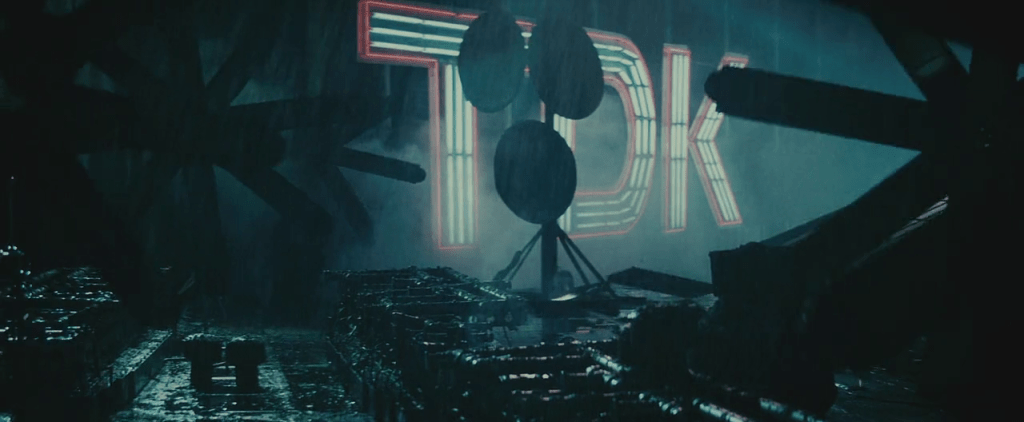
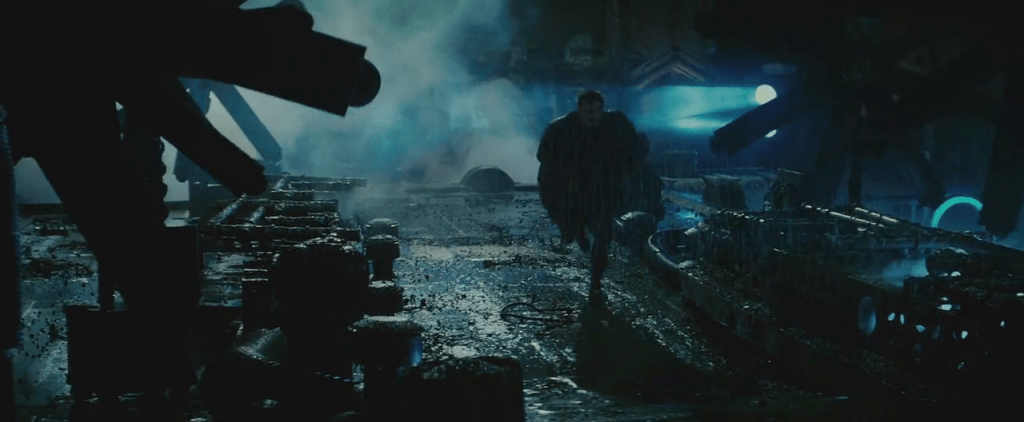
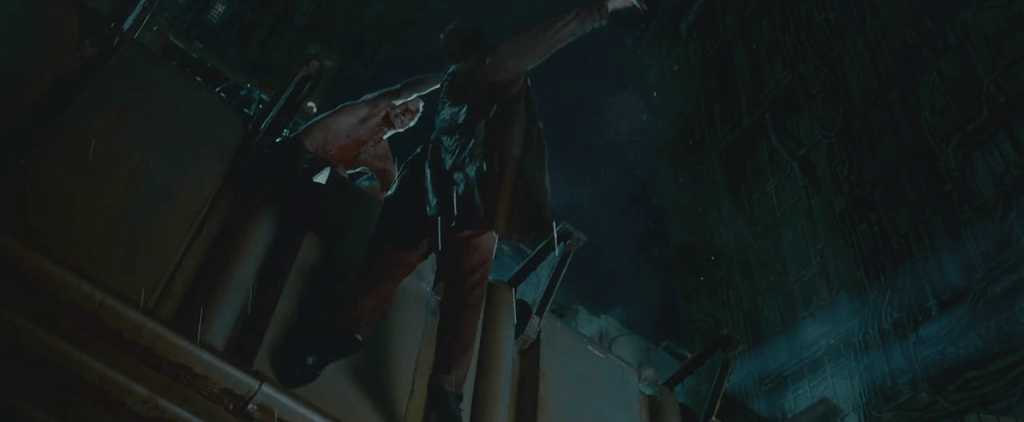
The final rooftop sequence of Blade Runner is one of my favorites. I want to focus on one aspect; the camera angles. Check to see if there is ground, or sky in the frame, and if so, how much? If you see a lot of ground, you are looking down. If you see a ceiling or a vast sky, you are looking up.
The build up to one of the greatest moments in cinematic history
Let’s start with Deckard climbing onto the rooftop. He just slammed Roy in the head with a plumbing pipe and jumped out the bathroom window. Deckard dropped his gun while climbing up shelves from a previous floor. It bothered me when I was younger that Deckard didn’t go back and get his gun, but Roy dodged Deckard’s bullets twice, once at point blank range. His gun won’t help him against Roy, Deckard just needs to escape.
Roy is playing with Deckard, but Roy does not immediately follow because he is expiring. Deckard intended to retire Roy, but where he failed, time is quickly succeeding. Roy’s hand clenches uncontrollably as his engineered body dies. Roy desperately bites at his hand, trying to coax life back into it.
The first shot we see of Roy in the film is his hand clenching, as Roy asks himself, “Time? Enough.” We only know a Roy whose body is shutting down. He has been dying the entire film. What must Roy have been like before his expiration date? Even Tyrell praised his accomplishments. Roy must have been legendary. But his time is almost up. Roy grabs an old nail from the floor joists and impales it through his hand to eke out a few more minutes of life in agonizing pain.
Now onto the camera angles. We get a close-up of Deckard’s broken fingers reaching over the edge as he slowly and carefully climbs to the roof to escape from Roy. We are at eye level with Deckard looking straight on as he climbs. Here, eye level is almost on the floor.
We get a shot of Deckard swinging his leg onto the roof. The shot is from above angled down but does not emphasize that he is dangling off the top of a building. That will come soon.
Deckard rolls onto the roof and sprawls out, inspecting his fingers. The camera lays with him looking straight on. The camera is on the rooftop floor with him.
We see a shot of Roy cutting back and forth through the apartment rooms below. The camera is looking almost straight on but is about at knee height. Roy starts far away as he cuts towards us, but this low angle makes him tower above us as he resumes hunting Deckard.
Deckard stands up. The camera is at thigh height, looking straight on as he gathers himself and looks for a way off the roof.
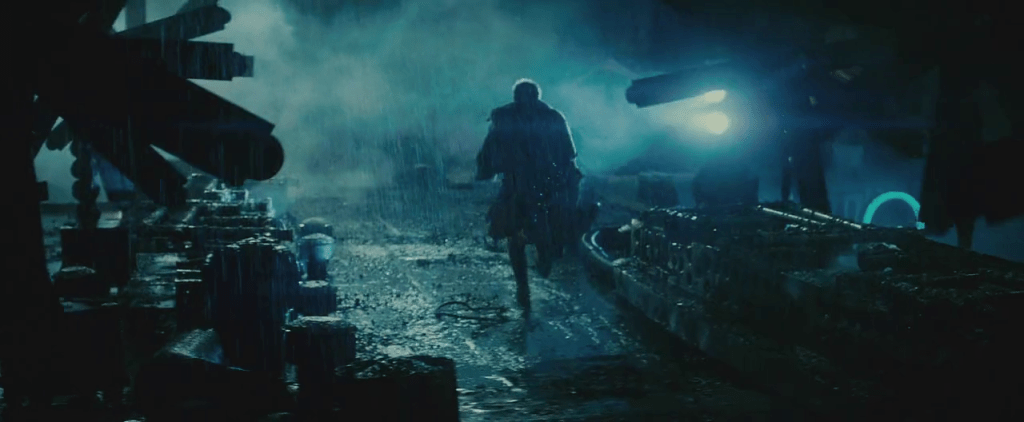
Deckard stumbles across the roof between pipes, spinning fan blades and spotlights. He is looking for an exit. It looks like this shot is on a fairly long lens to give more depth to all the spinning fans, layers of smoke, and wandering searchlights. We are at shoulder height, looking straight at Deckard.
We see Deckard’s POV of an exit hatch shot on a wider lens, but same waist high angle and straight view. An escape!
Deckard runs towards the camera and the hatch to get away from Roy. Because the lens on Deckard is long, the spinning blades blur as the focus pulls. The long lens also compresses space, giving the illusion that Deckard runs slower as he approaches the camera.
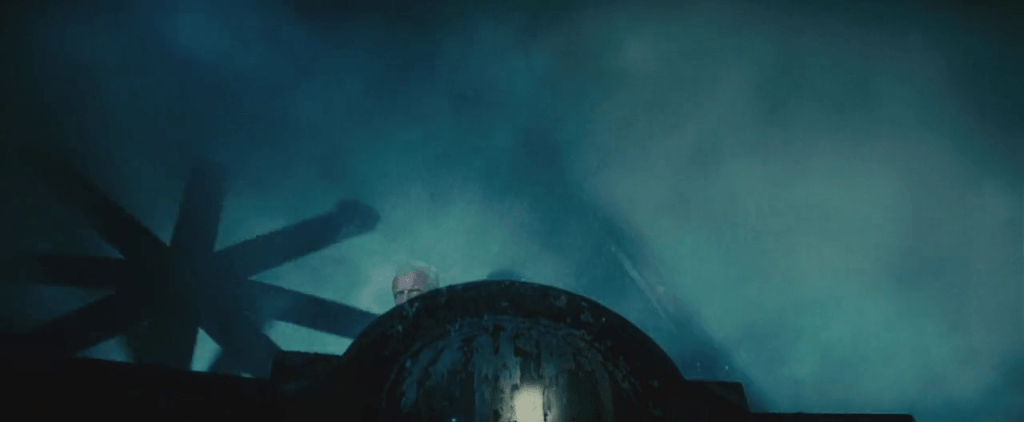
But then the exit hatch rips open. Someone is coming out of it.
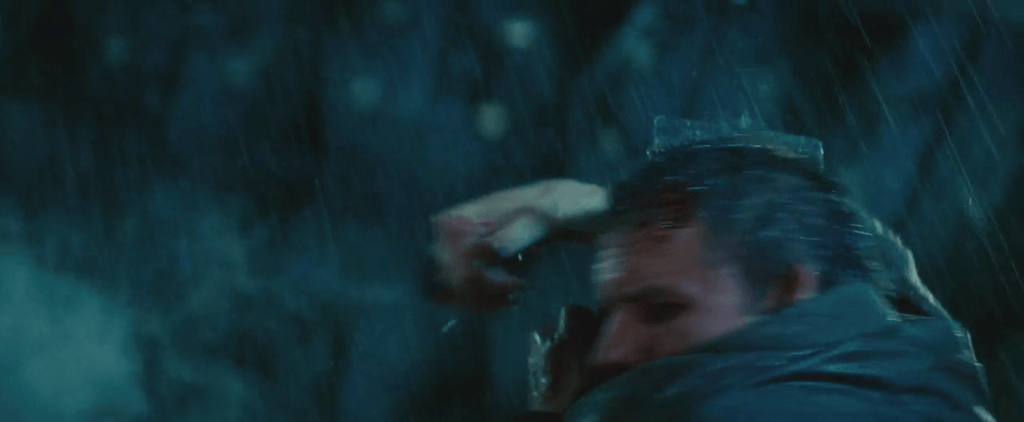
Deckard slides to a stop coming towards the camera. Hunched over, and staring in disbelief, Deckard is slightly below the camera. The background has now completely blurred, and we see the horror on his face as he realizes his safe exit is now a death trap.
We cut to see Roy standing hunched forward, looking at Deckard. Roy hunches over, and the camera is below him, looking slightly up. Even hunched over, Roy is above us. We do not see Roy jump out of the roof hatch. In the time it took for Deckard to slide to a stop, Roy has already closed some distance from the hatch to Deckard. I think the temptation in a computer graphics production would show Roy’s superhuman powers here. But this quick film edit is amazing, leaving Roy’s speed to our imagination.
Deckard turns to run. We angle down on Deckard as we can see the top of his shoulders and the floor behind him. In the previous shots, Roy’s and Deckard’s eyes were close to the same location in the frame, but Roy is above us, and Deckard is below.
Deckard turns and runs towards the camera. We see both Roy and Deckard together in the frame. With the camera angles and how they positioned Roy, Deckard’s head comes up to the center of Roy’s chest.
Deckard runs back the way he came. The camera looks tilted down at him. When Deckard ran towards us before, it appeared he was running downhill. The horizon line is high in the frame. But now that he is running back, it looks like he has to run uphill.
Roy gracefully leaps onto the pipes Deckard was running in between. Roy is even higher than us now.
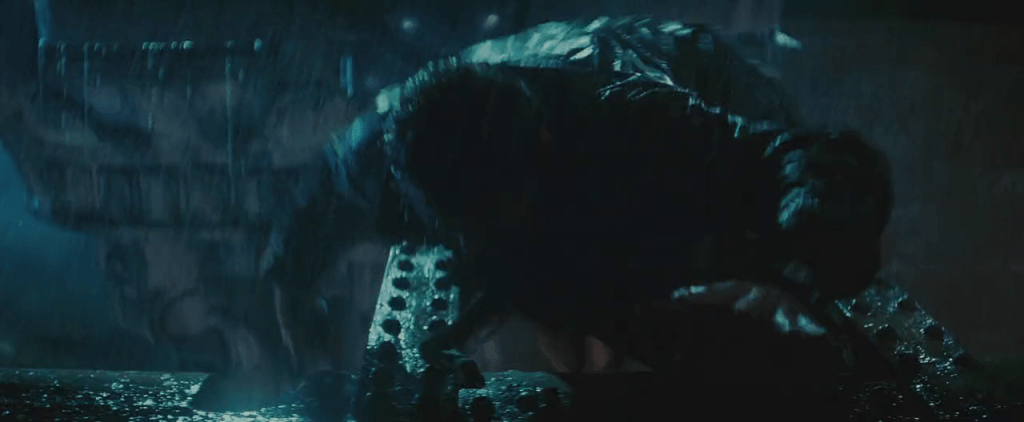
Deckard leaps off the roof, over the city street, toward the neighboring building. We are looking down at this stunt. Deckard’s shoulders barely reach the camera’s height, even at his highest point. Then he slams into the metal studs.
We cross over to see Deckard crash towards us onto the metal. When he climbed up onto the roof before we were level with his eyes. But now we look down on him as he slips off the building, trying desperately not to fall. But the camera does not drop to his level this time. Instead, we dolly in closer as the camera moves over the edge of the building, tilting down more and more on Deckard. He is below the floor level, and we look down at him like we stare at our shoes.
Same shot as we dolly in and tilt down
We cut to Roy, stepping towards the edge of the building to see what happened to Deckard. Roy is no longer running. He is carefully stepping forward to investigate. His game is over. Roy’s play-thing is now moments away from death, just like Roy himself. We are below the rooftop level, looking up at Roy. It’s like he’s on another floor above us.
We cut back to Deckard, struggling to hold on in the same shot we had before.
Now we cut even closer to Roy. We are on his left side, and Roy fills the frame. We are still looking up at him, but it is not as dramatic as before. The lens is long, bringing us close to Roy, who takes deep breaths as he watches Deckard lose his grip.
Roy steps away from the ledge, back where he came, leaving Deckard behind. Deckard struggles and looks away from his hands as if he doesn’t want to watch his death arrive.
Now we get a shot with Roy crossing his arms, a nail sticking through one hand, a dove in the other, his back to Deckard. Roy covers Deckard in the frame. The camera is now above Roy, angled down. Roy has been above us for most of this sequence. Even when he opened the hatch, it was only a couple frames before he loomed over Deckard.
What will Roy do? I am reminded of the first question in the Voight-Kampff test Holden asks, “You reach down, you flip the tortoise over on its back Leon…The tortoise lies on its back, its belly baking in the hot sun, beating its legs, trying to turn itself over,but it can’t, not without your help, but you’re not helping.”
Roy’s game put Deckard into this situation. Does Deckard deserve to fall for killing Zhora and Pris when Roy has already broken Deckard’s fingers for that? What will Roy do?
Roy unfolds his arms and turns around, revealing Deckard in the frame behind him. Roy then attempts the jump that Deckard failed. The camera tracks along with Roy as he leaps over the edge. The camera has not tracked along with a character at any other point in this sequence. We are with Roy as he makes the jump, making it feel like we, too, are leaping over the edge.
We then get a shot looking up at Roy as he clears the gap. The camera is so far below Roy that we see the soles of his shoes as he soars above us. We might be a couple of stories below him.
We see Roy soar over Deckard from behind and below. It’s an over-the-shoulder telephoto shot. The camera looks up at Deckard from below, while Deckard is far below Roy, who disappears into the smoke. Roy clears the gap with so much extra space he disappears into the rain and fog. Even at the brink of death, he is physically superior to Deckard.
Now, we see the highest-angle shot possible. The camera is directly above Deckard, looking down at the street. The camera tilts slightly, giving the image an unbalanced look.
We cut back to an over-the-shoulder below Deckard as Roy emerges from the smoke above us and kneels down. Both of them are high above us, but Roy is so high above the camera that even kneeling only brings him closer to us.
We get a new angle on Deckard as his grip fails. We look down on Deckard and the camera tilts so the metal beam is pointing up in the frame, above 45 degrees. Deckard slips farther down. This gives the illusion that the building tilts up and away from Deckard, almost trying to shake him off. Roy leans into the frame over Deckard in this exact shot, and you can see his shoulder on the left of the frame.
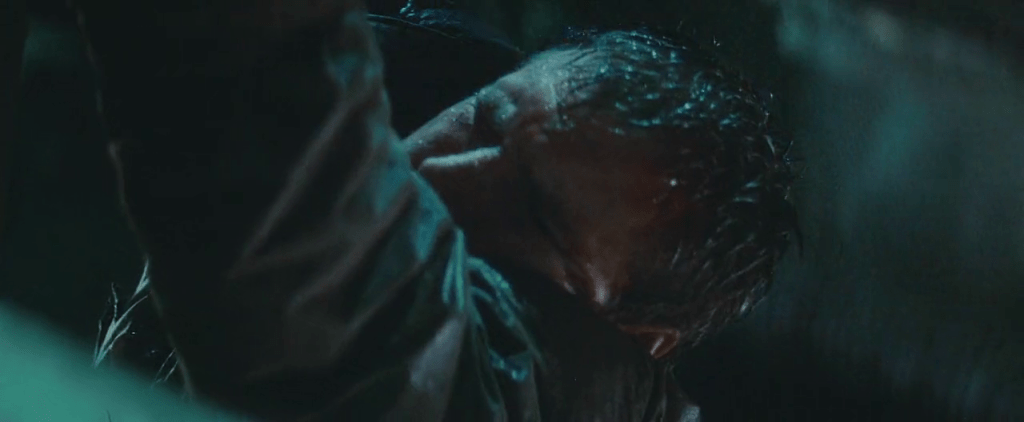
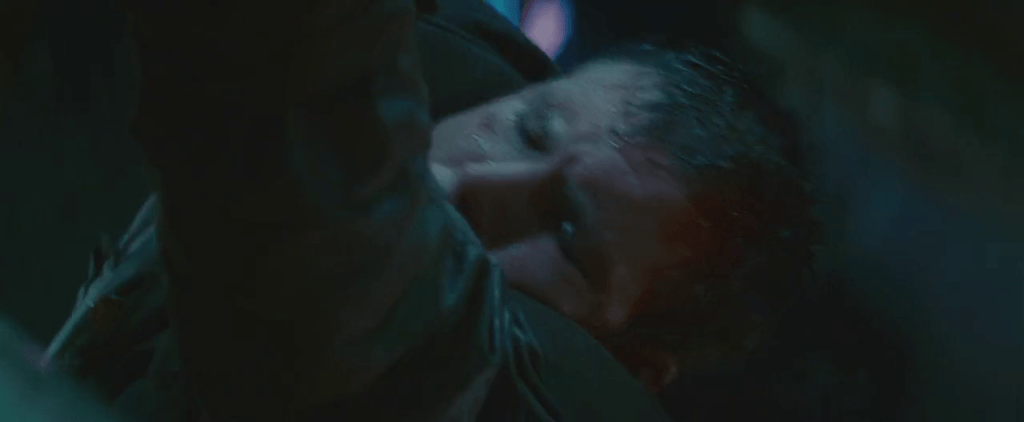
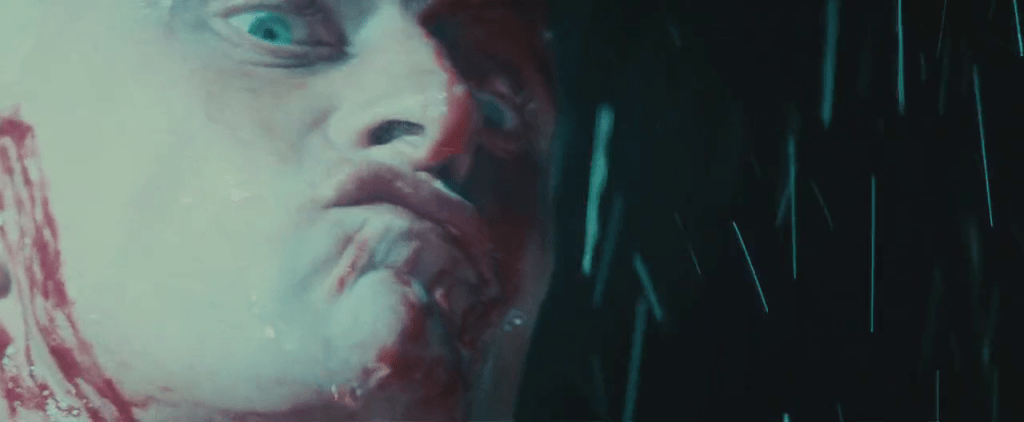
Then we cut to Roy’s eyes, almost glowing in the darkness as he looks down on us and Deckard. Roy is looking towards us, but if you look at the raindrops, you can see that Roy is standing high above the camera. The telephoto shot is so tight to Roy that his face fills the entire frame. Roy grimaces as he watches Deckard struggle as if going back and forth between entertainment, fascination, and horror.
Looking down at Deckard, we get a tighter shot of his face. His hands are no longer in the frame as he struggles to keep his grip. The long camera lens puts us close to both characters, with Roy high above and Deckard far below us.
The images cut back and forth between these shots as Roy tells Deckard, “Quite an experience to live in fear, isn’t it? That’s what it is to be a slave.” Roy is still above us but looking directly at us through the camera.
We see a shot looking down at Deckard’s fingers as he slips farther off the building. They angle the metal beam even higher in the frame. We were at his level when Deckard climbed onto the roof, but now he hangs far below us.
We cut back and forth to previous camera shots: a close-up looking down at Deckard’s hands as one hand slips, directly over Deckard as his grip fails, looking up at Roy, who smiles at Deckard. Deckard loses his grip completely and spits at Roy as he falls from the roof.
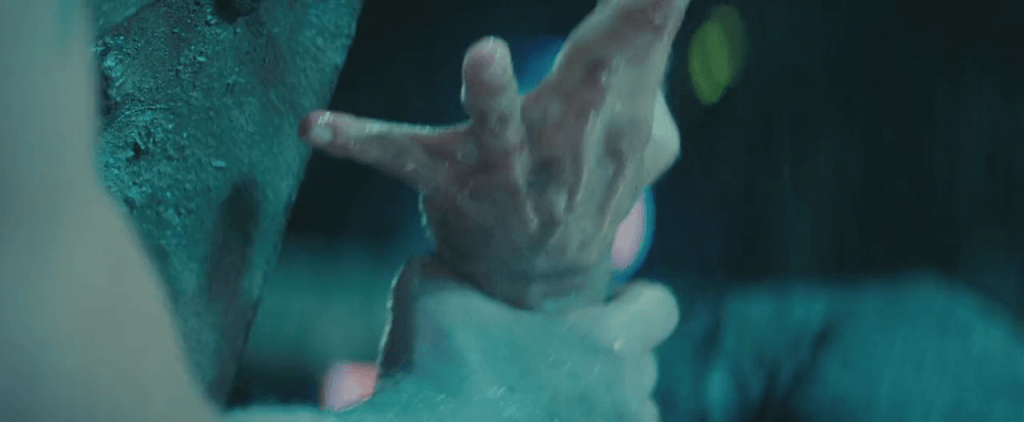
“Kinship!” shouts Roy as he catches Deckard’s wrist, saving Deckard from the fall. The camera looks down from Roy’s shoulder level. Roy dropped to catch Deckard. For his shoulder to be that low in the frame, Roy had to dive over the edge to catch Deckard. But we do not see Roy in that inferior position. Roy remains above us.
We get a low shot, looking up at Roy’s face as he struggles momentarily. This is the same hand that moments before had closed up as Roy’s body shut down.
We look down from above Deckard’s face as he grits his teeth like Roy is ripping his arm out of his socket. Roy is much stronger than Deckard, and even saving him hurts.
Roy purses his lips in determination as he lifts Deckard, the nail through Roy’s hand visible as he stands up, bringing Deckard onto the roof. Deckard holds onto his elbow, bracing himself, as Roy hoists him.
We get a shot from far below Roy and Deckard. Roy’s arm fully extends as he lifts Deckard up, showing just how strong Roy is. Deckard kicks his legs wide, trying to find some foothold to stand on.
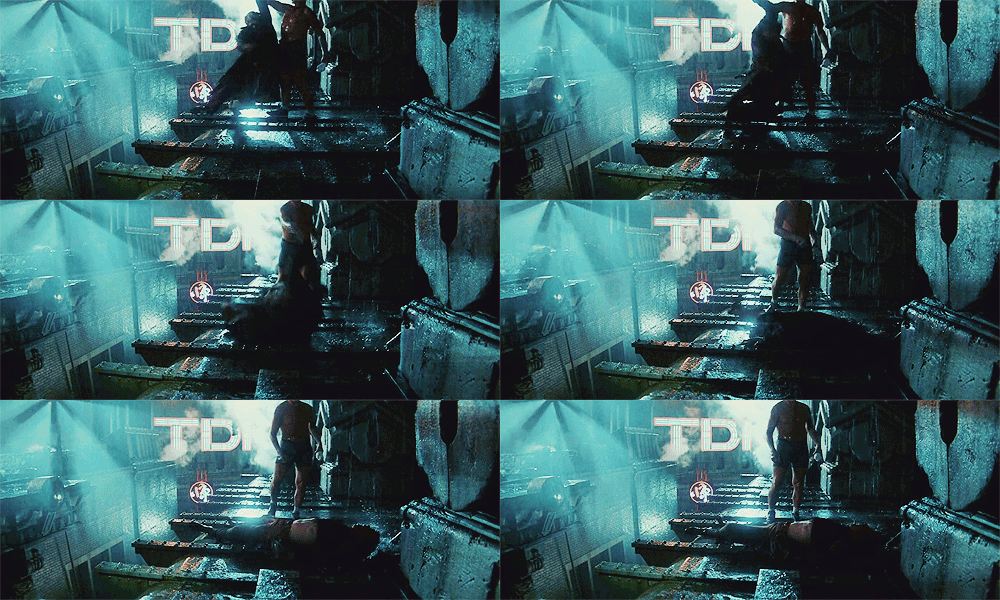
Roy flops Deckard down, his belly exposed to the rain. Deckard once again lays out completely, but now Roy stands directly above him. The extreme camera tilting is over. We will look a little up and down. But the character’s position in the frame tells the story here. Deckard lies at Roy’s feet. And Roy is standing so high in the frame that the edge of the frame cuts his head off. Deckard crawls away from Roy, coming towards the camera.
We get a reverse shot of Deckard crawling away from us. We are on Roy’s side now. The camera is at mid-thigh height, looking down on Deckard. Roy looms high above us, and most of his body clips out of frame. Deckard is completely visible in the frame, as if its edges trap him, but Roy is so big in frame he does not fit. We only see Roy’s knees, running shorts, and his hand with a nail through it as he steps towards Deckard, who crawls back into a pillar. Deckard has no way out now and squirms below Roy. And then Roy slowly sits down.
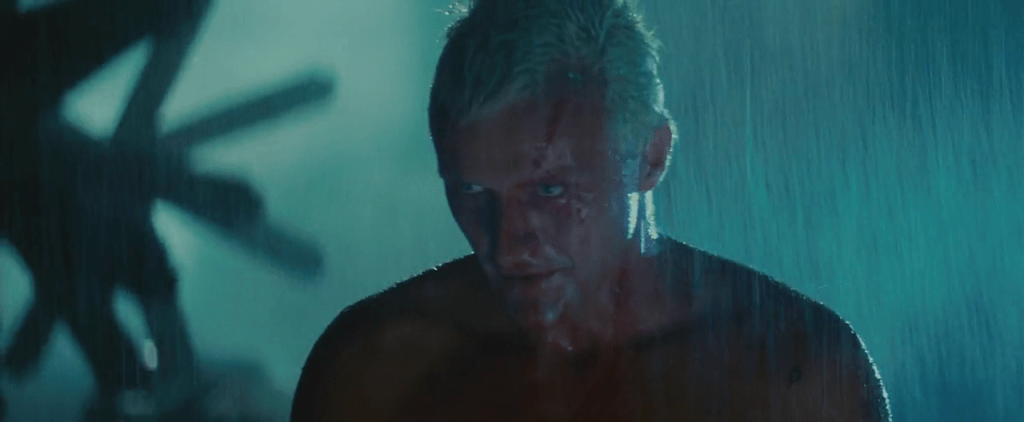
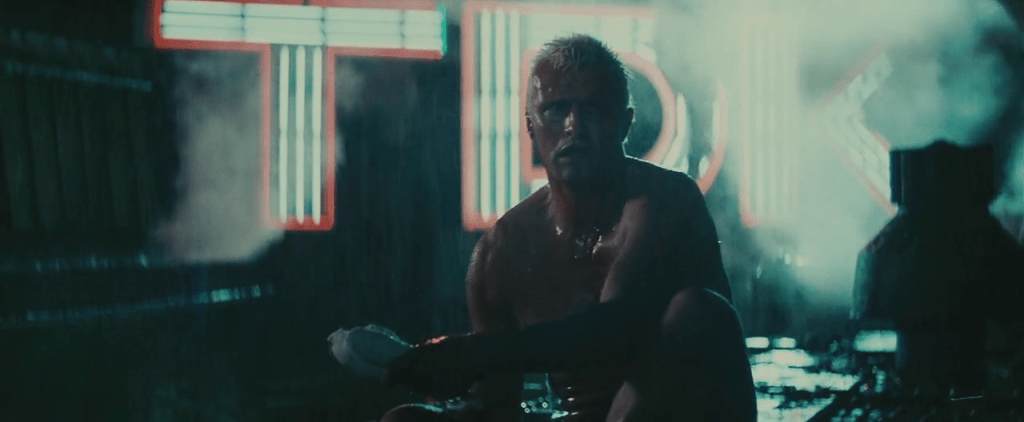
We get a reverse shot of Roy slowly sitting down. Moments before, Roy filled the entire frame; now, he sits just above eye level with the camera and gives the “tears in rain” monologue.
“I’ve seen things you people wouldn’t believe… Attack ships on fire off the shoulder of Orion… I watched C-beams glitter in the dark near the Tannhäuser Gate. All those moments will be lost in time, like tears in rain… Time to die.”
Roy remains above us, and Deckard stays below. But this might be as close as Roy can get to Deckard’s level because he might be more human than human.
I don’t know if it is possible to angle the camera higher up or lower down than this sequence shows. Deckard falls so far below us that we look straight down at the street below him. Roy jumps so high above us that we see the soles of his shoes.
There is tremendous power in the angle of a camera. If it took physical effort to climb to all the places the camera positions itself in this scene, we would have to climb up and down multiple stories in less than a minute. Emotionally, I think that happens here as well.
With all the fantastic special effects available, it is incredible how powerful the camera can be when pointing up and down.
As Roy dies, he releases the dove in his hand, and it flies up and away from us. We then get a shot of the clouds in the sky above 2019 Los Angeles.
“Death awaits you all- with nasty, big, pointy teeth! ~ Tim the Enchanter Monty Python and the Holy Grail
We want our monsters to be scary. But what makes a monster scary? Is it their size? How loud they can roar? Their number of teeth? How good of a jump scare they give us?
I think the answer lies in how a monster enters a scene. For this, let’s look at 1979’s Alien.
How does the Alien make its appearances in the movie?
An Alien egg opens onto Kane, and the face-hugger jumps out of the egg onto his face
They cut away Kane’s helmet revealing the face hugger wrapped around his face.
The face-hugger disappears from Kane’s face in the lab, and the crew looks for it. The dead face-hugger drops from the ceiling onto Ripley’s shoulder.
The Chestburster explodes through Kane’s sternum during dinner
The Alien drops from the top of the frame behind Brett
Dallas turns his flashlight onto the alien in the air ducts, and it grabs him
The Alien’s shadow sneaks behind Lambert, highlighted in a shadow. She turns around, and it stands up into the frame. Parker tries to fend the creature off, but it kills him, and then its tail slowly creeps between Lambert’s legs
The Alien turns the corner in the Nostromo, blocking Ripley from her escape pod
The Alien reaches out from the wall in the escape pod.
Ripley climbs into a space suit and turns on all the toxic gasses she can kill it. The creature writhes on the floor. But when she turns her head, it is no longer below her on the floor; it is right behind her rearing to strike.
So how does the Alien enter the scene? It doesn’t have to because the Alien is already there. We just can’t see it. Yet. We are going into its territory.
And the characters certainly do not know it is there. More often than not, the characters are entering the monster’s lair. A loud roar from a distance might be scary, but a whisper from right behind you chills to the bone.
Seeing something emerge from just below the surface or from the side of the frame is as surprising as it gets. Jump scares can emulate this temporarily, but without that ongoing physical proximity, the monster’s presence dissipates. Our physical sensation of being right next to something so dangerous adds a tense anxiety to our fear and horror.
More important than how scary a monster looks might be the question, “how did it get so close with no one noticing?”





















 Daniel N. Blair