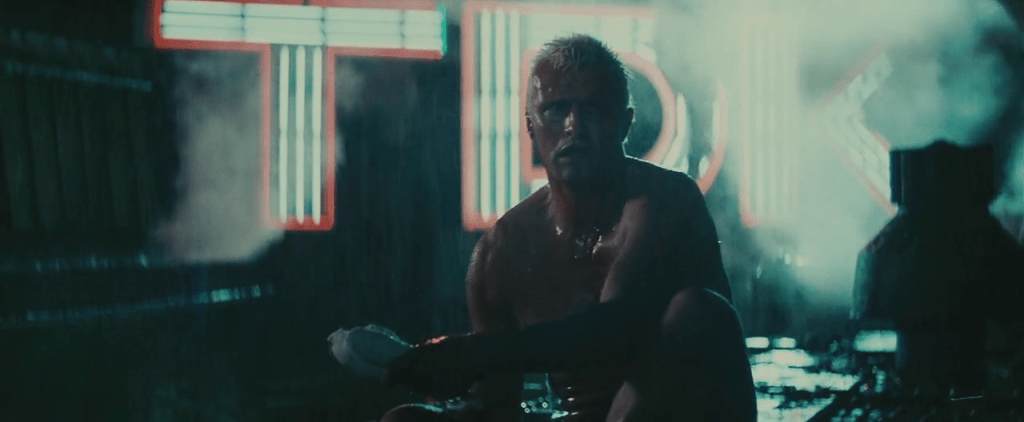
How Back to the Future and Star Wars prepares the audience to love the climax using models.

Everything speeds up at the end of a story. There is no more time for explanations or questions and answers. Events will flash by. So how can you make sure the audience knows what is going on? One solution is to walk them through it slowly, using a rough model with a basic simulation.

Then the audience knows what to expect, and a little twist, here or there, won’t spin them in circles. Instead, those little twists might be the most exciting parts of the entire story. The audience must know what to expect for an ending to surprise them when things go awry, making things more exciting. Both Back to the Future and Star Wars Episode IV: A New Hope uses simple models to prepare the audience for some of the most exciting endings in film history.

Doc Brown builds a complete model of downtown Hill Valley to show us what will happen. “Let me show you my plan for sending you home.” Doc tells Marty. “Please excuse the crudity of this model. I didn’t have time to build it to scale or paint it.”

Now we can carefully walk through everything that needs to happen for the ending. Marty winds up a toy car, and Doc prepares a lead acid battery to shock it at just the right time, playing their respective roles. Sure, the toy car bursts into flames, and the simulation goes poorly overall, but it successfully tells us precisely what to expect. Later, when we see Doc setting up the power line over the road, we see this scale model become real. We know what is going to happen. On Saturday, November 12, 1955, at 10:04 p.m., lighting will strike the clock tower providing 1.21 gigawatts of power to send Marty back to the future. He needs to be going 88 miles per hour at that exact moment.

So when the power cord disconnects and the Delorean’s engine dies, we are on the edge of our seats. This will ruin their entire plan! It is a complex situation, with multiple pieces that have to be hit at the same time. But we understand because we have already walked through a scale model of the situation. We know what Doc and Marty must do. There is no time to go back now; they are racing the clock!

So when Marty tries to tell Doc about the Libyans shooting him in 1985, there are enough pieces in play we that understand why Marty can’t stop everything to warn Doc.

Doc shouts, “Look at the time, you’ve got less than 4 minutes, please hurry!”

The stunt driving is more exciting than the cardboard and toy car model, but because of that crude model, we understand everything going on. Adding some complication to the situation now doesn’t throw us off completely.

Marty tries to figure out how to save Doc, talking to himself, saying, “Dammit, Doc, why did you have to tear up that letter? If only I had more time. Wait a minute; I got all the time I want! I got a time machine! I’ll just go back and warn him. 10 minutes oughta do it.”

Marty solved the problem for now. It’s an imperfect solution, but at least now he doesn’t have to worry about saving Doc. He can focus on getting back to the future. Then Marty runs through his checklist for time travel. We’ve seen the time travel launch process before, but walking through the steps again ensures we are all on the same page for the extra challenges Marty must face. “Time-circuits on, flux-capacitor fluxing, engine running, alright.”

But then the Delorean dies. “No, no, no, no, no,” Marty chants, trying to get the engine to turn over. This makes for one of the most exciting endings in film history, and I think one reason is we so clearly understand what Doc and Marty need to do in the end.

We are not thinking about the model town in Doc’s garage as lightning strikes, but it has already served its purpose of preparing us for the grand finale. If Marty is finally returning to the future, he must take the audience with him.

Star Wars also uses a rough model to prepare the audience for the ending. And the model is cruder than Doc Brown’s model of Hill Valley, although it is pretty cool to see early computer graphics.

General Dodonna tells the Rebel Pilots, “The approach will not be easy. You are required to maneuver straight down this trench and skim the surface to this point. The target area is only two meters wide. It’s a small thermal exhaust port, right below the main port. The shaft leads directly to the reactor system. A precise hit will start a chain reaction which should destroy the station.”

This plan is why the Rebels wanted the Death Star blueprints. Artoo carried the schematics throughout the movie and finally passed them off. After looking over the Death Star schematics, this is their best chance to take out the Imperial battle station. But the plan worries the pilots.

“That’s impossible, even for a computer.” Wedge says in disbelief.

“It’s not impossible,” Luke says. “I used to bull’s-eye womp rats in my T-sixteen back home. They’re not much bigger than two meters.” But that is all the preparation time the pilots get. It is time to sprint to the finale!

But the Star Wars model is not as complete as Back to the Futures. We can’t run through the simulation to build up our expectations with these white pixels. We know what will happen, but we have not seen it.

So the brilliant thing Star Wars does is have multiple pilots try the run to get the audience ready for the finale. Red Leader even runs through the entire process and misses. So with the added complexity of Darth Vader and his wingmen shooting down Rebel Fighters ship to ship, we know exactly what is waiting for Luke, Wedge and Biggs because we have seen it! When these three rookie Rebel pilots start their trench run, we know exactly how things can go wrong. Vader hits Wedge, and he has to Bail. Then Vader kills Biggs. Luke is alone.

The Death Star readies its planet-destroying laser beam, which we have also seen before when the Empire destroys Alderaan. We know what will happen to the Rebel Base and what can happen to Luke. It is not just our imagination. We have already seen planets and rebel fighters explode! Luke will not have time to make the shot!

So when the Millenium Falcon shoots Vader’s wingman and saves Luke from their chase, Luke has time to make the shot, and the audience goes wild.

Multiple events throughout the movie have prepared us for this ending. We’ve seen the Death Star blow up a planet and know the firing sequence and accompanying sound effects. We know Luke can use the force to guide his hands from the blaster shield training he did with Obi-Wan. And we know precisely how the trench run will go because we saw other rebel fighters attempt it. The computer graphics model is not quite enough to prepare us for the finale, but it helps set the stage.

Back to the Future and Star Wars do an incredible job of preparing the audience for the grand finale. We are dealing with complex science fiction processes that have to go just right, but the audience follows along with the characters because we know what to expect.

It might seem like a waste of time to put in a slow explanation, or a scale model, of what is about to happen at the end of a movie, but that preparation pays off multiple times over. It is a bit like a slow climb to the top of a roller coaster. The ending can speed up by building the anticipation, leaving the audience cheering.

The unbelievable power of lists in unraveling Rashomon- a Japanese short story at the gate of the dead.

Akira Kurosawa’s film Rashomon is based on Ryunosuke Akutagawa’s short story In a Grove, but it gets its title and the temple location from another of his short stories, also named Rashomon.

It is a brief story of a man who finds an old woman plucking hair from the dead and steals her clothes.

But that summary does not do it justice! It doesn’t explain the time, a real era from Japan, when calamities visit Kyoto with earthquakes, whirlwinds, fires, and the disease that comes with them. It does not explore the character’s struggles or justifications for their actions. The summary does not explore the scenery, which was so powerful; it became the icon for Akira Kurosawa’s breakout hit film.

You can read the 2,191 word short story here: https://www.shortstoryproject.com/stories/rashomon/

I took a Japanese literature in translation class in college, and usually we had a tremendous reading load. It was our teacher’s first class as a professor, which was lucky for me because she pushed us so hard. In every class, we would discuss complete novels or movies. Often more than one. But one class period, because of a scheduling conflict, we only had the short story of Rashomon to discuss. We broke into three-person groups and examined the text, looking for something to fill our class discussion time with. My group ran out of ideas quickly and decided to re-read the text together to fill the time. Then we read it again.

“Did anyone notice anything?” the reader asked, trying to find kindling for our discussion. “They referenced lots of animals. That cricket, in the beginning, gets a lot of attention,” someone said. “Really? I hadn’t noticed that many animals.” So we went back through the story again and made a list.

Animals mentioned:

  • Cricket sitting on a column
  • Foxes and other wild animals made their dens in the ruins of the gate
  • Flocks of crows flew in from somewhere
  • thrown away like a stray dog
  • huddling cat-like
  • cobwebs (spiders)
  • quiet as a lizard
  • as a monkey kills the lice of her young
  • shanks of a chicken
  • red eyes of a bird of prey
  • like the cawing of a crow
  • selling snake flesh at the guard barracks saying it was dried fish

It shocked us there were so many animal references. It’s like a zoo in there! How did he reference so many animals in such a short story? “I noticed a lot of colors. Let’s do those next!” So we made a list of colors.

Colors:

  • crimson lacquer
  • gold and silver leaf
  • white crow droppings
  • red sunset
  • blue kimono
  • fat black cloud
  • red festering pimple
  • dull yellow fire light
  • gray-hair
  • long black hair
  • silver white sword blade
  • yellow clothes
  • darkness and the abyss

There were as many colors as animals! We debated adding grass to the list but decided it was not technically a color, even if we all knew it was green. Are there any colors Akutagowa did not put in the story? “What should we list next?“How about the words that happen most often?” We popped the text into an online word counter.

Word counts:

  • Hair – 15 times
  • Gate – 12 times
  • Rain – 11 times
  • Stairs – 11 times
  • Old – 9 times
  • Floor – 7 times
  • Woman – 7 times

He mentions hair 15 times!? Is that what this story is really about? Should we next list weather, objects, calamities, sounds, smells, times, or physical sensations? We had a list of lists we could make! But to our surprise, we had reached our time, and our discussion was over.

I left in disbelief. How had we discovered so much to analyze in the shortest text we had read? Especially when we started with nothing to talk about! I could see the colors in my mind and visualize animals and animal-like behaviors. The imagery was so vivid in that brief piece!

What else might hide under the surface of a narrative? Was this a one-time thing? I wasn’t sure, but I thought making lists might be a powerful tool to find out. And I still do.

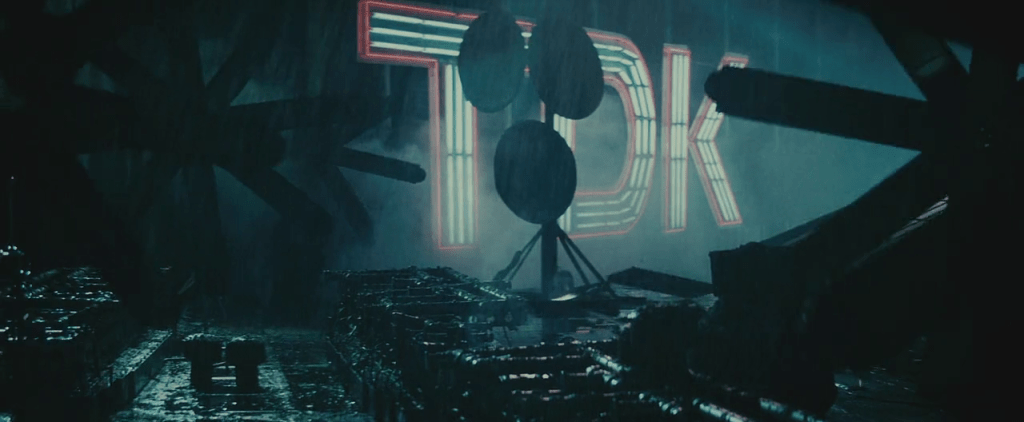
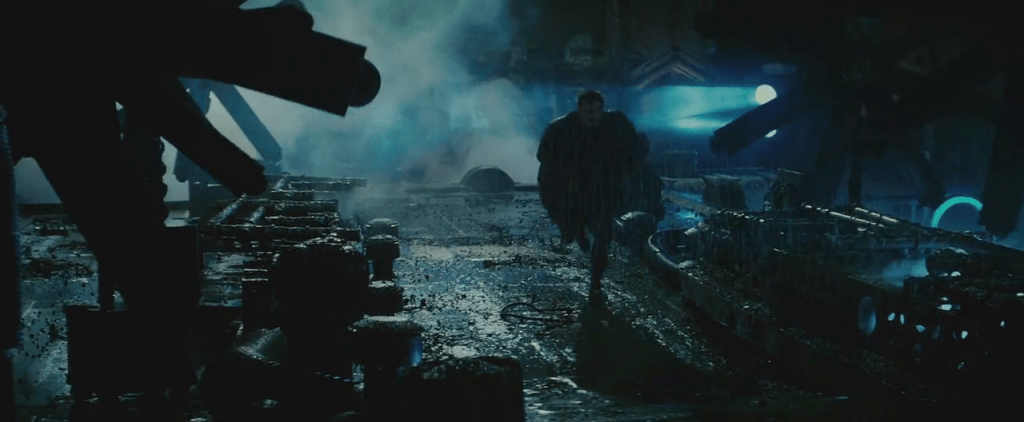
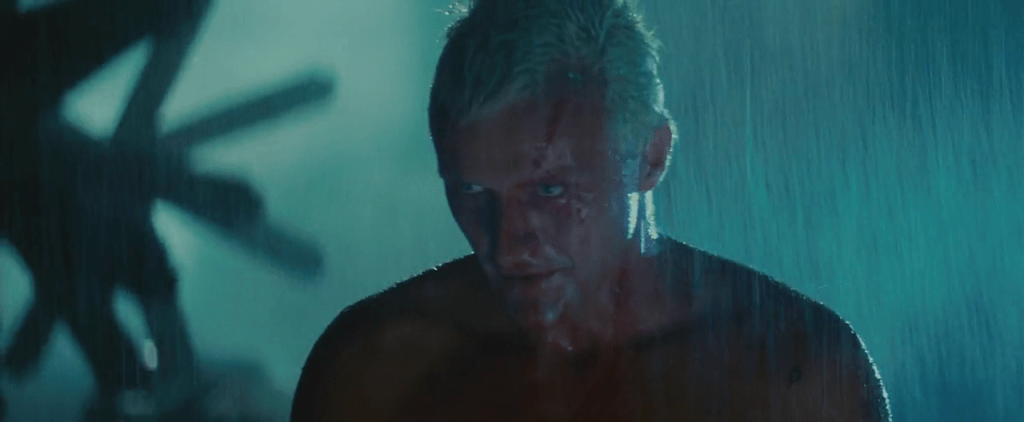
Blade Runner’s rooftop showdown told in Camera Angles.

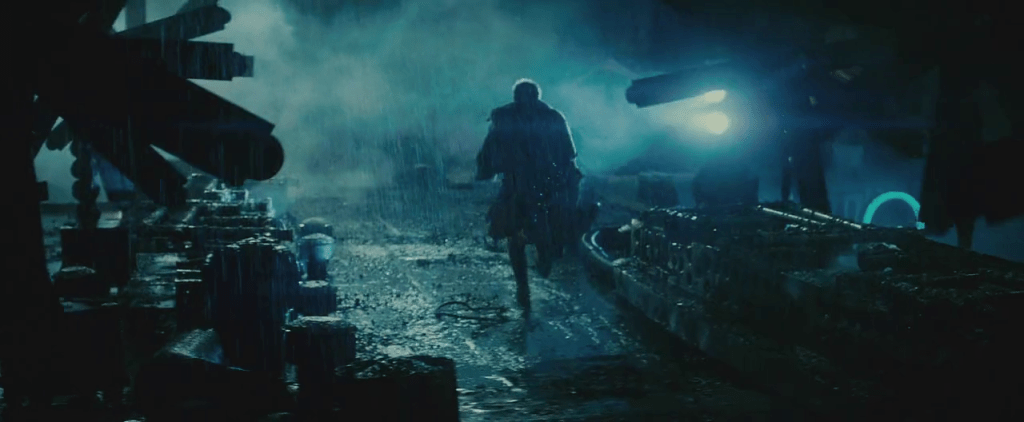
The final rooftop sequence of Blade Runner is one of my favorites. I want to focus on one aspect; the camera angles. Check to see if there is ground, or sky in the frame, and if so, how much? If you see a lot of ground, you are looking down. If you see a ceiling or a vast sky, you are looking up.

Let’s start with Deckard climbing onto the rooftop. He just slammed Roy in the head with a plumbing pipe and jumped out the bathroom window. Deckard dropped his gun while climbing up shelves from a previous floor. It bothered me when I was younger that Deckard didn’t go back and get his gun, but Roy dodged Deckard’s bullets twice, once at point blank range. His gun won’t help him against Roy, Deckard just needs to escape.

Roy is playing with Deckard, but Roy does not immediately follow because he is expiring. Deckard intended to retire Roy, but where he failed, time is quickly succeeding. Roy’s hand clenches uncontrollably as his engineered body dies. Roy desperately bites at his hand, trying to coax life back into it.
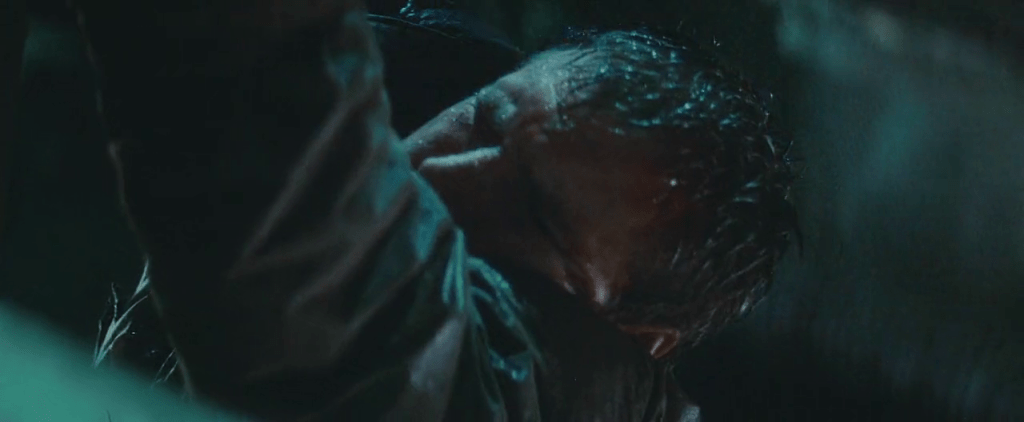
The first shot we see of Roy in the film is his hand clenching, as Roy asks himself, “Time? Enough.” We only know a Roy whose body is shutting down. He has been dying the entire film. What must Roy have been like before his expiration date? Even Tyrell praised his accomplishments. Roy must have been legendary. But his time is almost up. Roy grabs an old nail from the floor joists and impales it through his hand to eke out a few more minutes of life in agonizing pain.

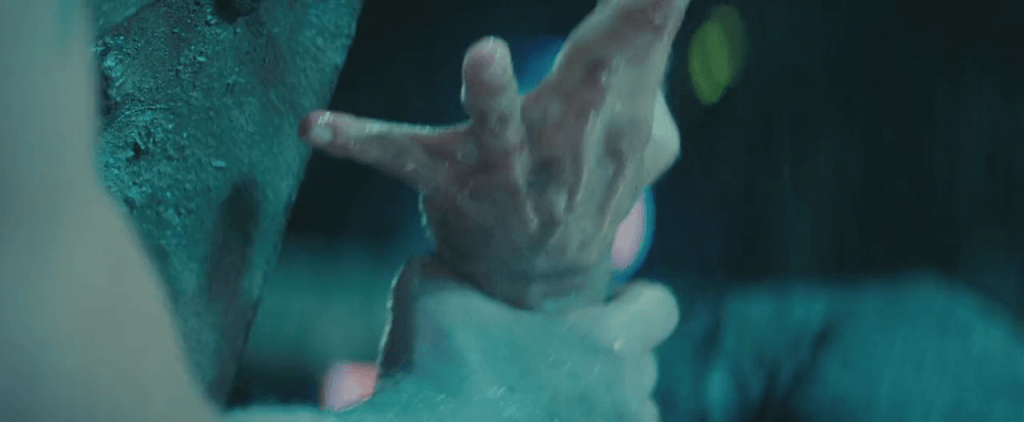
Now onto the camera angles. We get a close-up of Deckard’s broken fingers reaching over the edge as he slowly and carefully climbs to the roof to escape from Roy. We are at eye level with Deckard looking straight on as he climbs. Here, eye level is almost on the floor.

We get a shot of Deckard swinging his leg onto the roof. The shot is from above angled down but does not emphasize that he is dangling off the top of a building. That will come soon.
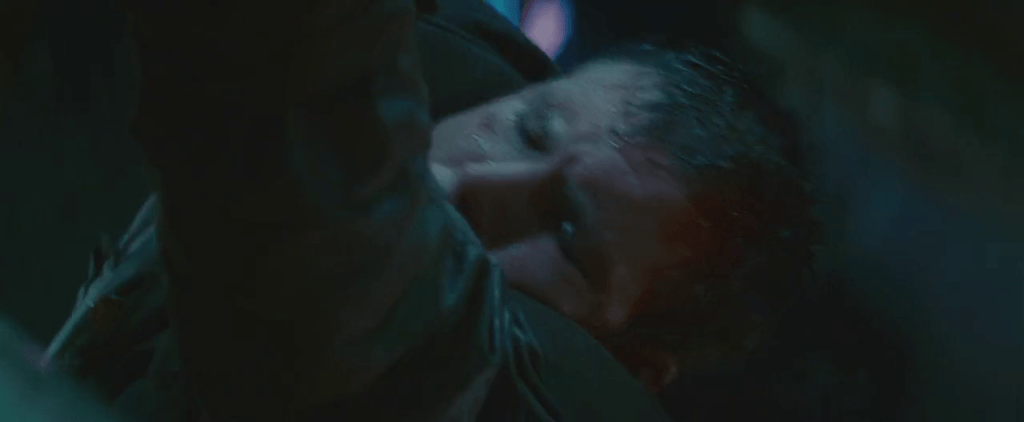
Deckard rolls onto the roof and sprawls out, inspecting his fingers. The camera lays with him looking straight on. The camera is on the rooftop floor with him.

We see a shot of Roy cutting back and forth through the apartment rooms below. The camera is looking almost straight on but is about at knee height. Roy starts far away as he cuts towards us, but this low angle makes him tower above us as he resumes hunting Deckard.

Deckard stands up. The camera is at thigh height, looking straight on as he gathers himself and looks for a way off the roof.

Deckard stumbles across the roof between pipes, spinning fan blades and spotlights. He is looking for an exit. It looks like this shot is on a fairly long lens to give more depth to all the spinning fans, layers of smoke, and wandering searchlights. We are at shoulder height, looking straight at Deckard.

We see Deckard’s POV of an exit hatch shot on a wider lens, but same waist high angle and straight view. An escape!

Deckard runs towards the camera and the hatch to get away from Roy. Because the lens on Deckard is long, the spinning blades blur as the focus pulls. The long lens also compresses space, giving the illusion that Deckard runs slower as he approaches the camera.

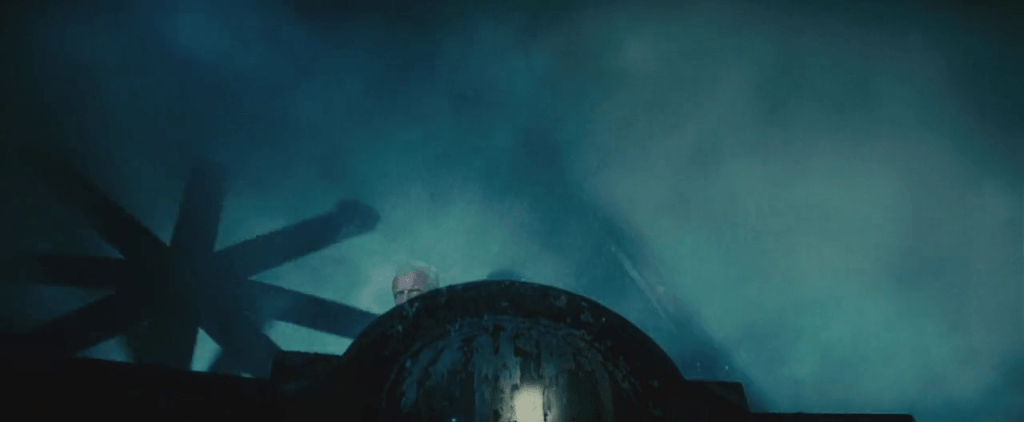
But then the exit hatch rips open. Someone is coming out of it.

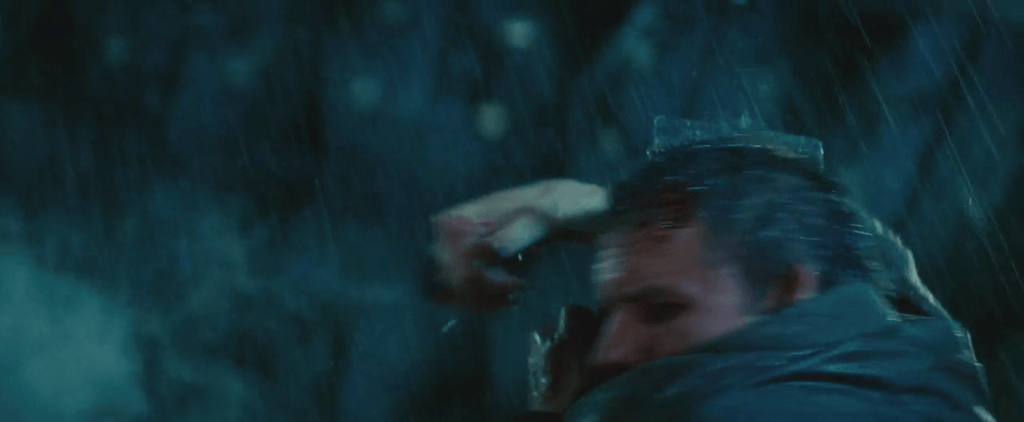
Deckard slides to a stop coming towards the camera. Hunched over, and staring in disbelief, Deckard is slightly below the camera. The background has now completely blurred, and we see the horror on his face as he realizes his safe exit is now a death trap.

We cut to see Roy standing hunched forward, looking at Deckard. Roy hunches over, and the camera is below him, looking slightly up. Even hunched over, Roy is above us. We do not see Roy jump out of the roof hatch. In the time it took for Deckard to slide to a stop, Roy has already closed some distance from the hatch to Deckard. I think the temptation in a computer graphics production would show Roy’s superhuman powers here. But this quick film edit is amazing, leaving Roy’s speed to our imagination.

Deckard turns to run. We angle down on Deckard as we can see the top of his shoulders and the floor behind him. In the previous shots, Roy’s and Deckard’s eyes were close to the same location in the frame, but Roy is above us, and Deckard is below.

Deckard turns and runs towards the camera. We see both Roy and Deckard together in the frame. With the camera angles and how they positioned Roy, Deckard’s head comes up to the center of Roy’s chest.

Deckard runs back the way he came. The camera looks tilted down at him. When Deckard ran towards us before, it appeared he was running downhill. The horizon line is high in the frame. But now that he is running back, it looks like he has to run uphill.

Roy gracefully leaps onto the pipes Deckard was running in between. Roy is even higher than us now.

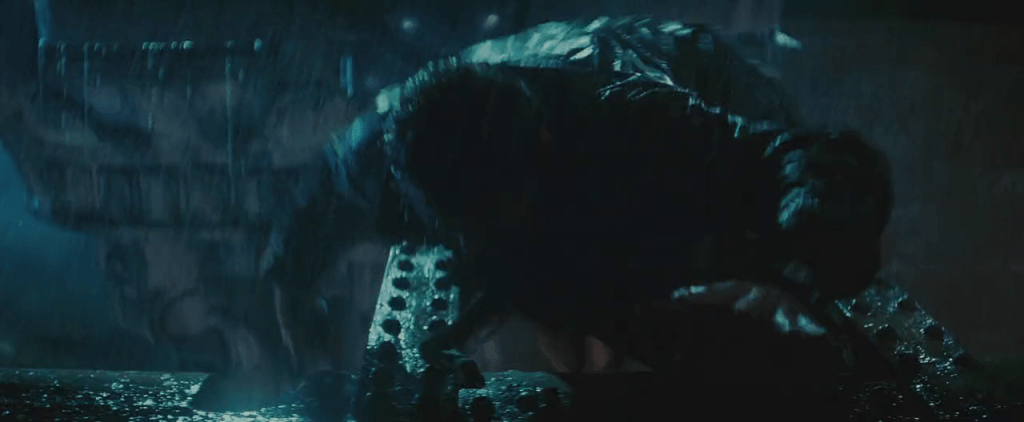
Deckard leaps off the roof, over the city street, toward the neighboring building. We are looking down at this stunt. Deckard’s shoulders barely reach the camera’s height, even at his highest point. Then he slams into the metal studs.

We cross over to see Deckard crash towards us onto the metal. When he climbed up onto the roof before we were level with his eyes. But now we look down on him as he slips off the building, trying desperately not to fall. But the camera does not drop to his level this time. Instead, we dolly in closer as the camera moves over the edge of the building, tilting down more and more on Deckard. He is below the floor level, and we look down at him like we stare at our shoes.

Same shot as we dolly in and tilt down

We cut to Roy, stepping towards the edge of the building to see what happened to Deckard. Roy is no longer running. He is carefully stepping forward to investigate. His game is over. Roy’s play-thing is now moments away from death, just like Roy himself. We are below the rooftop level, looking up at Roy. It’s like he’s on another floor above us.

We cut back to Deckard, struggling to hold on in the same shot we had before.

Now we cut even closer to Roy. We are on his left side, and Roy fills the frame. We are still looking up at him, but it is not as dramatic as before. The lens is long, bringing us close to Roy, who takes deep breaths as he watches Deckard lose his grip.

Roy steps away from the ledge, back where he came, leaving Deckard behind. Deckard struggles and looks away from his hands as if he doesn’t want to watch his death arrive.

Now we get a shot with Roy crossing his arms, a nail sticking through one hand, a dove in the other, his back to Deckard. Roy covers Deckard in the frame. The camera is now above Roy, angled down. Roy has been above us for most of this sequence. Even when he opened the hatch, it was only a couple frames before he loomed over Deckard.

What will Roy do? I am reminded of the first question in the Voight-Kampff test Holden asks, “You reach down, you flip the tortoise over on its back Leon…The tortoise lies on its back, its belly baking in the hot sun, beating its legs, trying to turn itself over, but it can’t, not without your help, but you’re not helping.”

Roy’s game put Deckard into this situation. Does Deckard deserve to fall for killing Zhora and Pris when Roy has already broken Deckard’s fingers for that? What will Roy do?

Roy unfolds his arms and turns around, revealing Deckard in the frame behind him. Roy then attempts the jump that Deckard failed. The camera tracks along with Roy as he leaps over the edge. The camera has not tracked along with a character at any other point in this sequence. We are with Roy as he makes the jump, making it feel like we, too, are leaping over the edge.

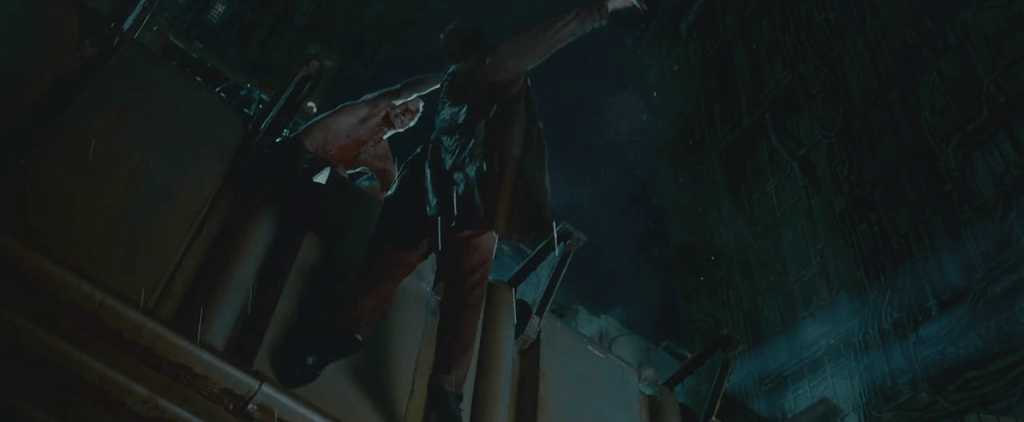
We then get a shot looking up at Roy as he clears the gap. The camera is so far below Roy that we see the soles of his shoes as he soars above us. We might be a couple of stories below him.

We see Roy soar over Deckard from behind and below. It’s an over-the-shoulder telephoto shot. The camera looks up at Deckard from below, while Deckard is far below Roy, who disappears into the smoke. Roy clears the gap with so much extra space he disappears into the rain and fog. Even at the brink of death, he is physically superior to Deckard.

Now, we see the highest-angle shot possible. The camera is directly above Deckard, looking down at the street. The camera tilts slightly, giving the image an unbalanced look.

We cut back to an over-the-shoulder below Deckard as Roy emerges from the smoke above us and kneels down. Both of them are high above us, but Roy is so high above the camera that even kneeling only brings him closer to us.

We get a new angle on Deckard as his grip fails. We look down on Deckard and the camera tilts so the metal beam is pointing up in the frame, above 45 degrees. Deckard slips farther down. This gives the illusion that the building tilts up and away from Deckard, almost trying to shake him off. Roy leans into the frame over Deckard in this exact shot, and you can see his shoulder on the left of the frame.

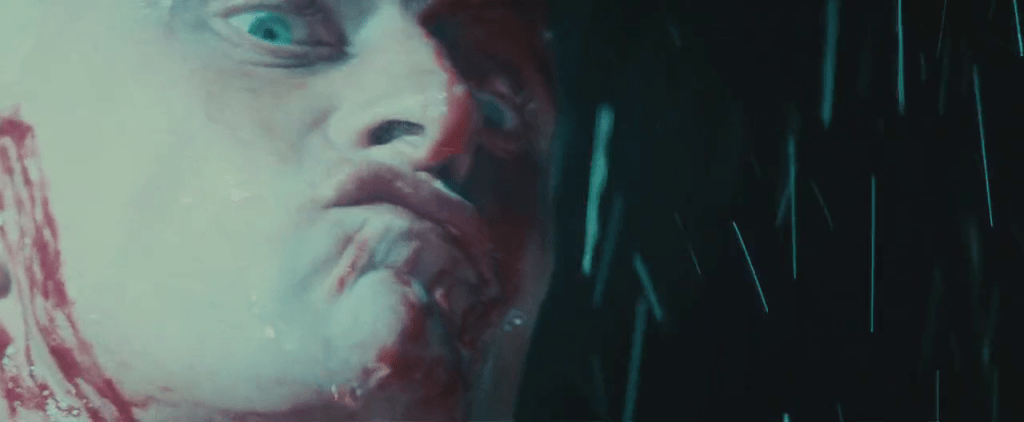
Then we cut to Roy’s eyes, almost glowing in the darkness as he looks down on us and Deckard. Roy is looking towards us, but if you look at the raindrops, you can see that Roy is standing high above the camera. The telephoto shot is so tight to Roy that his face fills the entire frame. Roy grimaces as he watches Deckard struggle as if going back and forth between entertainment, fascination, and horror.

Looking down at Deckard, we get a tighter shot of his face. His hands are no longer in the frame as he struggles to keep his grip. The long camera lens puts us close to both characters, with Roy high above and Deckard far below us.

The images cut back and forth between these shots as Roy tells Deckard, “Quite an experience to live in fear, isn’t it? That’s what it is to be a slave.” Roy is still above us but looking directly at us through the camera.

We see a shot looking down at Deckard’s fingers as he slips farther off the building. They angle the metal beam even higher in the frame. We were at his level when Deckard climbed onto the roof, but now he hangs far below us.

We cut back and forth to previous camera shots: a close-up looking down at Deckard’s hands as one hand slips, directly over Deckard as his grip fails, looking up at Roy, who smiles at Deckard. Deckard loses his grip completely and spits at Roy as he falls from the roof.

“Kinship!” shouts Roy as he catches Deckard’s wrist, saving Deckard from the fall. The camera looks down from Roy’s shoulder level. Roy dropped to catch Deckard. For his shoulder to be that low in the frame, Roy had to dive over the edge to catch Deckard. But we do not see Roy in that inferior position. Roy remains above us.

We get a low shot, looking up at Roy’s face as he struggles momentarily. This is the same hand that moments before had closed up as Roy’s body shut down.

We look down from above Deckard’s face as he grits his teeth like Roy is ripping his arm out of his socket. Roy is much stronger than Deckard, and even saving him hurts.

Roy purses his lips in determination as he lifts Deckard, the nail through Roy’s hand visible as he stands up, bringing Deckard onto the roof. Deckard holds onto his elbow, bracing himself, as Roy hoists him.

We get a shot from far below Roy and Deckard. Roy’s arm fully extends as he lifts Deckard up, showing just how strong Roy is. Deckard kicks his legs wide, trying to find some foothold to stand on.

Roy flops Deckard down, his belly exposed to the rain. Deckard once again lays out completely, but now Roy stands directly above him. The extreme camera tilting is over. We will look a little up and down. But the character’s position in the frame tells the story here. Deckard lies at Roy’s feet. And Roy is standing so high in the frame that the edge of the frame cuts his head off. Deckard crawls away from Roy, coming towards the camera.

We get a reverse shot of Deckard crawling away from us. We are on Roy’s side now. The camera is at mid-thigh height, looking down on Deckard. Roy looms high above us, and most of his body clips out of frame. Deckard is completely visible in the frame, as if its edges trap him, but Roy is so big in frame he does not fit. We only see Roy’s knees, running shorts, and his hand with a nail through it as he steps towards Deckard, who crawls back into a pillar. Deckard has no way out now and squirms below Roy. And then Roy slowly sits down.

We get a reverse shot of Roy slowly sitting down. Moments before, Roy filled the entire frame; now, he sits just above eye level with the camera and gives the “tears in rain” monologue.

“I’ve seen things you people wouldn’t believe… Attack ships on fire off the shoulder of Orion… I watched C-beams glitter in the dark near the Tannhäuser Gate. All those moments will be lost in time, like tears in rain… Time to die.”

Roy remains above us, and Deckard stays below. But this might be as close as Roy can get to Deckard’s level because he might be more human than human.

I don’t know if it is possible to angle the camera higher up or lower down than this sequence shows. Deckard falls so far below us that we look straight down at the street below him. Roy jumps so high above us that we see the soles of his shoes.

There is tremendous power in the angle of a camera. If it took physical effort to climb to all the places the camera positions itself in this scene, we would have to climb up and down multiple stories in less than a minute. Emotionally, I think that happens here as well.

With all the fantastic special effects available, it is incredible how powerful the camera can be when pointing up and down.

As Roy dies, he releases the dove in his hand, and it flies up and away from us. We then get a shot of the clouds in the sky above 2019 Los Angeles.

How does a MONSTER enter a scene?

“Death awaits you all- with nasty, big, pointy teeth! ~ Tim the Enchanter Monty Python and the Holy Grail

We want our monsters to be scary. But what makes a monster scary? Is it their size? How loud they can roar? Their number of teeth? How good of a jump scare they give us?

I think the answer lies in how a monster enters a scene. For this, let’s look at 1979’s Alien.

How does the Alien make its appearances in the movie?

  • An Alien egg opens onto Kane, and the face-hugger jumps out of the egg onto his face
  • They cut away Kane’s helmet revealing the face hugger wrapped around his face.
  • The face-hugger disappears from Kane’s face in the lab, and the crew looks for it. The dead face-hugger drops from the ceiling onto Ripley’s shoulder.
  • The Chestburster explodes through Kane’s sternum during dinner
  • The Alien drops from the top of the frame behind Brett
  • Dallas turns his flashlight onto the alien in the air ducts, and it grabs him
  • The Alien’s shadow sneaks behind Lambert, highlighted in a shadow. She turns around, and it stands up into the frame. Parker tries to fend the creature off, but it kills him, and then its tail slowly creeps between Lambert’s legs
  • The Alien turns the corner in the Nostromo, blocking Ripley from her escape pod
  • The Alien reaches out from the wall in the escape pod.
  • Ripley climbs into a space suit and turns on all the toxic gasses she can kill it. The creature writhes on the floor. But when she turns her head, it is no longer below her on the floor; it is right behind her rearing to strike.

So how does the Alien enter the scene? It doesn’t have to because the Alien is already there. We just can’t see it. Yet. We are going into its territory.

And the characters certainly do not know it is there. More often than not, the characters are entering the monster’s lair. A loud roar from a distance might be scary, but a whisper from right behind you chills to the bone.

Seeing something emerge from just below the surface or from the side of the frame is as surprising as it gets. Jump scares can emulate this temporarily, but without that ongoing physical proximity, the monster’s presence dissipates. Our physical sensation of being right next to something so dangerous adds a tense anxiety to our fear and horror.

More important than how scary a monster looks might be the question, “how did it get so close with no one noticing?”